Can a Campervan Fridge Run on 12V While Driving?
Author:
LarsonEmma
Published: Oct 12, 2026
Updated: Oct 12, 2026
Reading time: 11 minutes
Table of Contents

Larson Emma
Emma Larson has more than 15 years of experience in the energy storage battery industry. At Vatrer, she researches and writes about lithium batteries and energy storage, translating technical information into clear, practical guidance that helps more people make better battery decisions.
Share
You're driving your campervan through the French countryside, crossing the Alps in a motorhome, or towing a caravan towards the Mediterranean. The fridge is keeping your food cold, but where is its electricity coming from? Is the leisure battery doing all the work, or is the engine replacing the energy as you drive?
Yes, a campervan or motorhome fridge can run on battery power while driving, provided its cooling system supports 12V DC or an appropriate inverter is installed. A 12V compressor fridge runs directly from the leisure battery. A three-way absorption fridge may use 12V while travelling, whereas a 230V-only fridge needs an inverter.
The important question is not simply whether the fridge switches on. It's whether your electrical system can keep it running without leaving the leisure battery discharged when you arrive.
Understanding Campervan and Motorhome Fridge Types
Across Europe, campervans, motorhomes, and touring caravans commonly use absorption or compressor refrigerators. Both can keep food cold, but they use electricity differently.

Absorption Fridges: Gas, 230V, and 12V
Absorption refrigerators are common in traditional European caravans and motorhomes. They use a heat-driven cooling system and have no mechanical compressor.
Depending on the model, they may offer:
- Gas operation: LPG supplies the heat needed for refrigeration, while some models use 12V electricity for electronic controls and ignition.
- 230V mains operation: Normally used when the vehicle is connected to a suitable campsite electrical hook-up.
- 12V DC operation: Available on three-way models and frequently intended to maintain an already chilled fridge during travel.
A two-way absorption model may support gas and 230V only. The presence of a 12V electrical connection does not necessarily mean the cooling system can run from 12V.
Many three-way refrigerators also include automatic energy selection. However, the exact switching behaviour depends on the model and the vehicle's ignition-controlled electrical supply.
Absorption fridges need adequate ventilation and appropriate levelling, especially when operating while stationary. Follow the appliance manufacturer's instructions for operation on inclines, gas supply, and travel.
12V Compressor Fridges
A compressor fridge operates using an electric compressor rather than a gas-heated absorption circuit.
Many modern campervans and converted vans use efficient 12V compressor refrigerators because they can operate directly from the leisure battery, work well on uneven terrain, and do not require a gas flame.
A compressor fridge does not normally run continuously. It switches on when cooling is required and off when the target temperature is reached.
Power consumption depends on the fridge's capacity, outside temperature, insulation, ventilation, and how often it is opened. During hot weather in southern Europe, a compressor fridge can run much more frequently than during a mild trip in northern Europe.
Can a Campervan Fridge Run on 12V While Driving?
Yes, but check which cooling mode is available and whether the battery has a reliable supply.
Campervan Fridge Power Options While Travelling
| Fridge Type | Can It Run from a Battery? | Power Requirement |
|---|---|---|
| 12V compressor fridge | Yes, directly | 12V leisure battery and suitable fused wiring |
| Three-way absorption fridge | Yes, in its 12V mode | High-current 12V supply, often ignition-controlled |
| Gas/230V absorption fridge | Not normally for cooling directly from 12V | Approved gas operation or 230V supply |
| 230V compressor fridge | Yes, through an inverter | 12V-to-230V inverter sized for running and startup power |
A common misunderstanding is that the leisure battery automatically charges whenever the refrigerator is running on 12V.
In reality, the refrigerator can consume power faster than the vehicle replaces it. This is particularly important with three-way absorption fridges.
For example, a 12V heating element drawing 12A continuously consumes approximately 144W at 12V. Over an eight-hour journey, this represents 96Ah of electricity if there is no charging input.
A 12V compressor fridge averaging 45Ah per day would consume only about 15Ah over the same eight hours.
These are examples, not universal appliance ratings. Always use your refrigerator's actual consumption figures.
How Long Can a Leisure Battery Run a Fridge?
To estimate battery runtime, start with the fridge's average electricity consumption and the usable capacity of your leisure battery.
For example, a 12V compressor fridge consuming 45Ah per day has an average current of:
45Ah ÷ 24 hours = 1.875A
During six hours of driving without charging:
1.875A × 6 hours = 11.25Ah
A three-way absorption fridge drawing a continuous 12A would consume 72Ah during that same journey.
Estimated Leisure Battery Runtime Without Charging
| Leisure Battery | Usable Capacity | 12V Compressor Fridge (45Ah/day) | Absorption Fridge on 12V (12A) |
|---|---|---|---|
| 100Ah AGM battery | 50Ah | Approximately 27 hours | Approximately 4 hours |
| 100Ah LiFePO4 battery | 90Ah | Approximately 48 hours | Approximately 7.5 hours |
| 200Ah LiFePO4 battery | 180Ah | Approximately 96 hours | Approximately 15 hours |
These figures are planning estimates assuming a fully charged battery, no other loads, and no charging input. The calculations use a 50% depth-of-discharge allowance for AGM and 90% for LiFePO4. Battery age, temperature, wiring losses, and actual fridge consumption can change the result.
Battery runtime (hours) = Usable capacity (Ah) ÷ Average current (A)
For systems with different nominal voltages, compare watt-hours:
Energy (Wh) = Battery voltage (V) × Capacity (Ah)
A 12.8V 100Ah LiFePO4 battery provides 1,280Wh of nominal stored energy. With a 90% usable-capacity assumption, approximately 1,152Wh is available for planning.
For compact campervans and short off-grid stops, the Vatrer 12V 100Ah self-heating LiFePO4 battery provides a useful balance between capacity, weight, and space. It includes Bluetooth monitoring and a heating function to support charging in cold conditions. Check the vehicle's available battery space and charging compatibility before upgrading.
How Does a Campervan Leisure Battery Charge While Driving?
When the engine is running, the alternator supplies electricity to the vehicle's electrical system. However, that does not automatically mean the leisure battery receives enough current to keep up with the fridge.
The charging arrangement depends on the vehicle's design and the equipment installed between the starter and leisure batteries.

Split-Charge Relays and Battery Isolators
Many campervans have traditionally used split-charge relays or voltage-sensitive relays to connect the starter and leisure batteries when charging conditions permit.
These systems can work when correctly matched to the vehicle and battery chemistry. However, they do not necessarily control charging current or provide an appropriate LiFePO4 charging profile.
Modern vehicles with variable-voltage alternators can make relay-only charging less effective, while low-resistance lithium batteries may place considerable demand on the charging circuit.
DC-DC Charging for Lithium Leisure Batteries
A battery-to-battery charger, also called a DC-DC charger or B2B charger, regulates the charging voltage and current reaching the leisure battery.
It is particularly useful when upgrading from AGM to lithium or when the vehicle uses a smart alternator.
For more detail, see the campervan battery charging guide.
A correctly installed 30A DC-DC charger could theoretically deliver 30Ah in one hour if operating at its rated output throughout that period.
With a fridge averaging 1.875A, the theoretical net charge is around 28Ah per hour before other electrical loads and charging losses. Actual charging performance depends on alternator availability, battery temperature, charger limits, and state of charge.
Will a 13-Pin Caravan Connector Charge the Battery?
Many European caravans use a 13-pin towing connector that can include permanent and ignition-controlled electrical supplies.
However, having a 13-pin connector does not mean that both supplies are wired in your vehicle, or that the available wiring can support high-current battery charging.
Some caravans have electrical arrangements that power the fridge while driving, while others provide only limited charging current.
Before installing a powerful DC-DC charger, check the towing vehicle's wiring, fuse ratings, connector capacity, voltage drop, and the caravan manufacturer's specifications. A dedicated charging connection may be necessary.
Why LiFePO4 Is a Good Choice for Campervan Refrigeration
A fridge often needs to operate both while travelling and while parked away from an electrical hook-up. That makes usable capacity and charging efficiency particularly important.
- Higher usable capacity: A 100Ah LiFePO4 battery planned around 90% discharge offers approximately 90Ah, compared with 50Ah from a 100Ah AGM battery planned around 50% discharge.
- Long cycle life: Many LiFePO4 batteries are rated for thousands of cycles, making them suitable for frequent touring and regular off-grid use.
- Reduced weight: A typical 100Ah LiFePO4 battery may weigh around 11–15kg, compared with approximately 25–32kg for a similarly rated lead-acid battery.
- Efficient charging: Lithium batteries can accept substantial charging current when supported by a correctly configured charger and suitable battery temperature.
- Stable power delivery: LiFePO4 batteries maintain a relatively stable voltage during much of their discharge cycle, which suits 12V electrical equipment.
- Low-temperature protection: Charging ordinary LiFePO4 cells below 0°C can damage them. A battery with appropriate protection or internal heating is valuable for cold-weather touring.
For winter trips in Scandinavia, the Alps, or other cold European regions, temperature management is especially important. A battery installed in an unheated compartment may remain too cold to charge even when the vehicle interior feels comfortable.
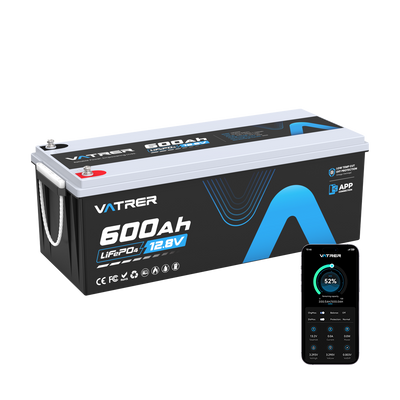
For larger motorhomes with extensive electrical equipment, the Vatrer 12V 460Ah self-heating lithium motorhome battery offers 5,888Wh of nominal storage, a 300A BMS, and integrated heating. Its large capacity may be suitable for longer off-grid stays when the installation space, weight allowance, and charging equipment are appropriate.
A Practical Campervan Fridge and Battery Setup
Imagine a campervan with a 12V compressor fridge, LED lighting, a water pump, and several USB charging outlets.
For this type of vehicle, a properly designed 12V leisure battery system can operate the fridge while travelling and continue supplying it during overnight stops.

- LiFePO4 leisure battery: A 100Ah battery can be sufficient for efficient refrigeration and essential overnight loads. Larger systems may require 200Ah or more, based on measured daily energy use.
- DC-DC charger: A properly sized 20–50A charger can replace energy while driving, subject to the vehicle and battery's electrical limits.
- Solar charging: A 200–400W rooftop solar array can contribute electricity during daylight hours. Actual production depends strongly on season, shade, weather, and panel orientation.
- 230V inverter: Necessary when using a 230V-only refrigerator without a campsite hook-up. Select an inverter that can support the appliance's compressor starting demand.
- Battery monitor: Monitoring energy flowing into and out of the battery makes it easier to determine whether driving and solar charging are sufficient.
For example, a 400W solar array receiving four peak-sun-hours with an assumed 75% system yield could produce approximately 1,200Wh in a favourable day. Output will be lower during heavily overcast weather or winter conditions.
Similarly, a 230V refrigerator drawing 180W through a 90%-efficient inverter requires approximately 200W of DC input while running, before adding inverter standby consumption.
Always calculate daily energy consumption rather than assuming the refrigerator draws its running power continuously.
Common Mistakes When Running a Campervan Fridge While Driving
- Confusing 12V control power with 12V refrigeration: Some absorption fridges use 12V for electronics but need gas or 230V to cool.
- Relying on a caravan connector for high charging current: Standard trailer wiring may not support the current required by a large lithium battery charger.
- Keeping an incompatible charging relay after switching to lithium: Review the complete alternator charging arrangement when upgrading battery chemistry.
- Forgetting inverter losses: Running a 230V fridge from a battery requires additional power for conversion and inverter standby operation.
- Ignoring cold-weather charging limits: The fridge may still operate while lithium battery charging is blocked by low-temperature protection.
- Using gas without checking travel restrictions: LPG requirements vary between vehicles, routes, tunnels, ferries, and destinations. Follow the appliance and gas-system instructions and the relevant operator's conditions.
- Loading a warm fridge immediately before departure: Pre-chilling food and the refrigerator reduces the work needed during the journey.
FAQ
Does a three-way caravan fridge run on 12V when driving?
Yes, if the appliance has a functioning 12V cooling mode and the vehicle provides the required electrical supply. Many systems use an ignition-controlled circuit so the fridge does not drain the starter battery when the engine stops. Check the actual wiring and appliance instructions.
Can a 100Ah lithium battery run a campervan fridge overnight?
Often, yes. For a compressor fridge using 45Ah per day, an eight-hour period requires approximately 15Ah. However, lights, heating controls, fans, and other devices also use battery power. An absorption fridge running continuously in 12V heating mode may need considerably more energy.
Why does my 12V fridge stop when the leisure battery still has charge?
Low-voltage protection, wiring voltage drop, fuse problems, or a BMS shutdown can interrupt operation. Check voltage directly at the fridge during compressor startup and inspect the charging and distribution circuits.
What temperature should my campervan fridge maintain?
For perishable food, aiming for approximately 4°C or colder in the refrigerator and -18°C or colder in the freezer is a sensible food-storage target. Check temperatures with a fridge thermometer rather than relying only on the thermostat setting.
Final Thoughts
A campervan or motorhome fridge can run on battery power while driving, but the type of fridge determines how much electricity it requires. A 12V compressor fridge is generally well suited to a leisure battery, while a three-way absorption fridge in 12V mode can demand substantially more current.
Before setting off, check your refrigerator's specifications, verify alternator charging, and calculate how much usable battery capacity remains for your campsite stay. For longer European journeys, a correctly sized LiFePO4 leisure battery and appropriate DC-DC charging system can make off-grid refrigeration much easier to manage.
Explore Vatrer LiFePO4 leisure batteries for campervans and motorhomes to compare capacities, cold-weather features, and battery monitoring options for your touring setup.
Share