Lithium Battery Breakthroughs: What Comes Closest Today
Reading time: 12 minutes

Share
When batteries become part of everyday life, their weaknesses become easy to spot. A golf buggy may lose power before the end of a busy day at the course. A motorhome leisure battery may take longer to recharge than expected after a night off-grid. A boat battery may feel too heavy for the runtime it delivers. In colder parts of Europe, performance can drop further if the battery is not designed for low-temperature use.
This is why people often refer to the “holy grail” of lithium batteries. They are not only looking for a small improvement over lead-acid batteries. They want one battery technology that delivers more energy, lasts for years, charges quickly, stays safe, works across different climates, and remains affordable.
For European users powering motorhomes, campervans, caravans, golf buggies, canal boats, marine electronics, solar storage systems, garden offices, and home backup setups, the real question is simple: does the perfect lithium battery exist today, or are we still moving towards it?


What Is the Holy Grail of Lithium Batteries?
The holy grail of lithium batteries is not a single battery you can buy from a shelf today. It is an ideal battery technology that removes the biggest compromises in energy storage.
In practical terms, the perfect lithium battery would combine high energy density, long cycle life, fast charging, strong safety, wide temperature performance, low maintenance, and reasonable cost. It would work reliably in a motorhome, golf buggy, marine system, off-grid solar setup, or home energy storage system without forcing users to choose between safety, performance, and affordability.
A true holy grail lithium battery would need to deliver several things at the same time:
- High energy density: More stored energy without making the battery larger or heavier. This means longer driving range, longer off-grid runtime, and fewer charging stops.
- Ultra-long cycle life: Thousands of charge and discharge cycles, ideally enough for many years of real-world use.
- Fast charging: Shorter charging times without overheating, cell damage, or reduced lifespan.
- Stable and safe chemistry: Low risk of overheating, fire, or thermal runaway when correctly installed and protected.
- Wide temperature tolerance: Reliable operation in different European climates, from hot southern summers to cold northern winters.
- Low maintenance: No watering, no acid spills, no corrosion cleanup, and less performance guesswork.
- Affordable long-term value: Not just impressive laboratory results, but practical cost for everyday users and businesses.
No battery technology currently delivers all of these benefits perfectly at the same time. That is why the holy grail of lithium batteries remains a goal the industry is still working towards.
Why Current Lithium Batteries Still Have Trade-Offs
Modern lithium batteries are already a major improvement over traditional lead-acid systems. They are lighter, more efficient, longer-lasting, and better suited to deep-cycle use. However, they still involve trade-offs depending on chemistry, design, price, and operating conditions.
The most common limitations include:
- Energy density versus safety: Some lithium chemistries store more energy in less space, but they can require more advanced thermal management and protection.
- Cold-weather charging limits: Many lithium batteries should not be charged below 0°C unless they include low-temperature protection or self-heating.
- Higher upfront cost: Lithium batteries usually cost more at purchase than lead-acid batteries, even though they often offer better long-term value.
- System compatibility: Chargers, solar controllers, DC-DC chargers, inverters, alternators, and golf buggy systems must be matched correctly.
- BMS quality differences: A lithium battery relies heavily on its battery management system for safety, balancing, and temperature protection.
These limitations do not make lithium batteries a poor choice. They simply show that battery selection still needs to match the application. A battery installed in a heated motorhome compartment has different requirements from one used in an unheated garage, a coastal boat, or a solar storage system in northern Europe.
The best battery today is not always the one with the highest energy density on paper. It is the one that delivers the right balance of safety, lifespan, usable capacity, temperature protection, and value in real conditions.
Next-Generation Battery Technology: Moving Towards the Holy Grail
Battery research is moving quickly. The future of lithium batteries is focused on higher capacity, faster charging, improved safety, longer lifespan, and lower production cost. Several next-generation technologies could change the market, but most are not yet ready for wide everyday use in leisure vehicles, marine systems, golf buggies, or home storage.
Solid-State Batteries
Solid-state batteries are often described as one of the strongest candidates for the holy grail of lithium batteries. Unlike conventional lithium-ion batteries that use liquid electrolytes, solid-state batteries use a solid electrolyte.
This design could bring several important advantages:
- Higher energy density: More energy may be stored in the same space.
- Improved safety potential: A solid electrolyte may reduce reliance on flammable liquid components.
- Longer lifespan potential: Future designs may support very high cycle counts.
- Better design flexibility: Solid-state technology may allow new battery formats and system layouts.
For electric vehicles and advanced energy storage, solid-state technology could become a major breakthrough. However, it is still difficult and expensive to manufacture at scale.
Challenges of Solid-State Battery Development
Solid-state batteries are promising, but they are not yet the complete answer. One key challenge is dendrite formation. Dendrites are tiny lithium structures that can grow inside the battery and potentially cause short circuits.
Other barriers include:
- Complex manufacturing processes
- High production costs
- Limited mass-market availability
- Difficulty achieving consistent performance across temperature ranges
- Scaling challenges for everyday deep-cycle applications
This means solid-state batteries may be part of the future, but they are not yet the standard choice for European motorhomes, caravans, golf buggies, boats, or off-grid solar systems.
Lithium-Sulfur Batteries
Lithium-sulfur batteries are another technology being explored. Their main appeal is the potential for very high energy density, which could be useful where weight matters greatly.
The current challenge is durability. Lithium-sulfur systems can suffer from faster degradation, making them less suitable today for users who need thousands of reliable deep cycles.
Sodium-Ion Batteries
Sodium-ion batteries are attracting interest because sodium is widely available and potentially lower cost than lithium. This could make them useful for large stationary storage systems where weight is less important.
However, sodium-ion batteries generally have lower energy density than lithium batteries. That makes them less ideal for mobile uses such as motorhomes, boats, golf buggies, and portable power systems where weight and space matter.
Solid-State vs Lithium-Ion vs LiFePO4 Batteries
When comparing battery technologies, it is important to separate future potential from current reliability. Solid-state batteries may be ahead in theory, but lithium-ion and LiFePO4 batteries are available and proven today.
| Battery Technology | Energy Density | Cycle Life | Safety Profile | Current Availability | Best Use Today |
|---|---|---|---|---|---|
| Standard Lithium-Ion | High | Moderate | Depends on chemistry and protection | Widely available | Consumer electronics, EVs, compact power systems |
| LiFePO4 | Moderate | Very long | High thermal stability | Widely available | Motorhomes, golf buggies, marine, solar, backup power |
| Solid-State | Very high potential | High potential | Very high potential | Limited and early-stage | Future EVs and advanced energy systems |
| Lithium-Sulfur | Very high potential | Still developing | Still developing | Limited | Research and future lightweight applications |
| Sodium-Ion | Lower than lithium | Developing | Promising | Emerging | Potential stationary storage and cost-focused systems |
Solid-state batteries may come closest to the holy grail on paper. But for users who need dependable power now, LiFePO4 batteries offer one of the best real-world balances of safety, long cycle life, usable capacity, and availability.
Why LiFePO4 Is the Best Practical Lithium Battery Technology Today
If you need a battery now for a motorhome, campervan, caravan, golf buggy, boat, solar storage system, or backup power setup, LiFePO4 is one of the most practical lithium technologies available today.
LiFePO4, or lithium iron phosphate, does not chase maximum energy density above everything else. Instead, it focuses on stability, safety, and long service life. This makes it especially suitable for deep-cycle applications where predictable performance matters more than having the smallest possible battery pack.
Key advantages include:
- Long cycle life: Many LiFePO4 batteries are designed for thousands of cycles, supporting years of regular use.
- Stable chemistry: LiFePO4 is known for strong thermal stability compared with many other lithium chemistries.
- Consistent voltage: Power output remains steadier through most of the discharge cycle.
- High usable capacity: More of the rated capacity can be used compared with traditional lead-acid batteries.
- Lower weight: LiFePO4 batteries are much lighter than many lead-acid batteries.
- Low maintenance: No water refilling, no acid spills, and less corrosion-related upkeep.
- BMS protection: A quality BMS protection system helps protect against overcharge, over-discharge, overcurrent, short circuits, and temperature risks.
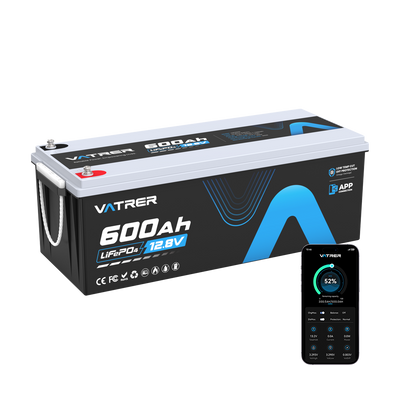
For example, Vatrer LiFePO4 batteries are designed for practical deep-cycle use with built-in BMS protection. Many models include monitoring features and low-temperature safeguards, which are useful for users dealing with winter storage, outdoor installations, or changing European climates.
Why Temperature Performance Matters in Europe
European battery users face very different climates depending on location. A campervan used in Spain may deal with high summer heat. A motorhome stored in Germany or the Netherlands may face damp winters. A golf buggy in the UK or Ireland may see frequent moisture. A solar storage system in Scandinavia or the Alps may need to handle freezing conditions.
Lithium batteries can often discharge in cold weather, but charging below 0°C can damage many lithium cells unless the battery has proper protection. This is why low-temperature charging cut-off, self-heating, clear temperature specifications, and a reliable BMS are important for many European applications.
Temperature planning is especially important for:
- Motorhome and caravan batteries stored in unheated compartments
- Golf buggies parked through the off-season
- Boat and canal boat batteries stored in damp or cold conditions
- Solar storage systems in cabins, garden offices, sheds, or workshops
- Home backup batteries installed in garages or utility rooms
- Portable power systems used for camping, fishing, or emergency backup
The ideal holy grail battery would work perfectly across all of these environments without special planning. Today, the smarter approach is to choose a battery designed with suitable temperature protection, BMS safeguards, and compatible charging equipment.
Where Lithium Batteries Deliver Real-World Value Today
You do not need to wait for future breakthroughs to benefit from lithium battery technology. LiFePO4 batteries already provide practical advantages in many common European applications.
Golf Carts
Golf carts and golf buggies benefit from lithium batteries because of lower weight, stable voltage, and reduced maintenance. Compared with lead-acid batteries, a LiFePO4 upgrade can improve range consistency, acceleration, hill performance, and charging convenience.
For golf clubs, resorts, campsites, private estates, holiday parks, and commercial sites, lithium batteries can also reduce downtime and replacement frequency.
RV and Off-Grid Systems
In Europe, this category often includes motorhomes, campervans, caravans, and off-grid leisure systems. LiFePO4 batteries are well suited for running lights, fridges, fans, pumps, inverters, laptops, and solar charging systems.
For off-grid stops, long road trips, campsite independence, and seasonal cabins, LiFePO4 batteries offer more usable capacity and faster recharge potential than lead-acid systems.
Marine Applications
Marine users often need lightweight batteries with dependable runtime. LiFePO4 batteries can power trolling motors, fish finders, navigation electronics, lighting, small appliances, and onboard accessories while reducing weight compared with lead-acid options.
For fishing boats, small leisure boats, canal boats, and coastal use, this can mean easier installation, better usable runtime, and steadier voltage throughout the day.
Home Energy Storage
Home energy storage systems need batteries that can cycle reliably, store energy efficiently, and provide power when needed. LiFePO4 chemistry is a strong fit because it offers long cycle life, stable performance, and low maintenance.
For homes, workshops, cabins, garden offices, and backup systems, lithium storage can help support essential loads, store solar energy, and reduce reliance on less efficient battery technologies.
How Close Are We to the Holy Grail Battery?
The battery industry is moving closer, but the perfect battery is not here yet. Solid-state batteries, lithium-metal designs, lithium-sulfur systems, and sodium-ion technology all show promise. However, each still has technical, cost, scaling, or lifespan challenges.
For everyday users, the key question is not which future technology sounds most exciting. It is which battery works reliably today.
That is where LiFePO4 stands out. It does not offer the highest possible energy density, but it delivers a practical balance of safety, cycle life, usable capacity, low maintenance, and availability. For many real-world applications, that balance is more valuable than laboratory targets.
What to Look for in a Lithium Battery Today
If you are choosing a lithium battery for a European motorhome, campervan, caravan, golf buggy, boat, solar system, or backup power setup, focus on real specifications rather than buzzwords.
| Feature | Why It Matters |
|---|---|
| Battery Chemistry | LiFePO4 is a strong choice for safety, cycle life, and deep-cycle use. |
| BMS Protection | Helps protect against overcharge, over-discharge, overcurrent, short circuits, and temperature issues. |
| Low-Temperature Protection | Important for cold-weather charging and winter storage. |
| Cycle Life Rating | Helps estimate long-term value and replacement frequency. |
| Continuous Discharge Current | Must support your motor, inverter, appliance, or equipment load. |
| Charger Compatibility | Prevents undercharging, overcharging, and poor system performance. |
| Monitoring Options | Bluetooth or display monitoring helps track voltage, SOC, current, and battery status. |
| Installation Environment | Moisture, vibration, temperature, and ventilation all affect long-term reliability. |
| Warranty and Support | Important for confidence, troubleshooting, and long-term ownership. |
A battery with clear specifications and strong real-world protections is often more valuable than one with impressive claims but limited technical detail. The closer a battery comes to the holy grail idea, the better it balances power, safety, lifespan, temperature control, and cost.
The Holy Grail of Lithium Batteries Is Still Evolving
The holy grail of lithium batteries is still more of a direction than a finished product. Manufacturers and researchers are working towards batteries that store more energy, charge faster, last longer, cost less, and operate safely across demanding conditions.
However, waiting for the perfect battery is not always practical. If you need reliable power today, LiFePO4 technology already delivers meaningful advantages over traditional lead-acid batteries. It is proven, available, and well suited for many deep-cycle applications used across Europe.
Choosing a solution like Vatrer batteries means choosing technology that already works in real life, whether you are powering a golf buggy, motorhome, caravan, boat, solar system, or home backup setup. The holy grail may still be evolving, but LiFePO4 batteries are one of the most practical steps towards it today.
FAQs
What is the holy grail of lithium batteries?
The holy grail of lithium batteries refers to an ideal battery that combines high energy density, long cycle life, fast charging, strong safety, wide temperature performance, low maintenance, and affordable cost. No battery currently achieves every goal perfectly.
What is the most promising next-generation battery technology?
Solid-state batteries are often considered one of the most promising next-generation battery technologies because they may offer higher energy density and improved safety. However, they are still limited in everyday commercial availability.
Is a solid-state battery better than lithium-ion?
Solid-state batteries may offer better performance in the future, but standard lithium-ion and LiFePO4 batteries are more practical today because they are widely available and proven in real applications.
What is the best lithium battery technology available today?
For deep-cycle applications, LiFePO4 is one of the best lithium battery technologies available today. It offers a strong balance of safety, long cycle life, stable voltage, low maintenance, and dependable performance.
Are LiFePO4 batteries suitable for colder European climates?
Yes, LiFePO4 batteries can be suitable for colder regions when selected and installed correctly. For winter use, choose batteries with low-temperature charging protection, self-heating if needed, and a reliable BMS.
Is the holy grail battery already available?
Not yet. The perfect battery is still a target the industry is working towards. However, LiFePO4 batteries come close for many practical applications because they provide a strong balance of safety, lifespan, efficiency, and availability.
Share