Should You Leave Your RV Battery On With Shore Power?
Author:
LarsonEmma
Published: Aug 17, 2026
Updated: Aug 20, 2026
Reading time: 6 minutes
Table of Contents

Larson Emma
Emma Larson has more than 15 years of experience in the energy storage battery industry. At Vatrer, she researches and writes about lithium batteries and energy storage, translating technical information into clear, practical guidance that helps more people make better battery decisions.
Share
For most RVs, the house battery should remain connected when the RV is plugged into shore power. If your rig has a battery disconnect switch, this normally means leaving it in the ON, USE, or CONNECT position while you are camping.
Shore power does not replace the 12V battery system. It supplies AC electricity to the RV, while the converter/charger changes part of that incoming power into DC electricity for lights, pumps, control boards, fans, and other low-voltage equipment. The converter also normally keeps the house battery charged.
There are exceptions, including battery maintenance, electrical repairs, a faulty converter, or an older charging system that does not suit the battery you have installed. Canadian RV owners should also pay particular attention to cold-weather charging, especially after upgrading from lead-acid to lithium.


Should the RV Battery Stay Connected on Shore Power?
During normal campground use, yes.
A connected house battery allows the converter to perform normal RV battery charging while it also supplies the 12V system.
If campground power goes out, the battery is already available to support compatible DC equipment without you having to change a switch first.
For a typical setup, you want:
- The battery disconnect in ON, USE, or CONNECT.
- The converter/charger receiving AC shore power.
- Battery cables and fuses connected normally.
- A charging profile suitable for your battery chemistry.
- No battery or BMS fault blocking charging.
What Shore Power Actually Does in an RV
An RV uses both AC and DC electricity, so plugging into a campground pedestal does not make the battery side of the system disappear.
The AC Side
Canadian RV parks generally supply 120V AC to compatible 30A or 50A RV electrical systems. That power can run outlets and AC appliances, depending on the equipment installed in your rig.
The 12V DC Side
Many systems inside an RV still depend on 12V DC. Your RV converter charger converts shore power into regulated DC electricity for these loads and for battery charging.
Typical DC loads include lighting, water pumps, fans, appliance control circuits, and other low-voltage equipment.
Why Keep the Battery Connected?
The battery remains a backup if AC service is interrupted. That can be useful at campgrounds where pedestal power is lost or a breaker trips unexpectedly.
Leaving it connected also allows the converter and battery to operate as the charging system was designed.
Does an RV Battery Always Charge When Plugged In?
No. It normally should, but shore power alone is not proof that the battery is receiving a charge.
The charging path is normally:
Shore power → converter/charger → DC charging circuit → house battery
If that path is open somewhere, your AC outlets may work and your lights may still operate while the battery remains discharged.
Check These Conditions
- Battery disconnect: The battery must actually be connected to the charging circuit.
- Converter power: The converter needs a working AC supply.
- Fuses and breakers: Applicable protection devices must be intact.
- Cable connections: Battery cables need clean, secure electrical contact.
- Battery compatibility: Converter output needs to suit the battery installed.
- Lithium protection: A BMS may stop charging when temperatures or electrical conditions fall outside safe limits.
Should You Switch the Battery Disconnect Off?
Usually not while you are actively camping.
Normal Camping: Leave It Connected
If the converter and battery are compatible and the system is working properly, leaving the battery ON is the simplest approach.
The converter can recharge energy used before you plugged in and maintain the DC system throughout your stay.
Maintenance or Repairs: Disconnect When Required
Battery isolation is appropriate when replacing the battery, servicing battery cables, repairing the main DC circuit, or performing another procedure that requires electrical isolation.
Keep in mind that shore power, solar, and other charging equipment may still energize part of the RV even after the battery disconnect is switched off.
Charging Faults: Do Not Ignore Them
If the battery repeatedly overheats, a converter is producing abnormal output, or lithium protection keeps shutting charging down, find the cause before leaving the system connected indefinitely.
Can You Stay Plugged Into Shore Power Long Term?
Yes, assuming the charger and battery are compatible.
A modern multi-stage converter can adjust its charging output as a lead-acid battery reaches a high state of charge. That is useful during extended campground stays or when an RV is plugged in between trips.
Older fixed-voltage converters should be checked more carefully before you leave an RV connected for weeks or months.
Check More Than Just the Power Cord
During long-term shore-power use, monitor:
- Battery voltage and state of charge.
- Battery temperature.
- Converter charging behaviour.
- Battery electrolyte on serviceable flooded batteries.
- Manufacturer storage guidance.
- Cold-weather limitations if using lithium.
Cold Weather Changes the Lithium Charging Question
For Canadian RVers, winter temperature is one of the biggest differences between simply asking whether the battery should stay connected and asking whether it should actually be charging.
A LiFePO4 battery may remain connected to the electrical system while its BMS blocks charging at low cell temperatures.
Some batteries add self-heating so charging can resume after the cells warm into an acceptable range.
Check Your Converter After Going Lithium
If your RV originally had flooded or AGM batteries, verify the converter before replacing them with lithium.
- Confirm the converter supports the lithium charging voltage.
- Check maximum charge current.
- Verify low-temperature charging protection.
- Understand how the battery should be stored during the off-season.
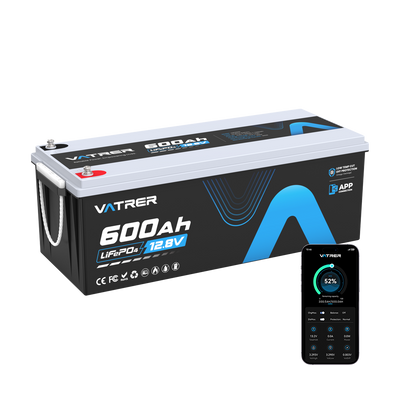
For winter travel, Vatrer lithium RV battery options include built-in BMS protection, low-temperature protection, Bluetooth monitoring, and self-heating on selected models. Those features can make battery status easier to monitor when temperatures fluctuate significantly.
Why Is the Battery Losing Charge Even Though the RV Is Plugged In?
If shore power is present but battery state of charge keeps dropping, start at the charging path rather than assuming the battery itself has failed.
Check the Disconnect Switch First
A battery switch left in STORE or OFF may isolate the battery even though the converter continues running some 12V circuits.
Check Converter Input and Output
Confirm that the converter receives AC electricity. Then measure its DC output according to the equipment manufacturer's procedure.
Inspect Fuses and Breakers
Check converter breakers, applicable DC fuses, main battery protection, and reverse-polarity fuses if your converter uses them.
Check Cables
Loose, corroded, damaged, or forgotten battery connections can prevent proper charging.
Check the BMS
For lithium batteries, temperature, over-voltage, under-voltage, or over-current protection may intentionally interrupt charging.
Battery On or Off on Shore Power?
| Situation | Recommended Battery State | Reason |
|---|---|---|
| Regular campground stay | ON / CONNECTED | Allows normal charging and 12V backup |
| Extended stay with compatible charger | Usually ON | Charging system can maintain the battery |
| Battery replacement | DISCONNECTED | Battery circuit needs to be isolated |
| DC electrical repair | DISCONNECTED as required | Helps isolate energized wiring |
| Converter charging fault | Disconnect until corrected | Prevents continued battery stress |
| Cold lithium battery | Depends on BMS and heating system | Battery may block charging below its safe limit |
The Bottom Line
For normal RV camping in Canada, leave the house battery connected when you plug into shore power. The converter needs access to the battery to maintain normal charging, and the battery remains available if AC power disappears.
Disconnect it when maintenance requires isolation or when you have identified a charging fault that could damage the battery.
If the battery does not charge on shore power, check the disconnect, converter, fuses, cables, charging profile, and BMS before assuming the battery needs replacement.
If you are upgrading an older lead-acid setup, Vatrer lithium RV batteries are available in capacities suited to different RV power requirements, with Bluetooth monitoring, BMS protection, low-temperature protection, and self-heating available on selected models. Make sure any lithium upgrade is paired with compatible charging equipment.
Share