





Lithium Marine & Trolling Motors Batteries
Sort by:
12 products


FAQs
Match the motor voltage first, then size Ah around runtime and maximum current draw. A 12V motor needs a 12V battery, while a 24V motor needs a 24V battery system; higher Ah gives you more time on the water.
Vatrer offers 12V lithium batteries up to 100Ah-600Ah for smaller trolling setups and 24V lithium batteries up to 200Ah–300Ah for longer fishing days and higher-demand boats. Always make sure the battery’s continuous discharge rating is higher than your motor’s maximum amp draw.
Use this quick estimate:
Runtime (hours) ≈ Battery Capacity (Ah) ÷ Average Motor Draw (A)
A 100Ah battery drawing an average 20A gives about 5 hours of theoretical runtime; at 40A, about 2.5 hours. Wind, current, boat weight, speed, and electronics will change the real result, so leave roughly 20%–30% reserve instead of planning around the full calculated runtime. Vatrer offers 100Ah up to 600Ah lithium batteries for anglers who need more reserve.
Choose based on your trolling motor’s required voltage, not simply the size of your boat. Many lower-thrust motors run on 12V, while higher-thrust fishing setups commonly move to 24V; always confirm the motor nameplate or manual.
For a dedicated 24V motor, a Vatrer 24V lithium trolling motor battery keeps the setup simpler than building 24V from two separate 12V batteries, with fewer battery-to-battery connections to manage.
The battery is not able to supply the motor’s peak current demand. If motor draw exceeds the battery or BMS continuous-current rating, the BMS can cut output, causing the motor to shut down, lose thrust, or behave erratically.
Before buying, compare the motor’s maximum amp draw with the battery’s continuous discharge rating. Vatrer offers 100A to 300A BMS ratings depending on the model, so choose based on current demand as well as Ah.
Most deep-cycle trolling motor batteries should not be used as starting batteries unless they have a specified cranking rating.
The Vatrer 12V 300Ah dual-purpose lithium battery is an exception: it provides 1,500 CCA, 3,840Wh of energy, and 200A continuous output, allowing one compatible 12V battery to support marine engine starting and deep-cycle onboard power. Check that your engine supports a LiFePO4 starting battery and requires no more than 1,500 CCA, and keep roughly 20%–30% SOC in reserve for starting.
You can, if the battery has enough capacity and output, but a separate electronics circuit is usually the cleaner setup. Shared wiring, grounding, and trolling motor EMI can introduce noise into fish finder or sonar displays.
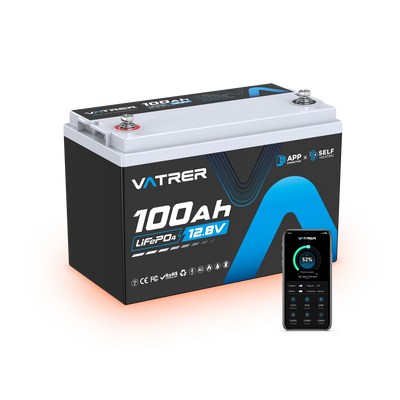
If you do share a battery, calculate the combined trolling motor and electronics draw and keep the wiring properly separated. Vatrer Bluetooth monitoring lets you check voltage, current, and battery status from your phone, which helps you see how much power is actually being used while fishing.
Use a charger with a LiFePO4 charging profile that matches the battery voltage. Avoid lead-acid equalization or desulfation modes, which are not designed for LiFePO4 charging.
If you want to recharge from the boat’s alternator, don't assume a direct connection is safe. For example, Vatrer 12V lithium battery should use a properly regulated alternator setup or a DC-DC charger, with the product specifying a 14.2V–14.6V charging range.
Yes, but charging below freezing needs protection. Vatrer batteries automatically stop charging below 32°F and stop discharging below -4°F.
For early-spring fishing or boats stored near freezing temperatures, choose a Vatrer self-heating lithium battery model. Heating starts below 32°F and stops at about 41°F, then normal charging can resume. With a non-heated model, warm the battery above the safe charging temperature instead of bypassing the protection.
Marine batteries still need a dry installation even when the enclosure provides water resistance. Vatrer lithium marine batteries use IP65-rated protection, which helps resist dust and water spray but does not mean the battery can be submerged.
Mount the battery above standing bilge water, keep terminals clean and dry, and avoid direct exposure to pooled saltwater. After saltwater trips, check terminals and connections for corrosion as part of normal boat maintenance.
For a dedicated 24V trolling motor, one 24V lithium trolling motor battery is usually the simpler setup. Two 12V batteries in series can also make 24V, but the batteries should be closely matched in model, capacity, age, and state of charge. Series wiring raises voltage but does not increase Ah capacity.
Vatrer offers 24V 200Ah and 300Ah lithium batteries, reducing the number of series connections and giving anglers a high-capacity single-battery option when battery-compartment space allows.
Other Vatrer Batteries Recommended


Vatrer 12V 300Ah Lithium Battery







- Reliable Power, Empowering Lives.
- Vatrer specializes in LiFePO4 lithium batteries for golf carts, RVs, home energy storage, and off-grid applications, designed for reliable performance and long-term use.
