





Vatrer 48V 100Ah Heated LiFePO4 Server Rack Battery for Off-Grid Solar Storage




Vatrer 48V 100Ah Heated LiFePO4 Server Rack Battery for Off-Grid Solar Storage
- Reliable Charging in Cold Conditions: Built for winter solar and off-grid use, this 48V 100Ah Heated LiFePO4 battery automatically warms itself before charging when battery temperature drops to 32°F or below. It is well suited for unheated cabins, garages, RVs, and solar equipment spaces.
- 5.12kWh Ready for Daily Energy Use: Store 5.12kWh in one battery for overnight loads, backup power, and daily off-grid use. The capacity gives 48V systems a practical balance between usable runtime and rack-space efficiency.
- Direct Fit for 48V Rack-Based Systems: This 48V 100Ah server rack LiFePO4 battery is designed for 48V solar and off-grid installations, eliminating the need to combine multiple lower-voltage batteries to reach system voltage.
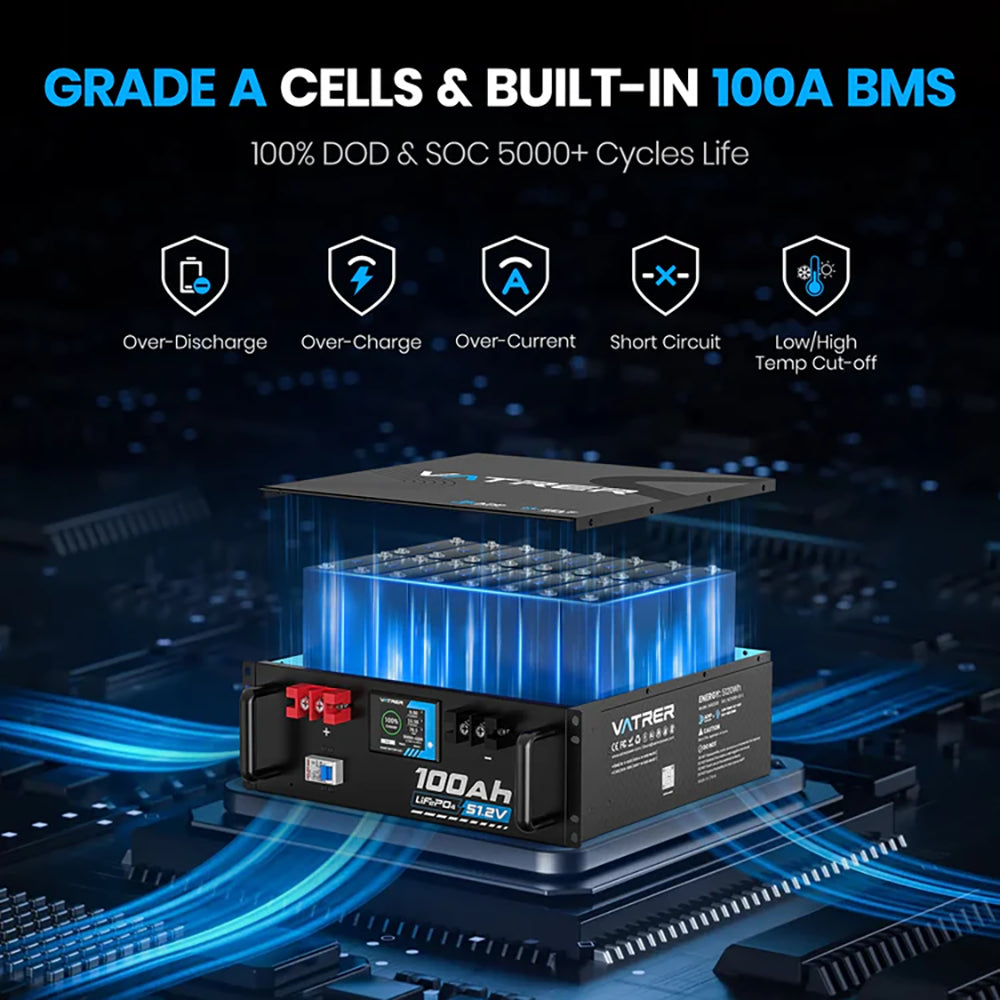
- Strong Output with Built-In Protection: A 100A smart BMS supports demanding 48V loads while protecting the battery from overcharge, over-discharge, over-current, short circuit, and temperature-related risks.
- Expand Storage Without Rebuilding Your System: Start with one Vatrer 48V 100Ah lithium solar battery and expand as your energy needs grow. Up to 10 batteries can be connected in parallel, making it easier to increase backup time or support additional loads later.
- Battery Status Visible at the Rack: The built-in display gives you direct access to operating data without adding a separate monitor. You can quickly check SOC, voltage, current, temperature, and cell-level information during setup or daily use.
- Local Monitoring from Your Phone: Bluetooth app monitoring lets you view battery status nearby from your phone, giving you a second way to check the 51.2V 100Ah self heating LiFePO4 battery without returning to the rack each time.
- Long Cycle Life for Repeated Solar Use: Grade A LiFePO4 cells are rated for more than 5,000 cycles, supporting frequent charging and discharging in solar, cabin, and backup applications while reducing the need for repeated battery replacement.



Estimated delivery between Oct 02 and Oct 07. Order within .

Cold Weather Charging with Automatic Self-Heating
A cold morning should not leave your solar system waiting for the battery to warm up on its own. This 51.2V 100Ah self heating LiFePO4 battery automatically uses incoming charging power for heating when the battery temperature reaches 32°F or below. Normal charging begins after the temperature rises above 41°F. This makes the battery especially useful in unheated cabins, garages, solar sheds, and RV installations exposed to winter temperatures.


5.12kWh for Nights and Backup Power
One battery stores 5.12kWh for the hours when solar production drops or utility power is unavailable. That reserve can support lighting, refrigerators, electronics, communications equipment, and other everyday off-grid loads. The 100A BMS provides the discharge current capacity needed for everyday loads in a 48V inverter system.


A Server Rack Battery Built for 48V Systems
You do not need to piece together multiple lower-voltage batteries to create a 48V battery bank. This Vatrer 48V 100Ah server rack LiFePO4 battery runs at a 51.2V nominal voltage, making it a natural fit for 48V solar and off-grid systems. Its rack-mount form keeps the battery installation organized in a dedicated cabinet or equipment rack.


Smart BMS Protection for Everyday Electrical Risks
The built-in 100A smart BMS monitors the battery while your inverter and loads are operating. It provides protection against overcharge, over-discharge, over-current, short circuit, and high or low temperature conditions. These protections help keep the cells within their intended operating range without requiring constant manual monitoring.


5,000+ Cycles for Daily Solar Use
A battery in an off-grid or solar system may charge and discharge every day, so cycle life directly affects long-term ownership. Grade A LiFePO4 cells give this battery a rated life of more than 5,000 cycles while supporting 100% depth of discharge. If you are replacing a lead-acid battery bank, you can use more of the battery's rated capacity in daily operation and face fewer battery replacements over time.


Expand Storage as Your Energy Needs Grow
You may only need one battery today even if your energy use increases later. This 48V 100Ah lithium solar battery supports up to 10 batteries in parallel, expanding total storage to 51.2kWh. You can add capacity as you install more appliances, need longer overnight runtime, or want essential loads to stay powered longer during outages.


Battery Status at a Glance
During setup or everyday use, the built-in display lets you check battery status without adding a separate meter. Its three screen pages show information such as state of charge, voltage, current, temperature, cycle data, and individual cell voltage. Bluetooth also provides local monitoring through the Vatrer app, so you can check battery status from your phone while you are near the system.


Choose Vatrer for Year-Round 48V Solar Storage
With Vatrer, you get a rack-mount battery that can warm itself before charging in cold conditions, show battery status locally, and handle repeated LiFePO4 cycling in a 48V solar or off-grid system. You can build for winter use from the start instead of adding separate cold-weather heating later.


Tech Specs
FAQs
Yes. When battery temperature is 32°F or below, our built-in self-heating system uses the incoming charging power to warm the battery first instead of charging the cells immediately. Once the temperature rises above 41°F, heating stops and normal charging begins. Keep more than 5A of charging current available so the heating function can activate properly in cold conditions.
The BMS stops discharging below -4°F to protect the cells from extreme cold. Do not bypass the protection or force the battery to deliver power. Let the battery warm back into its safe operating range; in very cold cabins or equipment rooms, an insulated battery enclosure can also reduce how quickly the battery cold-soaks.
No. Our self-heating system is triggered by charging input rather than running continuously from stored battery energy. It activates when the battery is cold and charging power is available, then shuts off after the battery reaches the temperature needed for normal charging. This avoids using battery capacity simply to maintain a constant enclosure temperature.
No. Bluetooth provides local monitoring through the Vatrer app while you are near the battery, and the built-in screen gives you direct access at the rack. This battery does not use Bluetooth as long-distance remote monitoring, so customers specifically looking for WiFi remote access should choose a Vatrer lithium battery with WiFi instead.
Yes. A 51.2V nominal LiFePO4 battery is designed for a 48V lithium battery system, so this model pairs naturally with 48V solar and off-grid inverters. Use the inverter's LiFePO4 charging mode rather than a lead-acid charging profile so charging behavior matches lithium battery operation.
One battery supports up to 5.12kW of load power through its 100A BMS. A 5kW inverter therefore falls within the battery's rated output range, but loads with large startup surges or sustained operation near maximum output are better supported by adding batteries in parallel so the current is shared across multiple batteries.
This battery is designed for parallel expansion rather than increasing system voltage through series connection. Keep the system at 51.2V and add batteries in parallel when you need more capacity or available current. Up to 10 batteries can be connected in parallel.
Use total load wattage as a quick planning guide. A steady 500W load would use 5.12kWh in about 10 hours theoretically, while a 1,000W load would use it in about 5 hours. Actual AC runtime will be somewhat shorter because inverter losses and changing appliance loads also consume energy.
Yes, in a 48V system, one 51.2V 100Ah battery provides the same nominal voltage and capacity as four 12.8V 100Ah LiFePO4 batteries connected in series. Using one battery removes the extra series wiring and eliminates the need to keep four separate batteries balanced against one another.
Yes. You can start with one battery and expand the system later instead of purchasing the full storage capacity at once. When adding another battery, bring the batteries to a similar state of charge before connecting them in parallel; this helps limit equalization current and lets the expanded system begin operating more evenly.
Comparison





- Reliable Power, Empowering Lives.
- Vatrer specializes in LiFePO4 lithium batteries for golf carts, RVs, home energy storage, and off-grid applications, designed for reliable performance and long-term use.
