How Long Will a 100Ah Battery Run a 55lb Trolling Motor?
Reading time: 14 minutes

Share
A 100Ah battery will run a 55lb trolling motor for about 2 hours at full throttle, around 4–5 hours at 50% speed, and roughly 8–10 hours at low speed. These numbers assume a 12V 55lb thrust motor that draws about 50 amps at full power, 20–25 amps at medium speed, and 10–12 amps at low throttle.
The real runtime depends on how you use the motor. A light jon boat on calm water at low speed can run much longer than a loaded fishing boat fighting wind and current. Battery type also matters when choosing a 55lb trolling motor battery. A 100Ah LiFePO4 battery usually delivers more usable capacity than a 100Ah lead-acid battery.
Quick Answer: 100Ah Battery Runtime for a 55lb Trolling Motor
Most 55lb trolling motors are used on small to mid-size boats, kayaks, and jon boats. If you are choosing a 100Ah battery for trolling motor use, full throttle, many 55lb models draw close to 40–55 amps, with 50 amps being a practical estimate for runtime calculations.
| Throttle / Speed | Estimated Amp Draw | Estimated Runtime with 100Ah Battery | Typical Use |
|---|---|---|---|
| 100% full throttle | Around 50A | About 2 hours | Short fast movement, strong current |
| 50% medium speed | 20–25A | 4–5 hours | Normal fishing movement |
| 25% low speed | 10–12A | 8–10 hours | Slow trolling, positioning |
| Very low positioning | 5–8A | 12+ hours | Small boat corrections, light use |
You can use this table as a planning estimate. If your trip involves heavy load, wind, current, or frequent full-speed movement, plan for the lower end of the range. If you mainly use the motor for quiet positioning and slow trolling, a 12V 100Ah trolling motor battery can last much longer than the full-throttle number suggests.


What Does a 55lb Trolling Motor Mean?
The “55lb” rating refers to 55 pounds of thrust. It tells you how much pushing force the motor can generate, not how much electricity it uses. That is why a 55 lb thrust trolling motor battery should be selected by voltage, capacity, and discharge current rather than thrust rating alone.
That distinction matters. Two 55lb trolling motors can have different amp draw depending on motor design, propeller efficiency, speed controller quality, and operating conditions. For runtime planning, amp draw is more useful than thrust rating.
A 55lb thrust motor is commonly used for:
- small fishing boats
- jon boats
- kayaks with motor mounts
- inflatable boats
- light to medium-load freshwater setups
For most 55lb motors, the system voltage is usually 12V, but you should still check the motor label or manual before choosing a battery. Matching voltage is not optional. A 12V motor needs a 12V battery setup.
What Does a 100Ah Battery Mean?
A 100Ah battery can theoretically provide 1 amp for 100 hours, 10 amps for 10 hours, or 100 amps for 1 hour. In real use, runtime changes with the current draw of the motor.
For a trolling motor, the key question is not just “Is the battery 100Ah?” The better question is:
How many amps is the motor pulling at the speed I actually use?
A 100Ah rating doesn't mean every battery provides the same usable runtime. Lead-acid batteries are typically not meant to be drained deeply and frequently. LiFePO4 batteries, on the other hand, can typically utilize 80%-100% of their rated capacity while maintaining a more stable voltage level during discharge.
That is why two batteries with the same 100Ah label can feel very different on the water, especially when you compare their real trolling motor battery life over several fishing trips.
How to Calculate 100Ah Battery Runtime for a 55lb Trolling Motor
The basic formula is simple:
Runtime = Battery Capacity ÷ Motor Amp Draw
For a 100Ah battery:
| Motor Amp Draw | Runtime Calculation | Estimated Runtime |
|---|---|---|
| 50A | 100Ah ÷ 50A | 2 hours |
| 25A | 100Ah ÷ 25A | 4 hours |
| 20A | 100Ah ÷ 20A | 5 hours |
| 10A | 100Ah ÷ 10A | 10 hours |
A 55lb trolling motor at full throttle may pull around 50 amps, so the full-speed estimate is:
100Ah ÷ 50A = 2 hours
At medium speed, if the motor draws 25 amps, the estimate becomes:
100Ah ÷ 25A = 4 hours
At low speed, if the motor draws 10 amps, runtime can reach:
100Ah ÷ 10A = 10 hours
This formula works best when you know the motor’s actual current draw. If you only know the thrust rating, use the motor manual or an amp draw chart from the manufacturer. Guessing based only on “55lb thrust” can put your estimate off by an hour or more.
If your fish finder, lights, or other 12V devices run from the same battery, add those loads to the calculation. For example, a motor drawing 20A plus a fish finder using 2A gives a total draw of 22A. In that case, a 100Ah battery would run about 4.5 hours, not 5 hours.
100Ah Battery Runtime Chart for a 55lb Trolling Motor
A trolling motor rarely runs at one fixed speed for an entire trip. Most anglers use short bursts of higher speed, then spend more time at low or medium throttle.
| Speed / Throttle | Estimated Amp Draw | Runtime with 100Ah Battery | Practical Meaning |
|---|---|---|---|
| Full throttle | 45–55A | 1.8–2.2 hours | Useful for short moves, not efficient for all-day use |
| High speed | 35–40A | 2.5–2.8 hours | Moving between fishing spots |
| Medium speed | 20–25A | 4–5 hours | Common for regular boat control |
| Low speed | 10–12A | 8–10 hours | Good for slow trolling and shoreline fishing |
| Very light positioning | 5–8A | 12–20 hours | Small adjustments in calm water |
If your goal is a full day of fishing, avoid planning around full-throttle runtime. A 100Ah battery is much more practical when the motor is used at mixed speeds, with full power reserved for short periods.
What Factors Affect the Runtime of a 55lb Trolling Motor?
Runtime changes because a trolling motor reacts to load. Anything that makes the motor work harder increases current draw.
Speed Setting and Throttle Use
Throttle setting has the biggest effect on runtime. Full throttle can pull around 50A, while low-speed use may pull only 10–12A.
That difference is huge. Running at 50A drains a 100Ah battery in about 2 hours. Running at 10A can stretch the same battery toward 10 hours.
For fishing, using 25% to 50% throttle is often more practical than full speed; lower speeds often provide better boat handling.
Boat Weight, Load, and Hull Type
A heavier boat needs more power to move. Extra passengers, coolers, tackle, anchors, livewells, and backup batteries all increase load.
Hull design matters too. A narrow kayak or light jon boat moves through water with less resistance than a wider, heavier boat. If two anglers use the same 100Ah battery and the same 55lb motor, the lighter setup can run noticeably longer.
A practical planning rule: if your boat is heavily loaded, assume your motor will operate closer to the high-draw side of the range.
Wind, Current, and Water Conditions
Calm water is easy on a trolling motor. Wind, chop, weeds, and current increase the workload quickly.
A motor that draws 20A while cruising in calm water may need 30–40A to maintain control against wind or river current. That can cut runtime by several hours.
This is where many estimates fail. The math may say 4–5 hours, but water conditions can turn that into 3 hours. Keep reserve power for the return trip, especially when fishing open water or moving upstream.
Battery Type and Usable Capacity
A 100Ah lead-acid battery and a 100Ah LiFePO4 battery do not behave the same way.
Lead-acid batteries lose voltage more noticeably as they discharge. They also age faster when repeatedly drained deeply. Many users avoid using the full rated capacity to protect battery life.
LiFePO4 batteries typically deliver a higher usable capacity and hold voltage more steadily through the discharge cycle. That helps a trolling motor maintain more consistent thrust for longer.
This does not change the basic formula, but it changes real-world experience. A lithium battery often feels stronger later in the trip, while a lead-acid battery may feel weaker as voltage drops.
Battery Age, Health, and State of Charge
A new, fully charged 100Ah battery is different from a three-year-old battery that has been stored poorly or discharged too deeply.
Battery capacity declines over time. Corroded terminals, loose connections, and partial charging also reduce usable power. If your battery only charges to 80% of its original capacity, your practical runtime drops by about 20%.
A battery monitor, LCD display, or Bluetooth app helps here. Voltage alone can be misleading, especially with LiFePO4 batteries because their voltage stays relatively flat for much of the discharge cycle.
Propeller, Wiring, and Connection Condition
This is easy to overlook. A trolling motor with weeds, fishing line, or grass wrapped around the propeller will draw more current. A chipped or damaged prop can also reduce efficiency.
Wiring matters as well. Undersized cables, loose terminals, and corrosion can create voltage drop. The motor may feel weaker, and the battery may appear to drain faster.
You do not need to overcomplicate this. Before a trip, check the propeller, tighten connections, and make sure the terminals are clean. Those small checks can protect runtime.
Lithium Battery vs Lead-Acid Battery for a 55lb Trolling Motor
The same 100Ah label can lead to different results depending on battery chemistry. When comparing a lead-acid battery with a lithium trolling motor battery, the difference shows up in usable capacity, weight, voltage stability, and maintenance.
| Battery Type | Usable Capacity | Weight | Voltage Stability | Maintenance | Best For |
|---|---|---|---|---|---|
| Flooded lead-acid | Lower usable capacity if you avoid deep discharge | Heavy | Drops more as it discharges | Higher | Occasional use, lower upfront cost |
| AGM | Moderate usable capacity | Heavy | More stable than flooded lead-acid | Lower than flooded | Sealed lead-acid users |
| LiFePO4 lithium | Higher usable capacity | Much lighter | More stable output | Low | Frequent fishing, longer runtime, lighter boats |
A lead-acid battery can work with a 55lb trolling motor, especially for short trips. The downside is weight and reduced usable capacity. Draining it deeply again and again will shorten its life.
AGM batteries reduce some maintenance issues, but they are still heavy and generally do not offer the same usable energy as LiFePO4.
A 12V LiFePO4 battery makes more sense for frequent fishing because it supports deep-cycle use, holds voltage more consistently, and reduces boat weight. That weight reduction matters on small boats. Dropping 30–50 lbs from the battery compartment can make launching, handling, and shallow-water movement easier.
Is a 100Ah Battery Enough for a 55lb Trolling Motor?
A 100Ah battery is enough for many 55lb trolling motor users, especially when the boat is light to medium-load and the motor is used mostly at low or medium speed. For most weekend anglers, a 100Ah battery for trolling motor use is practical without moving to a larger 150Ah or 300Ah battery.
It works well for:
- half-day fishing trips
- calm lakes and protected water
- kayaks, jon boats, and small fishing boats
- slow trolling and positioning
- users who can recharge after each trip
A 100Ah battery may feel limiting if you often run full throttle, fish in strong current, carry heavy gear, or spend a full day moving from spot to spot. In those cases, a 150Ah or 300Ah battery gives more margin.
What Size Battery Should You Use for a 55lb Trolling Motor?
Most 55lb trolling motors use a 12V battery system, so the common choices are 12V deep cycle batteries in the 50Ah to 200Ah range. For balanced weight and runtime, a 12V 100Ah trolling motor battery is often the most practical starting point.
| Battery Capacity | Recommended Use | Runtime Expectation | User Type |
|---|---|---|---|
| 50Ah | Short trips, light boats, backup use | Limited runtime | Casual users |
| 100Ah | Half-day to regular fishing trips | Balanced runtime | Most moderate users |
| 150Ah | Longer trips, heavier loads | More reserve power | Frequent anglers |
| 200Ah | All-day use, strong current, high confidence margin | Longest runtime | Heavy-use users |
Before choosing a battery, check six things: motor voltage, maximum amp draw, battery BMS continuous discharge rating, charger compatibility, battery dimensions, and available mounting space.
For a 55lb motor that may draw 50A at full throttle, do not use a lithium battery with a very low discharge limit. The BMS should comfortably support the motor’s maximum current, with some extra margin.
How to Get Longer Runtime from a 100Ah Trolling Motor Battery
You can extend runtime without changing the motor. Most improvements come from reducing unnecessary current draw and managing your trolling motor battery life more carefully during each trip.
- Use full throttle only when needed: Full speed can draw around 50A. Cutting speed to 50% may reduce draw to 20–25A and double the runtime.
- Keep the boat light: Remove gear you do not need. Extra weight forces the motor to work harder, especially when accelerating or fighting current.
- Plan around wind and current: Starting the day by running against the wind or upstream can leave you with an easier return. Doing the opposite can be risky if the battery is low later.
- Check the propeller: Weeds, line, and grass around the prop increase load. Clean it before and during the trip if performance drops.
- Start with a full charge: A 100Ah battery charged to 80% is not a 100Ah battery for that trip. It is closer to an 80Ah power source.
- Use the right charger: LiFePO4 batteries need a compatible lithium charger. A mismatched charger may undercharge the battery or reduce long-term performance.
- Monitor battery state of charge: A Bluetooth app, LCD screen, or dedicated battery monitor helps you see voltage, current, and remaining capacity. This is more useful than guessing from motor speed or waiting until performance drops.
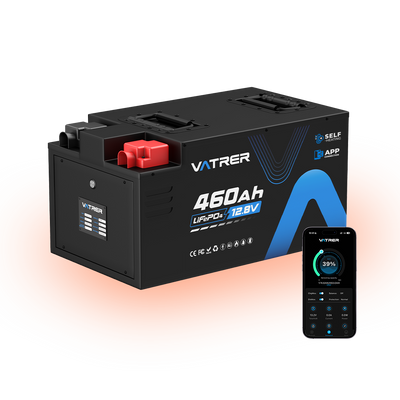
For anglers upgrading from lead-acid, this is where a battery like a Vatrer 12V LiFePO4 battery can be useful. Built-in BMS protection helps manage overcharge, over-discharge, overcurrent, and temperature-related cutoffs, while Bluetooth monitoring makes it easier to check battery status before and during a trip.
Why a 12V 100Ah LiFePO4 Battery Makes Sense for Trolling Motors
A Vatrer 12V 100Ah LiFePO4 battery fits the way many people use a 55lb trolling motor: long periods of low to medium current draw, occasional higher loads, and repeated deep-cycle use.
The main advantages are practical:
- lighter weight than lead-acid
- higher usable capacity
- more stable voltage output
- low maintenance
- long cycle life
- better fit for repeated deep discharge
For trolling motor users, stable voltage is not just a technical detail. It affects how the motor feels near the end of the trip. A lead-acid battery may still have some charge left, but voltage drop can make the motor feel weaker. A LiFePO4 battery tends to maintain steadier output until it reaches a low state of charge.
The right capacity still depends on your motor’s amp draw, boat load, and fishing style.
FAQs
Can a 55lb trolling motor run on a lithium battery?
Yes, a 55lb 12V trolling motor can run on a 12V LiFePO4 battery as long as the battery’s BMS supports at least 50A continuous discharge, with 80A–100A giving safer headroom. This applies to common 55lb models such as Minn Kota Endura Max 55, Minn Kota PowerDrive 55, Newport NV-Series 55lb, and MotorGuide R3 55.
What charger do I need for a 12V 100Ah lithium trolling motor battery?
Use a 12V LiFePO4 charger with a charging voltage around 14.4V–14.6V and a current of 10A–20A for a 100Ah battery. A 20A charger can recharge a depleted 100Ah lithium battery in about 5–6 hours, while a 10A charger takes about 10–11 hours.
What wire size should I use for a 55lb trolling motor?
For a 12V 55lb trolling motor drawing around 50A, use at least 6 AWG marine-grade wire for longer runs up to about 15–20 ft, and 8 AWG may work for shorter runs around 5–10 ft. Pair the wiring with a 50A–60A marine circuit breaker, depending on the trolling motor manufacturer’s requirement.
Do I need a circuit breaker for a 55lb trolling motor?
Yes, most 12V 55lb trolling motors should use a 50A or 60A resettable marine circuit breaker between the battery and motor. For example, many Minn Kota 12V 50–55lb motors commonly use a 60A breaker, while some smaller 12V setups may use 50A.
Can I connect two 100Ah batteries for a 55lb trolling motor?
Yes, connect two 12V 100Ah batteries in parallel to keep the system at 12V and increase capacity to 200Ah, which can roughly double runtime. Do not connect them in series for a 12V 55lb motor, because series wiring creates 24V and can damage a 12V trolling motor.
Conclusion
A 100Ah battery will usually run a 55lb trolling motor for about 2 hours at full speed, 4–5 hours at medium speed, and 8–10 hours at low speed. The exact number depends on amp draw, throttle setting, boat weight, water conditions, battery chemistry, and battery health.
For light to medium fishing use, a 100Ah battery is a practical choice. For strong current, heavy loads, long days, or frequent full-throttle movement, a larger capacity such as 200Ah or 300Ah gives more reserve.
A 12V LiFePO4 battery is worth considering when weight, usable capacity, low maintenance, and stable output matter. Vatrer 12V LiFePO4 batteries offer deep-cycle performance with BMS protection and monitoring options that help make runtime easier to manage on the water.
Share