Best RV Battery for Boondocking: What Matters Most?
Reading time: 16 minutes

Share
If you're trying to figure out the best RV battery for boondocking, here’s the quick takeaway: go with a LiFePO4 battery. Most people land on a 12V 100Ah or bigger deep cycle setup, ideally with a built-in BMS, around 80%–100% usable capacity, and a cycle life of 4,000+ charges.
Why? Because in real-world use, lithium batteries have a longer lifespan, are lighter, and can maintain 80%-100% charge, a stark contrast to many lead-acid batteries.
But choosing the right battery isn’t just about picking lithium and calling it a day. Boondocking puts very specific demands on your power system. If you don’t understand those, even a good battery won’t perform the way you expect.


Why Boondocking Changes Your RV Battery Needs?
Boondocking means you’re completely on your own. No shore power pedestal, no campground hookups, just your RV and whatever energy you’ve stored. Whether you're parked on a Bureau of Land Management flat outside Moab, Utah, tucked into a forest clearing in the Pacific Northwest, or sitting in the Sonoran Desert with nothing but silence around you, your battery becomes your entire power source.
Most RVs aren’t running on a single system, they’re running on two. Understanding how these work is what separates a reliable off-grid setup from one that leaves you in the dark.
AC (120V) System
This is what runs your larger household-style equipment, usually through an inverter when you're off-grid.
- Microwave
- Coffee maker
- Residential refrigerator
- TV and entertainment systems
- Laptop chargers
These loads are power-hungry. Without a solid battery and inverter setup, they either won’t run or will drain your battery very quickly.
DC (12V) System
This system is powered directly by your battery bank and runs constantly, even when you don’t notice it.
- Interior LED lighting
- Water pump
- Bathroom exhaust fan
- Furnace blower
- Slide-out motor and powered awning
- RV control panel
These are the systems that keep your RV livable. And when your battery dies, these go first.
Why Battery Choice Matters More Off-Grid
When you’re plugged into a KOA or a full-hookup campground, shore power handles the heavy lifting. It runs your AC system and recharges your batteries at the same time through a converter.
But the moment you unplug, that safety net disappears. Now, every single watt, whether it’s your lights, your fan, or your morning coffee comes out of your battery.
That’s why choosing an RV battery for boondocking is completely different from choosing one for occasional campground use. You’re not just maintaining power between stops, you’re replacing shore power entirely.
A setup that works fine at a campground can leave you without lights by 10 PM on your first night off-grid. Get the battery right, and boondocking feels easy. Get it wrong, and you’ll feel it immediately.
Which RV Battery Actually Works for Boondocking?
When you’re off-grid, your battery isn’t just a component, it is your power system. So the type you choose directly affects how much power you can really use, how long it lasts, how heavy your setup is, and how much effort it takes to keep everything running.
Most people end up choosing between three types of RV batteries. On paper, they might look similar. In real-world boondocking? They behave very differently.
Flooded Lead-Acid RV Battery
This is what many RVs come with from the factory. It’s the default option simple, widely available, and cheap. But once you start boondocking, you quickly run into its limits.
- Usable Capacity: You can only safely use about 45–50% of the rated capacity. So a 100Ah battery really gives you closer to 45–50Ah before you risk damaging it. That gap matters more than people expect.
- Weight: A typical 12V 100Ah lead-acid battery weighs around 60–70 lbs. If you’re running multiple batteries, that adds up fast, especially in smaller rigs.
- Maintenance: You’ll need to check water levels regularly and top it off with distilled water. Skip it a few times, and you’re shortening the battery’s life.
- Ventilation: These batteries release gas when charging, so they have to sit in a vented compartment. Not every RV setup makes that easy.
- Cost: Upfront, they’re cheap, usually around $100–$150. But with a lifespan of only a few hundred cycles, you’ll be replacing them more often than you’d like.
For short trips with a generator, they can get the job done. For real boondocking, they tend to feel like something you’re constantly managing.
AGM RV Battery
AGM is often seen as the middle ground. It fixes some of the hassle of flooded batteries, but it doesn’t completely solve the core limitations.
- Usable Capacity: You can go a bit deeper, around 50–75% DoD. That’s an improvement, but you’re still not getting full use of what you paid for.
- Weight: Still heavy. Around 60–65 lbs for a 12V 100Ah AGM battery, so there’s no real advantage here.
- Maintenance: No watering, no venting. This is where AGM shines, it’s much more hands-off.
- Cycle Life: Typically in the 400–600 cycle range. Better than flooded, but still nowhere near lithium.
- Cost: Usually $200–$300. That puts it in an awkward spot, more expensive than flooded, but without a major leap in performance.
AGM works fine if you want something simpler without jumping to lithium yet. But for frequent off-grid use, it still feels like a compromise.
LiFePO4 Lithium RV Battery
This is where things start to feel different. Not just a little better, just easier to live with.
- Usable Capacity: You can safely use 80–100% of the battery. So a 100Ah lithium battery actually gives you close to the full 100Ah in real use.
- Weight: Around 24–29 lbs for a 12V 100Ah lithium battery. That’s a big deal if you’re tight on payload or just don’t want to wrestle heavy batteries during install.
- Cycle Life: 4,000+ cycles is common. If you’re cycling daily, that’s easily 8–10 years of use.
- Charging Speed: With the right charger, you can go from empty to full in a few hours. No long absorption phase like lead-acid.
- Maintenance: Nothing to maintain. No water, no venting, no equalizing. You install it and forget about it.
- Built-in BMS Protection: A good lithium battery manages itself, protecting against overcharge, over-discharge, temperature issues, and short circuits automatically.
The only thing that slows people down is the upfront cost. You’re usually looking at $250–$400 for a 12V 100Ah battery.
But when you factor in how much of that capacity you can actually use, how long it lasts, and the fact that you’re not constantly maintaining or replacing it, the long-term cost tends to even out, or even come out ahead.
Quick Comparison: Which Type Better for Boondocking
| Spec | Flooded Lead-Acid | AGM | LiFePO4 Lithium |
|---|---|---|---|
| Usable Capacity (DoD) | ~45–50% | ~50–75% | 80–100% |
| Weight (12V 100Ah) | 60–70 lbs | 60–65 lbs | 24–29 lbs |
| Cycle Life | 300–500 cycles | 400–600 cycles | 4,000+ cycles |
| Charge Time (0–100%) | 8–10 hrs | 6–8 hrs | 2–5 hrs |
| Maintenance Required | Yes (water + venting) | No | No |
| Low Temp Protection | No | No | Yes (BMS) |
| Typical Cost (12V 100Ah) | $100–$150 | $200–$300 | $250–$400 |
| Est. Lifespan | 2–4 years | 3–5 years | 8–10+ years |
Lead-acid and AGM can work if you’re out for a weekend and running a generator regularly. But if you’re planning to stay off-grid longer, or just don’t want to think about your battery all the time, lithium is what most people end up moving to anyway.
Key RV Battery Factors That Actually Matter for Boondocking
Choosing lithium is just step one. What really makes a difference is how the battery performs in real use. When you’re picking an RV battery for off-grid camping, these are the specs that actually matter.
Capacity vs Usable Capacity (Ah & Wh)
The numbers on the label, 100Ah and 200Ah, don't tell the full story. What matters is how much energy you can actually use.
A 12V 100Ah LiFePO4 battery gives you close to the full 1,280Wh. A lead-acid battery of the same size? You’re realistically getting about half of that. Same rating. Very different real output. When comparing batteries, always think in usable watt-hours (Wh), not just Ah.
Voltage and Battery Bank Configuration
Most RV systems run on 12V, so sticking with a 12V lithium battery is usually the simplest option. Some larger setups move to 24V to reduce current and improve efficiency, but that adds complexity, you’ll need converters to run standard 12V gear. If you just need more capacity, the common approach is simple: Connect batteries in parallel. For example, two 12V 100Ah batteries connected in parallel can form a 12V 200Ah battery. Same voltage, more runtime
Tips: Just make sure everything matches, same brand, same capacity, same age. Mixing batteries almost always leads to uneven charging and a shorter lifespan.
Battery Cycle Life and Long-Term Value
Cycle life is easy to overlook, but it’s one of the biggest long-term factors.
A LiFePO4 lithium battery rated for 4,000+ cycles can last 8–10 years with daily use. A lead-acid battery might last 300–500 cycles closer to a year or two in the same conditions. That’s why lithium often ends up cheaper over time, even if the upfront cost is higher.
Weight
Weight adds up fast in an RV. Swapping two lead-acid batteries (around 140 lbs total) for lithium equivalents (around 50–60 lbs) can free up 70–90 lbs of payload. That’s extra room for water, gear, or just staying within your GVWR.
Charge Speed
Off-grid, you don’t have unlimited time to recharge. Solar only works a few hours a day. Generators burn fuel, and nobody wants to run one all day. Lithium batteries can charge much faster, often reaching full in a few hours. Lead-acid batteries charge slower and spend a long time in the final “top-off” stage. In real use, lithium makes much better use of your available charging window.
Tips: Make sure your charger supports lithium. Using a lead-acid charger can result in incomplete charging or interruptions.
Built-in BMS (Battery Management System)
A good lithium battery takes care of itself. The built-in BMS protects against:
- Overcharge
- Over-discharge
- Short circuit
- High/low temperature
You don’t have to monitor it constantly, it handles that in the background. That’s especially important when you’re off-grid and not checking things every hour.
Cold Weather Performance
Lithium batteries won’t charge properly below freezing. Most have protection that stops charging around 32°F and cuts off discharge at very low temps. That protects the battery, but it also means you might not be able to charge in the morning if it’s too cold.
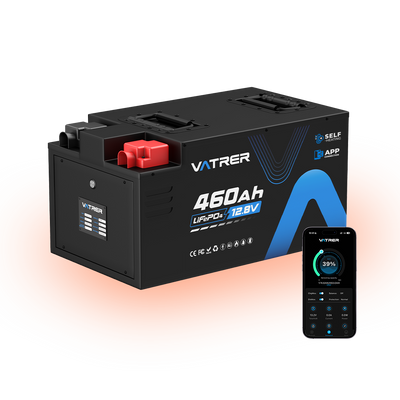
That’s where self-heating batteries make a real difference. They warm themselves automatically when temperatures drop, then resume normal charging once conditions are safe. No waiting, no manual workaround. If you camp in freezing conditions, this isn’t just a nice feature, it solves a real problem.
Vatrer 12V 100Ah and 12V 300Ah LiFePO4 batteries include built-in self-heating that kicks in at 32°F and allows charging again at 41°F.
Bluetooth Monitoring
When you’re miles away from the nearest hookup, guessing your battery level isn’t ideal. Bluetooth monitoring gives you real-time data:
- Remaining capacity
- Voltage
- Charge/discharge current
- Battery temperature
It’s not just a nice extra, it helps you avoid running out of power unexpectedly. Vatrer LiFePO4 RV batteries support Bluetooth monitoring through the Vatrer app, so you can check your system anytime from your phone.
How Much RV Battery Capacity Do You Need for Boondocking?
This is where most people get stuck. There’s no one-size-fits-all answer, it really depends on how you use your RV. The good news is you can get a pretty accurate estimate with a simple approach before buying anything.
Start With Your Daily Power Use
Start by listing every DC and AC device you plan to run and estimate daily usage hours. The basic formula is:
Watts ÷ Volts = Amps
Amps × Hours = Ah used
For AC devices (like a laptop or TV), you’re pulling power through an inverter, so the real battery draw is higher than it looks. For example, A 45W laptop charger might not seem like much, but over 5 hours it can use close to 20Ah from your battery. Small loads add up fast.
Here's a realistic reference table for common boondocking loads:
| Device | Typical Power Draw | Daily Use | Est. Daily Ah (12V DC) |
|---|---|---|---|
| 12V LED interior lighting (full RV) | 30–50W | 4 hrs | 10–17Ah |
| Residential refrigerator (via inverter) | 150W avg | 24 hrs | 300Ah* |
| 12V compressor refrigerator (e.g., ARB, Dometic) | 40–60W | 24 hrs | 80–120Ah |
| Water pump (Shurflo 3.0 GPM) | 60W | 0.5 hrs | 2.5Ah |
| Bathroom exhaust fan | 15–20W | 4 hrs | 5–7Ah |
| Laptop charging (45W) | 45W | 5 hrs | 18.75Ah |
| Smartphone charging (2 devices) | 20W total | 4 hrs | 6.7Ah |
| 32" RV TV (12V DC) | 30–40W | 3 hrs | 7.5–10Ah |
| RV furnace blower (not propane) | 80–100W | 2 hrs | 13–17Ah |
| Portable CPAP machine | 30–60W | 8 hrs | 20–40Ah |
Many people underestimate the power consumption of household refrigerators. They can drain a battery quickly. That’s why many boondockers switch to a 12V compressor fridge to cut down daily usage.
Capacity Recommendations by Trip Length
Once you know your daily usage, you size your battery with some buffer. Solar isn’t always perfect, and you won’t always want to run a generator.
- 1-night trips (60–80Ah/day): A single 12V 100Ah LiFePO4 battery is usually enough, with some margin left.
- 2–3 nights (80–120Ah/day): A 200Ah setup (two 100Ah batteries) gives you more flexibility and a cushion for cloudy days.
- Extended or full-time boondocking (100–200Ah+/day): You’re typically looking at 300–400Ah as a starting point, often paired with solar. Many full-timers run 400–600Ah with 400–600W of panels.
For most real-world setups, around 200Ah of usable lithium capacity covers a typical 2–3 person RV for a few days off-grid without stress.
Expanding Your Battery Bank Later
One of the nice things about LiFePO4 is how easy it is to scale. Need more capacity? Just add another matching battery in parallel.
- Same voltage
- Double the capacity
- No system changes needed
Just keep it consistent, same brand, same size, same age if possible. Mixing old and new batteries tends to cause uneven charging and shortens lifespan.
Best LiFePO4 RV Batteries for Boondocking
Once you understand what boondocking really requires, the battery choice becomes much clearer. You need usable power you can rely on, a lifespan that holds up over years, and built-in protection so you don’t have to constantly think about it.
Vatrer 12V 100Ah Self-Heating LiFePO4 RV Battery
If you’re coming from a single Group 27 or Group 31 battery, this is a very practical upgrade. It’s lighter, easier to install, and gives you far more usable power right away.
Key Advantages:
- Full usable capacity (100Ah / 1,280Wh): You can actually use the full capacity, instead of only half like lead-acid.
- Self-heating for cold weather: Starts heating at 32°F and resumes charging at 41°F. Useful for camping in colder seasons or higher elevations.
- 4,000+ cycles with built-in BMS: Designed for long-term use, with automatic protection for charging, discharging, and temperature.
- Bluetooth monitoring: Check battery status, voltage, and temperature directly from your phone.
Why choose it: A good fit for vans, small trailers, and Class C rigs under ~24 ft. Handles typical daily loads like lighting, a 12V fridge, and device charging without stress. Add a second battery if you want extra buffer for multi-day stays.
Vatrer 12V 300Ah Bluetooth LiFePO4 RV Battery
This is where things start to feel more off-grid ready. One unit replaces several lead-acid batteries and gives you enough capacity for longer stays without constantly thinking about power.
Key Advantages:
- 300Ah / 3,840Wh usable energy: Enough for a full day of normal use with room to spare.
- 200A BMS with low-temp protection: Handles higher loads and protects automatically in cold conditions.
- 5,000+ cycle life: Built for long-term use, even with frequent cycling.
- Fast charging support: Works well with solar or generator charging in shorter time windows.
- Bluetooth monitoring: Real-time data on usage, charge level, and system status.
Why choose it: A strong option for larger travel trailers, fifth-wheels, or Class C rigs with higher daily usage. Works well for 2–3 day off-grid stays without needing to recharge, especially when paired with solar.
Vatrer 12V 600Ah Bluetooth LiFePO4 RV Battery
If you’re tired of thinking about power limits, this is the kind of setup that changes the experience. Large capacity in a single unit, no need to build a complex battery bank.
Key Advantages:
- 600Ah / 7,680Wh usable capacity: Enough for multiple days of off-grid use, even with heavier loads.
- 300A BMS for high-demand systems: Supports inverter loads like refrigerators, tools, and other AC devices.
- All-in-one simplicity: Large capacity without wiring multiple batteries together.
- Bluetooth monitoring: Full visibility into system performance at any time.
- 4,000+ cycle life: Built for long-term, full-time RV use.
Why choose it: Best for full-time RVers or anyone running higher loads, like a residential fridge, CPAP, laptops, and fans, while staying off-grid for several days at a time.
Conclusion
The best RV battery for boondocking isn’t about the biggest number on the label, it’s about what actually works when you’re off-grid. You want real usable capacity, a battery that lasts for years, and something that takes care of itself when conditions aren’t ideal.
Focus on three things:
- Size your battery based on how much power you actually use
- Pair it with a solid charging setup (solar or generator + lithium charger)
- Choose self-heating if you camp in cold weather
Get those right, and managing power stops being a daily concern, you just use your RV the way you want.
Whether you're running a small trailer for weekend trips or living full-time off-grid, Vatrer Power offers options that match different setups, from a simple 12V 100Ah upgrade to large-capacity systems for extended stays. With built-in BMS protection, Bluetooth monitoring, and long cycle life, the goal is simple: give you a battery you don’t have to think about once it’s installed.
FAQs
How Many Amp Hours Do I Need For RV Boondocking?
For most 2–3 person boondocking setups with a 12V compressor fridge, LED lighting, and device charging, plan for 100–150Ah of daily consumption. A 200Ah LiFePO4 battery bank gives you a comfortable one-day buffer; 400Ah paired with 200–400W of solar supports extended off-grid stays without generator dependence.
How Long Will My RV Battery Last While Boondocking?
A 12V 200Ah LiFePO4 battery with 100% DoD provides approximately 200Ah, enough for 1.5–2 days of moderate use (80–120Ah/day) without recharging. With a 200W solar array adding 60–80Ah per day, the same battery bank sustains indefinite boondocking on moderate loads in good sun conditions.
What Is The Best 12V Lithium Battery For RV Camping?
For most RVers, a 12V 100Ah or 12V 300Ah LiFePO4 battery with built-in BMS, self-heating capability, and Bluetooth monitoring covers the full range of boondocking needs. The Vatrer 12V 300Ah battery delivers 3,840Wh of usable capacity at 55.23 lbs and supports up to 200A charge current, making it one of the most capable drop-in options available for RV off-grid use.
Can I Use a Regular Lead-Acid Charger On a Lithium RV Battery?
No. LiFePO4 batteries require a charger with a lithium-specific charging profile, typically a constant current / constant voltage profile with a 14.4–14.6V absorption voltage and no equalization stage. Using a lead-acid charger risks incomplete charging or BMS-triggered shutdown. Always use a charger explicitly rated for LiFePO4 chemistry.
Is Lithium Worth The Cost Over AGM For Boondocking?
Yes, for regular or full-time boondocking. A 12V 100Ah AGM battery costs $200–$300, lasts 400–600 cycles, and delivers 50–75Ah of usable capacity. A comparable LiFePO4 battery costs $250–$400, lasts 4,000+ cycles, and delivers 80–100Ah of usable capacity. Per usable amp-hour over the battery's full lifespan, LiFePO4 is significantly cheaper, and that's before accounting for zero maintenance costs.
Share