Which Golf Cart Batteries Are Best for Yamaha Golf Carts?
Reading time: 7 minutes

Share
A lot of the time, the Yamaha golf cart itself still feels solid, the steering is fine, and the motor sounds normal, but the experience starts slipping. A round that used to feel smooth turns into watching the battery gauge like it's a countdown timer. Hills feel heavier than they used to. And the worst part is it's not dramatic enough to scream broken, just annoying enough to ruin the day.
That slow decline isn't your Yamaha cart aging out, it's the battery pack dragging everything down. Therefore, if you match the right golf cart battery to your Yamaha's voltage, driving style, and climate, the cart usually feels young again, more consistent power, less babysitting, and fewer unpleasant surprises.


Which Golf Cart Batteries Are Compatible with Yamaha Golf Carts?
Before considering the best fit, you need compatibility. For Yamaha golf carts, compatibility is mostly about system voltage and how the battery delivers power. Most Yamaha carts you'll see in life are built around 36V or 48V systems. That voltage determines what battery setup can physically and electrically replace your pack.
In practical terms, a compatible replacement usually falls into one of these buckets:
- Traditional lead-acid packs (often multiple 6V or 8V batteries wired in series)
- Lithium golf cart batteries (either a single drop-in style pack designed for golf carts, or a matched lithium kit)
The reason people get tripped up is that “it fits” doesn’t always mean “it works well.” Two batteries can both be 51.2V (48V), but behave differently under load. A Yamaha cart that feels sluggish on takeoff or sags on hills often isn’t missing voltage, it’s missing usable power under demand.
If you're not sure whether your Yamaha is 36V or 48V, check the existing battery count and labels under the seat (and your battery charger label). It is not recommended to order batteries in advance before confirming whether the voltage matches.
What Type of Golf Cart Battery Works Best for Yamaha Carts?
"Best" doesn't always mean the most expensive. It's the battery type that gives you steady power, predictable range, and less hassle for how you actually use the cart: short neighborhood drives or long days on the course, flat paths or hills, and summer-only or year-round.
For Yamaha owners, the best battery decision usually comes down to lead-acid or lithium:
- If you are sensitive to initial costs and use the vehicle infrequently or only occasionally, then a lead-acid battery might be a good option.
- If you want your golf cart to maintain consistent performance from a full charge to an almost depleted battery, and you prefer driving to maintenance, then lithium batteries are generally the best option.
Lead-Acid vs Lithium Batteries for Yamaha Golf Carts
Lead-acid is the classic setup, lots of Yamaha carts came with it, and it's familiar. The trade-off is you're signing up for a relationship, not just a battery. Watering (for flooded lead-acid), terminal cleaning, corrosion control, and performance drop as the pack ages are all part of the deal. In terms of cycle life, many lead-acid packs are commonly discussed in the 300-500 cycles range, and performance tends to fade gradually rather than staying consistent.
Lithium (LiFePO4) behaves differently, it’s lighter, more efficient, and it holds voltage more steadily under load, so the cart often feels “strong” much longer into a drive.
Many lithium golf cart batteries have a lifespan of over 4000 cycles, depending on the depth of discharge, and are generally more maintenance-free in daily use, requiring no watering, and experiencing far fewer corrosion problems. Charging is also faster with a compatible lithium charger.
Lead-Acid vs Lithium for Yamaha Golf Carts
| Decision Factor | Lead-Acid (Flooded) | Lithium (LiFePO4) |
|---|---|---|
| Typical cycle-life expectations | Often discussed around 300–500 cycles | 4,000+ cycles |
| “Feel” during a long drive | Can feel weaker as voltage sags | More consistent power delivery |
| Maintenance | Add water regularly | No maintenance |
| Charging time experience | Often longer | Often faster with the correct charger setup |
| Weight impact | Heavier battery pack | Easier installation, less load on cart |
| Best fit for | Light use, lower upfront cost priority | Frequent use, plug and play |
If your Yamaha cart is used like a tool (daily rides, hills, passengers, or long rounds), lithium battery usually wins on consistency and total ownership experience. If your Yamaha is used more like a toy (short, occasional trips), lead-acid can still be a reasonable choice.
Best Lithium Golf Cart Batteries for Yamaha Golf Carts
Choosing lithium isn’t about chasing new technology, it’s about solving very practical problems: uneven power delivery, frequent maintenance, and batteries that feel “half-dead” long before the charge indicator reaches empty. A well-matched lithium golf cart battery addresses those issues by delivering stable voltage, reducing system weight, and simplifying daily use.
When evaluating lithium batteries for Yamaha golf carts, three criteria matter most:
- correct system voltage (usually 48V)
- sufficient capacity for real-world range
- a battery management system (BMS) designed for golf cart load patterns.
Structurally, lithium batteries are better aligned with how Yamaha carts are actually used:
- Consistent power output from full charge to low state of charge, which helps maintain predictable acceleration and hill performance
- Lower overall weight, reducing stress on suspension and improving efficiency
- Minimal maintenance, eliminating watering, corrosion cleanup, and frequent balancing
- Higher usable capacity, allowing deeper discharge without the same long-term damage common in lead-acid systems
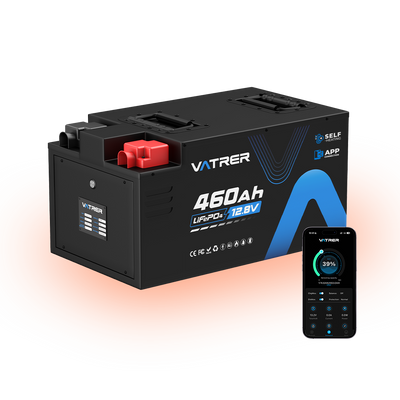
Vatrer Power specifically designed lithium-ion golf cart batteries to address these needs, focusing on stable discharge performance, integrated safety protection features, and simplified installation on Yamaha-compatible systems.
Recommended 48V Lithium Options for Yamaha Golf Carts
For most 48V Yamaha golf carts, two capacity ranges cover the majority of real-world use cases:
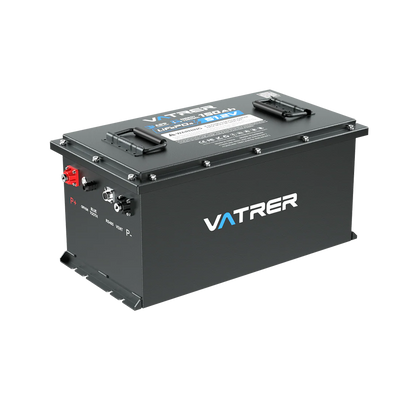
This battery capacity is well-suited for daily personal use, standard course play, and neighborhood driving. It weighs only 102.5 lbs and delivers 5736Wh of energy, supporting up to 50 miles of range. For many owners, this size delivers a noticeable upgrade in performance and reliability compared to traditional lead-acid packs.
This higher-capacity battery is better suited for heavier carts, frequent passenger loads, hilly terrain, or extended daily operation. The added capacity increases usable range (up to 70 miles) and reduces depth of discharge per cycle, which can contribute to longer overall battery life in demanding applications.
In both cases, the real advantage comes from pairing the correct capacity with a lithium battery designed specifically for golf cart discharge patterns, rather than simply selecting the largest battery available.
What to Check Before Replacing Batteries in a Yamaha Golf Cart
Replacing batteries in a Yamaha golf cart is a technical upgrade, not just a parts swap. Proper compatibility ensures reliable operation, protects the controller and motor, and avoids unnecessary performance limitations after installation. Start with the non-negotiables:
Confirm system voltage (36V or 48V)
The voltage determines the type of batteries you can install. It also affects charger compatibility and how your cart behaves under load.
Check charger compatibility
If you're moving from lead-acid to lithium, you often need a charger that matches lithium charging profiles. Some lithium conversion kits include a charger designed for that setup, which simplifies the upgrade path.
Make sure the battery can handle real driving demand
Yamaha carts see short current bursts when starting, climbing, or carrying extra weight. A pack that is fine but limited in discharge behavior can lead to weak acceleration or protective shutoffs.
Physical fit and secure mounting
Lithium packs can leave extra space if you're replacing multiple lead-acid batteries with a single pack. That space needs to be handled safely with proper brackets or mounting, no loose packs bouncing under the seat.
Tips: Don't ignore connectors and cable condition. A surprising number of battery problems are actually bad cables, loose terminals, or corrosion creating resistance and heat.
How to Choose the Best Golf Cart Battery for Your Yamaha Cart
The fastest way to choose the best battery for a Yamaha golf cart is to stop thinking like a spec sheet and start thinking like a driver. Picture your most common day:
- Are you doing short laps around the neighborhood, or running errands for hours?
- Do you deal with hills, or mostly flat paths?
- Do you carry passengers or gear?
Then match the battery type to that reality.
Battery Choice for Yamaha Golf Cart Owners
| Your Yamaha Use Case | What You’ll Usually Want | Battery Direction |
|---|---|---|
| Occasional weekend rides, mostly flat | Lower upfront cost, good enough performance | Lead-acid or AGM |
| Frequent driving (3–7 days/week) | Consistent power, fewer surprises | Lithium |
| Hills, passengers, stop/start driving | Better voltage stability under load | Lithium with BMS and high discharge rate |
| You hate maintenance | No watering, fewer corrosion issues | Lithium |
| Cold-climate charging/season use | Clear low-temp protections or self-heating | Lithium with low-temp features |
The best golf cart battery for Yamaha is the one that matches your usage stress. If your cart lives an easy life, you don't need to overbuy. If your cart works hard, the battery needs to behave like a reliable power system, not a fragile fuel tank.
Conclusion
Choosing the best battery for a Yamaha golf cart ultimately depends on how well the vehicle is used and the battery's power capacity is matched.
For light, occasional use, traditional lead-acid batteries can still serve a purpose. However, for owners who value consistent performance, reduced maintenance, and predictable range, lithium batteries help Yamaha carts feel stable and responsive throughout the entire discharge cycle rather than only at full charge.
Share