How to Convert kWh to Amps: Formula & Calculator
Reading time: 10 minutes

Share
You can convert kWh to amps only if you also know the system voltage and how long the energy was used. The basic formula is:
Amps = (kWh × 1,000) ÷ (Volts × Hours)
The number you get is the average current during that period. It does not tell you the highest current an appliance may draw at startup or under a heavy load.
There is one other distinction worth getting straight at the start. If you are sizing a battery and want to know its required capacity, you probably need kWh to amp hours, not kWh to amps. The math is closely related, but the answers describe different things.


kWh to Amps Calculator
A kWh to amps calculator uses three inputs: energy, voltage, and time. Once those values are known, the calculation itself is simple.
Calculator Inputs
Enter:
- Energy in kWh: The amount of energy consumed or delivered.
- Voltage in volts: Common examples include 12V, 24V, 48V, 51.2V, 120V, and 240V.
- Time in hours: How long it took to use that energy.
A kilowatt hour to amps calculator cannot give a meaningful current value if the time field is missing. One kWh used in 30 minutes creates a very different average load from one kWh spread across eight hours.
Calculator Result
The output tells you the average amps over the selected time. That number is useful for energy-use estimates and comparing loads across different voltages.
Do not treat it as an automatic fuse, breaker, wire, inverter, or BMS rating. A refrigerator might average only a few amps across several hours while pulling much more current during compressor startup. It is similar to the average speed on a road trip: useful information, but it does not show the fastest point of the trip.
kWh to Amps Formula and Calculation Steps
The easiest way to understand the kWh to amps formula is to split the calculation into two parts. First, convert energy into average power. Then convert that power into current.
Basic Formula
For a DC circuit, or a simplified AC calculation with a power factor of 1:
A = (kWh × 1,000) ÷ (V × h)
Where:
- A = current in amps
- kWh = energy consumed
- V = voltage
- h = operating time in hours
Because 1 kWh = 1,000 Wh, you can also work through the math this way:
Average watts = (kWh × 1,000) ÷ hours
Then:
Amps = watts ÷ volts
This is also why kWh to watts and watts to amps often show up together in electrical calculations. They are two stages of the same conversion.
Step-by-Step Example
Suppose a load uses 2 kWh over 4 hours on a 120V circuit.
Convert the energy first:
2 kWh × 1,000 = 2,000 Wh
Find the average power:
2,000 Wh ÷ 4 hours = 500W
Now calculate current:
500W ÷ 120V = 4.17A
The load averaged about 4.17 amps during those four hours.
The relationship also works in reverse. To calculate amps to kWh, use:
kWh = (Amps × Volts × Hours) ÷ 1,000
A 10A load running at 120V for five hours uses:
10 × 120 × 5 ÷ 1,000 = 6 kWh
Why Time Matters
A kilowatt-hour measures energy, so there is no fixed amp value for 1 kWh. The result changes with runtime.
At 120V with a power factor of 1:
- 1 kWh used in 1 hour = 8.33A
- 1 kWh used in 2 hours = 4.17A
- 1 kWh used in 4 hours = 2.08A
- 1 kWh used in 8 hours = 1.04A
The energy stays at 1 kWh in every case. Spreading that energy across more hours lowers the average power demand and, in turn, lowers the average current.
kWh to Amps Conversion Chart by Voltage
The tables below give quick reference values for several common electrical systems. Every value assumes the listed energy is consumed in exactly one hour.
12V to 51.2V Systems
Average Current for Energy Used Over 1 Hour
| Energy Used | 12V | 24V | 48V | 51.2V |
|---|---|---|---|---|
| 1 kWh | 83.33A | 41.67A | 20.83A | 19.53A |
| 2 kWh | 166.67A | 83.33A | 41.67A | 39.06A |
| 5 kWh | 416.67A | 208.33A | 104.17A | 97.66A |
| 10 kWh | 833.33A | 416.67A | 208.33A | 195.31A |
Moving to a higher system voltage reduces current for the same power level. That becomes especially noticeable with larger inverters and battery banks, where a 12V system can require several hundred amps while a 48V-class system carries the same power at roughly one-quarter of the current.
Battery labels also deserve a closer look. A 12V LiFePO4 battery commonly uses a 12.8V nominal voltage, and a 48V LiFePO4 battery often uses 51.2V nominal voltage. Use the nominal voltage listed for your battery if you want a more realistic calculation.
120V and 240V Systems
Average Current at Common AC Voltages
| Energy Used in 1 Hour | 120V | 240V |
|---|---|---|
| 1 kWh | 8.33A | 4.17A |
| 2 kWh | 16.67A | 8.33A |
| 5 kWh | 41.67A | 20.83A |
| 10 kWh | 83.33A | 41.67A |
At the same power level, a 240V load draws about half as much current as a 120V load under the same simplified conditions. Real AC equipment can vary because motors, compressors, and other loads may have a power factor below 1.
kWh to Amps vs kWh to Amp-Hours
Amps and amp-hours sound similar, but they answer different questions. Amps tell you how much current is flowing. Amp-hours describe electrical charge and are commonly used to rate battery capacity.
Amps for Current
To convert kWh to amps, you need energy, voltage, and runtime:
A = (kWh × 1,000) ÷ (V × h)
Take 1 kWh on a 24V system. If that energy is used in one hour, the average current is 41.67A. Spread it across four hours, and the average falls to 10.42A.
Current is tied to how quickly the energy is being delivered.
Amp-Hours for Battery Capacity
A kWh to Ah calculation is different:
Ah = (kWh × 1,000) ÷ Volts
Some quick examples:
- 1 kWh at 12V = 83.33Ah
- 1 kWh at 24V = 41.67Ah
- 1 kWh at 48V = 20.83Ah
- 5 kWh at 51.2V = 97.66Ah
A kWh to Ah calculator is often more useful than a current calculator if your goal is to estimate how much battery capacity you need. You can also reverse the formula:
kWh = (Ah × Volts) ÷ 1,000
So a 100Ah battery at 12.8V stores about:
100 × 12.8 ÷ 1,000 = 1.28 kWh
Amps, Ah, kW, and kWh
Common Electrical Units
| Unit | What It Measures | Typical Use |
|---|---|---|
| kWh | Energy | Electricity use, battery energy |
| kW | Power | Appliances, chargers, inverter output |
| A | Current | Electrical load |
| Ah | Electrical charge/capacity | Battery capacity |
This is also where kW to amps differs from a kWh calculation. kW already represents power, so a basic DC calculation only needs voltage:
Amps = (kW × 1,000) ÷ volts
With kWh, runtime has to be included because the starting value represents energy rather than power.
Why kWh to Amps Results Can Differ From Actual Current
Electrical loads rarely stay perfectly flat. Appliances cycle, motors start and stop, inverter efficiency changes with load, and battery voltage moves during charging and discharging. A calculated value can still be useful, but it should be treated as an average rather than a live current reading.
Average vs Peak Current
Startup loads can be much higher than running loads. Common examples include:
- Air conditioners
- Refrigerators and freezers
- Water pumps
- Power tools
- Motors and compressors
A system that averages 30A over an hour might briefly pull 60A, 100A, or more. The exact surge depends on the equipment.
That gap matters much more for inverter, BMS, fuse, and cable selection than it does for an energy-use estimate.
AC Power Factor
Some AC equipment also needs power factor included in the current calculation.
For a single-phase AC load:
A = (kWh × 1,000) ÷ (V × h × PF)
A resistive load may operate close to PF 1.0. A motor load could be lower.
For 1 kW of real power at 120V:
- PF 1.0 → 8.33A
- PF 0.9 → 9.26A
- PF 0.8 → 10.42A
Lower power factor means more current is required to deliver the same amount of real power.
System Losses
An inverter never passes every watt from the battery to the AC load. If a 1,000W appliance is supplied through an inverter running at 90% efficiency, the battery has to provide about:
1,000W ÷ 0.90 = 1,111W
Cable resistance, charger efficiency, battery temperature, and voltage sag can move the real number farther from the ideal calculation. For system sizing, measured loads and equipment specifications matter more than a rounded conversion result.
Using kWh to Ah for Battery Bank Sizing
If your goal is to choose a battery bank, start with daily energy use. Then convert that requirement to Ah at your planned system voltage and check whether the battery can deliver enough current for the inverter and connected loads.
Daily Energy Use
Write down each appliance, its rated power, and how long you expect to use it.
A 100W device running for five hours uses:
100W × 5h = 500Wh = 0.5 kWh
A 60W refrigerator averaging 10 hours of compressor runtime uses about:
60W × 10h = 600Wh = 0.6 kWh
Add each load together to get a daily energy target. Air conditioning, electric cooking, space heating, and large pumps can push that number up quickly, so use realistic runtimes rather than assuming every appliance runs continuously.
Required Battery Capacity
Suppose your loads need 5 kWh and you plan to use a 51.2V battery system.
The theoretical capacity is:
5,000Wh ÷ 51.2V = 97.66Ah
Real systems need some headroom. If you plan around 90% usable battery capacity and 90% inverter efficiency:
5 kWh ÷ (0.90 × 0.90) = 6.17 kWh
At 51.2V:
6,170Wh ÷ 51.2V ≈ 120.5Ah
That gives you a more practical starting point than choosing a battery from a simple Ah figure alone.
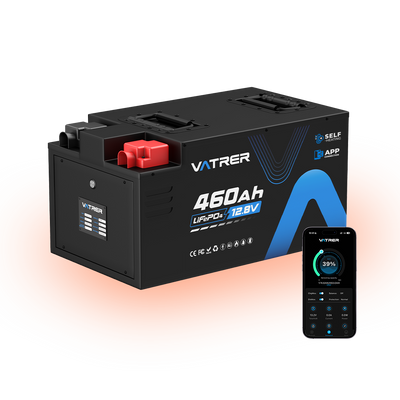
If your math points toward a 12V or 48V LiFePO4 battery, Vatrer battery range can be chosen by nominal voltage, Ah capacity, and BMS current rating. Those three numbers tell you much more about system fit than capacity by itself.
Battery Current Limits
A battery may have enough stored energy and still fall short on power delivery. Check:
- Continuous discharge current: how much current the battery can deliver steadily.
- BMS current rating: the protection limit built into the battery.
- Inverter demand: a 3,000W inverter at 12.8V can require about 234A before conversion losses.
- Surge demand: compressors, pumps, and motors can briefly push current much higher.
This is why a 5 kWh battery is not automatically suitable for every 5 kWh application. Capacity tells you how much energy is available; discharge capability tells you how fast that energy can be supplied.
Common kWh to Amps Conversion Mistakes
Most calculation errors come from mixing up energy, power, current, and battery capacity. Keeping the units attached to every number makes mistakes much easier to spot.
Leaving Out Time
This calculation is incomplete:
kWh ÷ volts = amps
Dividing energy by voltage gives a quantity related to amp-hours, not current.
Use:
A = (kWh × 1,000) ÷ (V × h)
if amps are what you need.
Mixing Up kW and kWh
kW measures power. kWh measures energy.
A 2 kW appliance running for three hours uses:
2 kW × 3h = 6 kWh
If you already know the power in kW, you can move directly to current once voltage is known for a basic DC calculation. Starting with kWh adds time to the equation.
Mixing Up Amps and Ah
A 100Ah battery does not mean the battery constantly outputs 100A.
Think of Ah as the size of a fuel tank and amps as the rate at which fuel is leaving the tank. A large battery can run a light load for a long time or a heavy load for a shorter period.
Sizing From Average Current
A long-term average is useful for energy planning, but electrical protection and power equipment need to handle actual operating conditions. Wire size, fuse ratings, breakers, BMS limits, and inverter capacity should be checked against continuous current, surge current, equipment specifications, and applicable electrical requirements.
Conclusion
The useful part of this calculation is not the formula itself. It is knowing which number should drive the next decision. Average amps help describe load over time, Ah helps compare battery capacity, and continuous or surge current determines whether the battery and inverter can actually support the equipment.
Once you know your daily kWh requirement and system voltage, compare battery capacity and discharge capability together. If you're preparing to upgrade or replace your battery, Vatrer offers LifePO4 batteries from 12V to 72V, covering use from RV travel and low-speed vehicles to home off-grid systems. These batteries all have built-in BMS and low-temperature protection, and also support Bluetooth monitoring and self-heating features, ensuring that every power supply matches your lifestyle.
Share