Two 6V Batteries vs One 12V RV Battery: Which Is Better?
Reading time: 16 minutes

Share
Your RV runs on a 12V house system, so the real question is not whether 6V or 12V sounds better on the label. Two 6V batteries can be wired together to make a 12V battery bank, while one 12V battery connects directly. Both can power an RV. The better choice depends on capacity, battery chemistry, weight, charging setup, and how long you camp without shore power.
Two 6V deep cycle lead-acid batteries usually give you more runtime than one small 12V lead-acid RV battery. A single 12V LiFePO4 battery, though, can be the stronger upgrade if you want more usable energy, less weight, and fewer maintenance chores.
Quick Answer: Two 6V Batteries vs One 12V RV Battery
A pair of 6V flooded lead-acid batteries, one 12V lead-acid battery, and one 12V lithium RV battery can all serve as an RV house battery, but they behave very differently once you start camping off-grid.
Best for Lead-Acid Runtime
Two 6V deep cycle batteries are often the better traditional lead-acid choice for longer dry camping trips. Many 6V golf cart-style batteries have higher amp-hour ratings than smaller 12V lead-acid RV batteries, so the finished battery bank can store more total energy.
A common setup is two 6V batteries rated around 200Ah to 235Ah each. Wired in series, they become a 12V battery bank with the same Ah rating. That is a much different system than a single 12V 75Ah or 100Ah lead-acid battery.
Best for Simple RV Use
One 12V deep cycle RV battery is easier to install and easier to replace. It makes sense for lighter use, especially if your RV spends most nights plugged into shore power.
This setup can handle basic 12V loads such as LED lights, a water pump, roof vent fan, propane refrigerator control board, and phone charging. It is not the best choice for long off-grid stays unless the battery capacity is large enough for your daily power use.
Best for Lithium Upgrade
A properly sized 12V LiFePO4 RV battery can deliver more usable energy than a similarly rated lead-acid battery because lithium batteries tolerate deeper discharge much better. They also weigh less and charge more efficiently with the right charger.
If you are looking at an RV battery replacement, focus on capacity, physical size, BMS rating, charging compatibility, and low-temperature protection instead of choosing by Ah alone.
Fast Comparison of Common RV Battery Setups
| RV Battery Setup | Best Use | Main Strength | Main Trade-Off |
|---|---|---|---|
| Two 6V lead-acid batteries | Longer lead-acid runtime and boondocking | Higher reserve capacity than many single 12V lead-acid batteries | More weight and more maintenance |
| One 12V lead-acid battery | Simple weekend camping | Lower upfront cost and easy replacement | Less usable runtime |
| One 12V LiFePO4 battery | Lithium upgrades, solar, frequent off-grid use | More usable capacity with lower weight | Higher purchase price and charger checks |
A single 12V lead-acid battery is the simplest choice. Two 6V batteries are the stronger lead-acid bank. One 12V LiFePO4 battery is often the better long-term system if your RV can charge it correctly.
How Two 6V Batteries Work in a 12V RV System
Two 6V batteries work in an RV because they are wired in series. That wiring raises the voltage to match the RV’s 12V house system while keeping the amp-hour rating the same as one battery in the series string.
Series Wiring
Series wiring connects one battery to the next. With two 6V batteries, you connect the positive terminal of one battery to the negative terminal of the other battery. The two remaining open terminals connect to the RV’s positive and negative cables.
The wiring pattern is simple:
- One 6V battery positive goes to the other 6V battery negative.
- The remaining negative terminal connects to the RV negative cable.
- The remaining positive terminal connects to the RV positive cable.
- The RV now receives 12V power from the pair.
Do not connect one 6V battery directly to a 12V RV house system. The voltage will be wrong, and your 12V equipment will not run properly.
Voltage and Amp-Hours
Series wiring adds voltage. It does not add amp-hours. This is the part that causes the most confusion.
Two 6V 225Ah batteries wired in series become a 12V 225Ah battery bank. They do not become a 12V 450Ah battery bank. The voltage doubles from 6V to 12V, while the Ah rating stays at 225Ah.
A quick rule helps:
- Series connection raises voltage.
- Parallel connection raises amp-hours.
- Two 6V batteries in series create the voltage your RV needs.
- The capacity rating does not double in that same series string.
Think of it like stacking two pressure sources to reach the right system pressure. You changed how the batteries push power through the system, not the size of the tank.
Watt-Hours
Watt-hours give a clearer picture of runtime than amp-hours alone. Amp-hours can be misleading if the voltage is different.
The basic formula is:
Volts × Amp-hours = Watt-hours
Approximate Stored Energy by Battery Setup
| Battery Example | Nominal Setup | Approximate Stored Energy |
|---|---|---|
| Two 6V 225Ah batteries in series | 12V 225Ah | About 2,700Wh |
| One 12V 100Ah lead-acid battery | 12V 100Ah | About 1,200Wh |
| One 12V 200Ah LiFePO4 battery | 12.8V 200Ah | About 2,560Wh |
The two 6V setup often wins against one small 12V lead-acid battery because it stores more energy. A higher stored-energy number can translate into more usable power in daily RV use.
12V LiFePO4 RV Battery vs Two 6V Lead-Acid Batteries
A 12V LiFePO4 RV battery changes the comparison because it offers more usable capacity per pound and far less maintenance. It costs more upfront, but the daily experience is very different from flooded lead-acid batteries.
Usable Capacity
Lead-acid batteries do not like deep discharge over and over. If you drain them too far too often, their life drops faster.
LiFePO4 batteries handle deep cycling much better. A 12V 300Ah LiFePO4 battery can provide a large amount of usable power without the same deep-discharge penalty you would expect from flooded lead-acid batteries.
That is why a lithium battery may replace a heavier lead-acid bank even when the label ratings look closer than expected. Usable capacity is the number that matters at the campsite.
Weight and Space
Lithium batteries are much lighter than lead-acid batteries with similar usable energy. Depending on the battery size, switching from two flooded lead-acid batteries to one LiFePO4 battery can remove a noticeable amount of weight from the front of a travel trailer.
That can help with tongue weight, storage space, and battery compartment clutter. If you are comparing Vatrer lithium batteries during an RV battery replacement, measure the tray first and then compare usable energy against the weight you are removing.
Charging Speed
LiFePO4 batteries can accept charge more efficiently when paired with the right equipment. That helps if you recharge from solar panels, a generator, shore power, or a DC-DC charger while driving.
Lead-acid charging slows down near the top of the charge. The final stretch can take a long time. Lithium charging tends to make better use of the available charge current, which can reduce generator run time and make solar charging more productive during limited daylight.
The charger must match the battery. A lead-acid-only converter may not fully charge a lithium battery.
Maintenance and Lifespan
LiFePO4 batteries remove the messiest parts of battery care. No watering. No acid spills. No equalizing charge.
You still need to inspect terminals, tighten cables when needed, and stay within the battery maker’s charging limits. Low maintenance is not the same as no responsibility.
Cycle life is another reason many RV owners move to lithium. A quality LiFePO4 battery can handle thousands of cycles under proper use. Flooded lead-acid batteries can work for years, but they are more sensitive to sitting discharged, repeated deep discharge, and poor maintenance.
Upgrade Checks
A lithium upgrade should match the whole RV electrical system. The battery is only one part of the setup.
Check these items before switching:
- RV converter: Can it charge LiFePO4 correctly?
- Solar charge controller: Does it have a lithium setting?
- DC-DC charger: Is alternator charging controlled?
- Cable size: Can the wiring handle the expected current?
- Fuse protection: Is the circuit protected for the new load?
- Battery compartment: Does the battery fit and mount safely?
- Low-temperature charging protection: Needed for freezing-weather charging.
- BMS rating: Must support your expected inverter and DC loads.
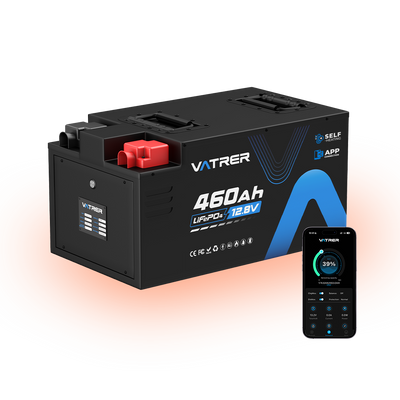
If you are considering a lithium upgrade, Vatrer 12V 300Ah Bluetooth lithium battery offers 3,840Wh of energy, a 200A BMS, and high/low-temperature protection. It is an ideal choice for RV owners who want more usable power for daily living, app-based monitoring capabilities, and reduced maintenance requirements.
RV Battery Capacity and Runtime Comparison
Runtime comes from daily power use, not from battery voltage alone. Once you know how many watt-hours you use in a day, the right RV battery setup becomes much easier to choose.
Daily Power Use
Start with each load. Multiply watts by hours used, then add the numbers.
A 10W LED light used for 5 hours consumes 50Wh. Four lights used the same way consume about 200Wh. A furnace fan or inverter can use much more than that in a shorter time.
Typical daily RV loads often fall into these ranges:
| RV Load | Rough Daily Use |
|---|---|
| LED lights | 40Wh to 250Wh |
| Water pump | 20Wh to 100Wh |
| Roof vent fan | 100Wh to 400Wh |
| Furnace fan | 300Wh to 1,000Wh on a cold night |
| Phone charging | 10Wh to 30Wh per phone |
| Laptop charging | 50Wh to 150Wh per charge |
| Small inverter loads | Highly variable |
Usable Capacity
Rated capacity is printed on the label. Usable capacity is the amount you can realistically use without shortening battery life or hitting low-voltage limits too early.
Rated Capacity vs Practical Usable Capacity
| Battery Type | Example Rated Capacity | Approximate Stored Energy | Practical Usable Energy |
|---|---|---|---|
| 12V lead-acid battery | 100Ah | About 1,200Wh | Often around 500Wh to 700Wh |
| Two 6V lead-acid batteries in series | 225Ah at 12V | About 2,700Wh | Often around 1,300Wh to 1,600Wh |
| 12V LiFePO4 battery | 200Ah at 12.8V | About 2,560Wh | Usually much more usable than lead-acid |
The practical difference is easy to see here. A lithium battery may not look dramatically larger by stored watt-hours, but it can give you more usable energy before you need to recharge.
Common RV Loads
Most RV house loads are moderate. Lights, water pump use, fans, control boards, and charging small electronics can run from almost any properly sized RV battery setup.
Time matters more than people expect. A roof vent fan running all afternoon can use more energy than a short burst from a small appliance. A furnace fan cycling through the night can be the biggest draw in cold weather.
A battery monitor helps because it shows what is actually happening. Voltage alone is a rough clue. Current draw, state of charge, and remaining capacity give a much better picture.
High-Power Appliances
Microwaves, coffee makers, electric kettles, induction cooktops, electric heaters, and air conditioners are a different class of load. They usually require an inverter and pull heavy current from a 12V battery bank.
A 1,000W AC load can draw roughly 80A to 100A from a 12V battery system after inverter losses. That is far beyond what many small battery setups should handle for long.
Check the system before running large AC loads:
- Battery bank size: The bank must have enough usable watt-hours.
- Inverter rating: Running watts and surge watts both matter.
- Cable and fuse size: High DC current needs proper wiring and protection.
- Battery discharge rating: The battery or BMS must support the current draw.
- Charging source: Solar, generator, shore power, or alternator charging has to replace the energy used.
For air conditioner use, a larger LiFePO4 battery bank is usually a better starting point than a small lead-acid setup.
Cost, Lifespan, and Maintenance of RV Battery Setups
The cheapest battery on the shelf is not always the lowest-cost setup over time. Value depends on how often you use the RV, how deeply you discharge the battery, and how much maintenance you are willing to do.
Upfront Cost
One 12V lead-acid battery usually has the lowest purchase price. Two 6V lead-acid batteries cost more because you are buying a pair and may need cables, boxes, or tray changes. A 12V LiFePO4 RV battery usually costs more upfront, especially at higher capacities.
Typical Cost Ranges for RV Battery Setups
| Battery Setup | Typical Upfront Cost Range | Extra Items to Check |
|---|---|---|
| One 12V lead-acid battery | About $100 to $300 | Battery box, terminals |
| Two 6V lead-acid batteries | About $250 to $600+ | Series cable, boxes, tray space |
| One 12V LiFePO4 RV battery | About $300 to $1,000+ | Charger, solar controller, cable rating |
A low purchase price works for light use. Frequent off-grid camping makes usable capacity and lifespan much more important.
Long-Term Value
Two 6V deep cycle batteries can be a better lead-acid value than one small 12V lead-acid battery if you boondock often. They usually provide more reserve capacity and handle repeated cycling better.
LiFePO4 costs more at the start, but it can provide more usable capacity over more cycles with less maintenance. That can lower the cost per usable cycle for frequent campers.
If you compare Vatrer lithium batteries with lead-acid options, look beyond the first receipt. Weight saved, maintenance avoided, usable watt-hours, and charger compatibility all affect the real cost.
Maintenance Comparison
Maintenance changes the ownership experience. Some RV owners are comfortable checking water levels and cleaning terminals. Others would rather avoid that routine.
Here is the split:
- Flooded lead-acid batteries need water checks, distilled water, terminal cleaning, ventilation, and careful storage.
- AGM batteries are sealed and cleaner, but still heavy and less tolerant of deep cycling than LiFePO4.
- LiFePO4 batteries need no watering or equalizing charge, though cables and terminals still deserve occasional inspection.
A battery that requires maintenance is not a bad battery. It just needs the right habits behind it.
RV Battery Installation and Compatibility Checks
A battery that does not fit, charge correctly, or match the wiring can create problems even if the capacity looks perfect. Check the installation details before buying.


Battery Compartment
Measure the battery compartment before choosing the battery. Product photos do not tell you how a battery will fit under your RV’s hold-downs or inside a tight front tray.
Look at length, width, height, mounting points, ventilation, and cable reach. For travel trailers, also think about tongue weight. Two flooded 6V batteries can add well over 100 lbs to the front of the trailer.
A lighter lithium battery can help, but it still needs secure mounting. Weight savings do not replace proper installation.
Matching Batteries
Two 6V batteries should be bought and used as a matched pair. Same voltage, same capacity, same chemistry, similar age, similar condition.
Do not mix flooded lead-acid with AGM. Do not mix lead-acid and lithium in the same bank. Avoid pairing a new battery with an old one.
Matched batteries charge and discharge more evenly. That protects the weaker battery from being dragged down and the stronger battery from working too hard.
Charger Profile
Flooded lead-acid, AGM, and LiFePO4 batteries do not use the same charging profile. Your converter, charger, solar controller, and DC-DC charger should match the battery type.
Older RV converters may be set up only for lead-acid batteries. They may undercharge lithium or use charging behavior that does not fit LiFePO4 well.
Before installing a 12V lithium RV battery, check the converter manual. If it does not support lithium charging, replace or supplement it with compatible charging equipment.
Solar Charging
Solar can work with lead-acid or lithium batteries, but the experience is different. Lead-acid batteries charge more slowly near full and offer less usable capacity. LiFePO4 batteries usually make better use of limited daylight because they accept charge efficiently and allow deeper discharge.
The solar charge controller has to support the battery type. A controller with a lithium setting is the safer choice for LiFePO4.
Solar still has limits. A small solar array will not refill a large overnight load during cloudy weather just because the battery bank is new.
Temperature Protection
Cold and heat both affect battery performance. Lead-acid batteries lose capacity in cold weather, and heat can increase water loss in flooded batteries.
LiFePO4 batteries keep more usable energy in many cold conditions, but charging below freezing can damage lithium cells unless the battery has low-temperature charging protection or a heating feature. A quality BMS should protect against overcharge, over-discharge, overcurrent, and temperature problems.
How to Choose the Right RV Battery Setup
The best RV battery setup should match how you camp, how you charge, and how much space your RV gives you. Voltage starts the conversation, but your actual power habits finish it.
Camping Frequency
A few weekend trips each year do not require the same battery bank as frequent dry camping. Light use favors a simple 12V deep cycle battery. More frequent use makes higher usable capacity and longer cycle life more valuable.
A 12V LiFePO4 RV battery becomes easier to justify when the battery is used often, discharged deeply, or charged from solar and generator power.
Off-Grid Runtime
One night away from hookups is easy to cover with a modest setup. Several nights in cold weather require more planning.
If most camping happens at powered sites, one 12V battery may be enough. If dry camping is a regular part of your trips, two 6V batteries or a larger lithium battery bank makes more sense.
For multi-day off-grid use, start with daily watt-hours. Guessing from battery voltage leads to bad sizing.
RV Size and Weight
Small campers and travel trailers have less room for battery weight. A single 12V battery or compact LiFePO4 battery may fit better than two flooded 6V batteries.
Tongue weight also matters on towable RVs. Adding 120 lbs or more to the front of the trailer can change how it tows. A motorhome or fifth wheel may have more room, but payload still has a limit. The battery should improve the RV, not make it harder to handle.
Charging Source
Your charging source should influence the battery choice.
- Shore power: a single 12V battery can work well for light loads.
- Generator charging: LiFePO4 can reduce recharge time with the right charger.
- Solar charging: lithium often uses solar input more efficiently.
- Alternator charging: lithium systems may need a DC-DC charger.
A strong battery bank with weak charging will still leave you short on power.
Maintenance Preference
Lead-acid batteries can work well if you care for them. They need water checks, clean terminals, proper charging, and good storage habits.
LiFePO4 is the better fit if you want fewer routine battery chores. A single 12V lead-acid battery is best when low cost and easy replacement matter most. Two 6V lead-acid batteries fit the middle ground: better traditional runtime, but more weight and maintenance.
Conclusions
Start with your real use. Choose two 6V batteries if you want a traditional lead-acid bank with better off-grid runtime and you have room for the weight, cables, and maintenance. Choose one 12V lead-acid battery if your trips are light, your RV is usually plugged in, and easy replacement matters more than long runtime.
Choose a Vatrer 12V lithium RV battery if you want the most practical upgrade path for deeper usable capacity, lower weight, faster charging potential, and less upkeep. Before buying, check the converter, solar controller, cable size, fuse protection, battery compartment, and temperature limits. The right battery is the one your RV can use, charge, and carry without compromise.
Share