Is a Car Battery AC or DC Power?
Reading time: 10 minutes

Share
A car battery supplies DC power, or direct current. In most passenger vehicles, the familiar “12V” battery is part of a nominal 12V DC electrical system that starts the engine and supports low-voltage electronics.
The part that often causes confusion is the alternator. It creates AC internally, but that current is converted before it reaches the battery. Chargers and inverters add another layer because they can change power from AC to DC or from DC to AC. Knowing where each conversion happens makes battery testing, charging, and accessory use much easier to understand.
Is a Car Battery AC or DC?
A normal car battery is a DC power source. Its positive and negative terminals maintain fixed polarity during normal operation, unlike AC power, where electrical polarity reverses repeatedly.
AC vs. DC Basics
AC and DC describe the behavior of electrical current. They do not describe the amount of voltage by themselves. A simple way to picture the difference is to think of DC as water moving through a pipe in one direction, while AC repeatedly reverses its electrical direction.
AC vs. DC Power Comparison
| Comparison | AC Power | DC Power | Typical Car Battery |
|---|---|---|---|
| Current behavior | Reverses direction periodically | Maintains fixed polarity | DC |
| Household frequency | 60 Hz | 0 Hz | 0 Hz |
| Common household supply | 120V AC | — | — |
| Typical passenger-car battery | — | Nominal 12V DC | Nominal 12V DC |
| Common source | Utility outlet, alternator internally | Batteries, rectified power | Battery |
The voltage number and the current type describe different things. A source can be 12V DC, 24V DC, 120V AC, or another combination depending on the electrical system.
DC From Battery Chemistry
A battery produces electricity through electrochemical reactions inside its cells. Those reactions create a voltage difference between fixed positive and negative terminals, so the battery naturally delivers DC at its external connections.
A conventional 12V lead-acid starter battery contains six cells, each producing roughly 2.1V when fully charged. Together, they typically measure around 12.6V to 12.8V at rest after the battery has settled.
The battery is still called a “12V battery” because 12V describes its nominal system class rather than its exact voltage at every moment.
What 12V DC Means
On a car battery, 12V tells you its nominal voltage, while DC tells you how the electrical output behaves.
That distinction matters whenever you choose a charger, multimeter setting, inverter, or other electrical equipment. A 12.7V DC battery and a 120V AC household outlet both have voltage ratings, but they cannot be connected or used in the same way.
How Car Battery DC Power Works in a Vehicle
A starter battery has two main jobs: provide the heavy current needed to crank the engine and support low-voltage electrical loads when the charging system is not supplying enough power.
Starting Power
Starting an internal-combustion engine takes a large amount of current for a short period. A starter motor in many passenger vehicles may draw roughly 100 to 300 amps, and larger engines or cold starts can push demand higher.
That short, heavy current draw is exactly what an automotive starter battery is built to handle. Its job is very different from a battery that powers moderate loads continuously for several hours.
Low-Voltage Vehicle Systems
The battery also supports electrical equipment throughout the vehicle. Common DC loads include:
- Headlights, interior lighting, and exterior lamps
- Ignition electronics and control modules
- Infotainment systems, locks, USB ports, and accessories
- Blower motors, relays, pumps, and other low-voltage equipment
Some individual components may create alternating electrical signals or use other forms of power internally, but the main low-voltage supply in a conventional passenger vehicle is based around DC.
Engine-Off and Engine-Running Power
With the engine off, electrical accessories draw energy from the battery. Leave enough equipment running for long enough and the available starting energy can drop below what the starter motor needs.
Once the engine is running, the alternator handles much of the electrical demand and replaces energy used from the battery. That charging process involves AC inside the alternator, but not at the battery terminals.
Does a Car Alternator Produce AC or DC?
A car alternator generates AC internally. Its output then passes through rectifier diodes that convert the alternating current into DC for the vehicle's electrical system.
AC Generation
The engine spins the alternator through a belt or another drive system. Inside the alternator, a rotating magnetic field induces electrical current in the stator windings.
Because of the way that current is generated, the raw electrical output alternates rather than flowing with fixed polarity.
Rectifier Conversion
The rectifier is the component that changes the alternator's raw AC into usable DC.
The basic power path is:
Engine → Alternator → AC → Rectifier → DC → Battery and Vehicle Electrical System
That conversion explains why an alternator can generate AC while a conventional vehicle still operates primarily on low-voltage DC power.
Voltage Regulation
Converting the current type is only part of the job. The charging system also controls voltage so the battery and electronics are not exposed to uncontrolled alternator output.
Many conventional charging systems operate somewhere around 13.5V to 14.8V with the engine running. Actual readings can vary with temperature, electrical load, battery condition, and the vehicle's charging strategy. Modern smart-charging systems may change voltage more aggressively than older fixed-regulation designs.
Car Battery Chargers Use AC Input and DC Output
A plug-in battery charger sits between household AC power and the battery. The wall side and the battery side therefore use different electrical conditions.
AC Charger Input
A typical household outlet provides about 120V AC at 60 Hz. A plug-in automotive charger accepts that AC supply and processes it electronically.
The input specification printed on the charger refers to the power coming from the wall, not the current being sent directly into the battery.
DC Charging Output
Inside the charger, AC is converted into controlled DC at a voltage and current suited to the battery being charged.
The path looks like this:
120V AC Wall Outlet → Charger → Controlled DC → Battery
A good charger also follows a charging profile appropriate for the battery chemistry. Lead-acid, AGM, and LiFePO4 batteries can all provide DC power, but they should not automatically be treated as if they use identical charging settings.
Direct AC Connection Risks
Household AC should never be connected straight to battery terminals. A 120V AC source is far outside the operating conditions of a nominal 12V automotive battery and can create shock, arcing, overheating, fire, and battery-damage hazards.
The safe conversion happens inside equipment built for battery charging.
How to Test Car Battery DC Voltage With a Multimeter
For a normal battery-voltage check, set your multimeter to DC volts, commonly shown as V⎓. If the meter requires you to choose a manual range, 20V DC is commonly appropriate for a 12V automotive battery.
DC Voltage Setting
Touch the red probe to the positive terminal and the black probe to the negative terminal. A digital meter should show a positive voltage reading with the probes connected this way.
If you reverse the probes, many digital meters simply display the same value with a minus sign. The battery has not changed polarity; the meter is showing that your leads are reversed.
Battery Voltage Readings
Resting voltage can provide a useful quick check for a conventional 12V lead-acid battery, although it does not replace a proper load or conductance test.
Typical 12V Lead-Acid Resting Voltage Guide
| Resting Voltage | Approximate Charge Level | General Interpretation |
|---|---|---|
| 12.6-12.8V | Near 100% | Fully or nearly fully charged |
| About 12.4V | Around 75% | Partially discharged |
| About 12.2V | Around 50% | Recharge recommended |
| About 12.0V | Around 25% | Heavily discharged |
| Below 11.9V | Very low | Charge and test the battery |
These values are approximate. Temperature, battery age, recent charging, and surface charge can shift the reading.
With the engine running, the meter usually shows a higher voltage because you are now seeing charging-system output as well as battery terminal voltage.
AC Ripple Checks
A technician may sometimes switch the multimeter to AC voltage while diagnosing the alternator. That measurement looks for AC ripple, which can increase when rectifier diodes or other charging-system components develop problems.
This is a diagnostic use of the AC setting rather than a normal battery-voltage test.
Can a Car Battery Power AC Devices?
A car battery can supply energy to AC equipment, but an inverter must change the battery's low-voltage DC into AC first.
DC-to-AC Inverter
The conversion may look like this:
12V DC Battery → Inverter → 120V AC Output
That makes it possible to run compatible chargers, laptops, tools, and small appliances. The usable load depends on much more than the inverter's outlet shape.
Power and Wiring Limits
High-power AC devices can demand surprisingly high current from a 12V battery. A 600W load requires about 50 amps at 12V before conversion losses. A 1,200W load is already around 100 amps before losses.
Several parts of the system have to support that current:
- The inverter needs enough continuous and surge wattage.
- The battery must support the required discharge current.
- Cables need enough conductor size for the current and cable length.
- Fuse or breaker protection should match the circuit.
- Battery capacity determines how long the load can run.
An inverter does not create extra energy. It changes voltage and current while losing a small amount of power as heat.
Starter Battery Limitations
Automotive starter batteries are made for short, high-current engine starts followed by prompt recharging. Repeated deep discharges from running an inverter can shorten their service life and may leave too little energy to restart the engine.
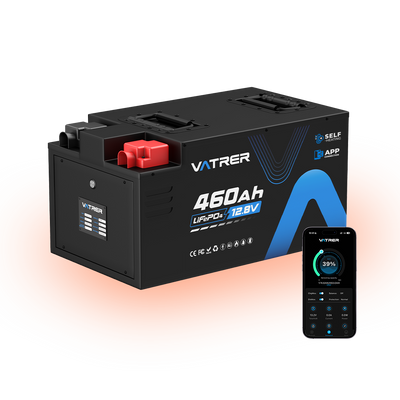
A dedicated deep-cycle battery makes more sense if you need to run camping equipment, an inverter, or other auxiliary loads for extended periods. Vatrer 12V lithium batteries are intended for repeated cycling in applications such as RV, marine, and off-grid auxiliary power, with built-in BMS protection and Bluetooth monitoring. That is a different job from replacing the starter battery under your hood.
Are Electric Car Batteries AC or DC?
An EV traction battery is also a DC battery, even though AC appears in both charging and motor operation. The difference is that an EV uses much more power electronics to move energy between DC storage and AC components.
DC Battery Storage
EV traction batteries commonly operate at hundreds of volts DC, far above a conventional 12V starter battery. The higher voltage reduces the current required to transfer large amounts of power through the drivetrain.
Battery chemistry does not change this basic electrical behavior. Lithium-ion traction batteries still have fixed-polarity DC output at the battery terminals.
AC and DC Charging
Level 1 and Level 2 charging provide AC to the vehicle. The onboard charger handles the conversion before that energy reaches the traction battery:
Grid AC → Onboard Charger → DC → EV Battery
DC fast charging moves much of the conversion equipment outside the car. The charging station supplies DC to the vehicle's high-voltage charging system, allowing much higher charging power than a typical onboard AC charger can handle.
Motor Power Conversion
Many EV traction motors use controlled AC. An inverter converts the battery's DC into the variable-frequency AC needed to control motor speed and torque.
Regenerative braking sends energy the other way. The motor acts as a generator, and the power electronics process that generated energy into DC that the traction battery can accept.
The EV battery itself stays on the DC side throughout both processes.
Conclusions
Knowing the current type helps you choose the right equipment rather than treating every electrical source as interchangeable. Use the DC voltage setting for a normal 12V battery check. Use a compatible battery charger when charging from a household outlet. Put an inverter between a DC battery and equipment that needs household-style AC.
The battery you choose should also match the job. A starter battery is built around short cranking events, while repeated inverter loads and long accessory runtimes call for deep-cycle capability. If you are putting together a dedicated 12V auxiliary system for an RV, boat, camping setup, or off-grid use, Vatrer LiFePO4 lithium batteries provide deep-cycle energy storage with integrated BMS protection and multiple capacity options, giving that type of system a more appropriate power source than repeatedly draining a vehicle starter battery.
Share