Amps vs Volts vs Watts: What’s the Difference?
Reading time: 19 minutes

Share
You see volts, amps, and watts on batteries, chargers, inverters, appliances, solar equipment, and power stations. The numbers often appear close together, but each one describes a different part of the electrical system.
Volts measure electrical potential. Amps measure electrical current. Watts measure the rate at which power is delivered or consumed. Once you understand how they work together, you can read equipment labels, estimate battery runtime, calculate inverter current, and match components more accurately.
Amps vs Volts vs Watts Explained
Voltage, current, and power answer three separate questions. Voltage tells you the operating level. Amperage shows how much current moves through the circuit. Wattage shows how much electrical work is being done.
Volts, Amps, and Watts Compared
| Comparison | Volts | Amps | Watts |
|---|---|---|---|
| Full unit name | Volt | Ampere | Watt |
| Symbol | V | A | W |
| Measures | Electrical potential difference | Electrical current | Electrical power |
| Plain meaning | The push behind current | The amount of current flowing | The rate of energy transfer |
| Common label locations | Batteries, chargers, outlets | Chargers, BMS specifications, breakers | Appliances, inverters, generators |
| Main sizing question | Does the voltage match? | Can the circuit carry the current? | Can the source support the load? |
Voltage establishes compatibility, current affects conductor and component loading, and watts describe the actual power level.
Voltage
Voltage is the electrical potential difference between two points. It creates the force that can move current through a completed circuit.
Voltage behaves like pressure in a closed water line. Pressure can remain in the pipe while the faucet is closed. In the same way, a 12V battery can show voltage at its terminals while delivering 0A because no load is connected.
Common voltage levels include:
- 5V for many USB devices
- 12V for RV house systems, boats, lights, and pumps
- 24V or 36V for larger trolling motors
- 36V, 48V, or 72V for golf carts
- 48V or 51.2V for many solar storage systems
- 120V or 240V AC for household appliances and larger equipment
Connected components must operate within compatible voltage ranges. A 48V charger cannot be used on a 12V battery simply because both products charge or store electrical energy.
Battery voltage also changes during charging and discharging. A 12V LiFePO4 battery commonly has a nominal voltage of 12.8V, while its specified charging voltage may be 14.2V to 14.6V.
Current
Current is the movement of electrical charge through a circuit. One ampere represents one coulomb of charge passing a point each second.
Amperage works like the flow rate inside a pipe. Voltage provides the pressure, while amperage describes how much is moving through the available path.
The connected load normally determines its current draw at a given voltage. A power supply rated for 20A does not automatically send 20A through every device. The rating usually describes the maximum current the source can provide under its stated operating conditions.
Current affects several parts of an electrical system:
- Battery and BMS limits: The battery must support the required continuous and peak current.
- Cable size: Higher current normally requires thicker conductors.
- Connection quality: Loose terminals create resistance, heat, and voltage drop.
- Circuit protection: Fuses and breakers must match the conductor and equipment limits.
- Charging speed: More charging current can reduce charge time, provided the battery accepts it.
A high-current battery circuit may carry 100A, 200A, or more. Cable length, cable gauge, terminal condition, and fuse placement become increasingly significant as current rises.
Power
Watts measure electrical power, which is the rate at which energy is transferred or consumed. One watt equals one joule per second.
A 600W appliance uses energy six times faster than a 100W appliance while both operate at their rated power. Their voltage and current may be different, yet wattage gives you a direct view of their power demand.
You will commonly see watts used for:
- Appliance power consumption
- Inverter continuous output
- Generator output
- Charger output power
- Solar panel production
- Motor running and starting demand
- Battery discharge power
Watts let you compare power across different system voltages. A 1,200W load still requires 1,200W even if one system supplies it with high voltage and lower current while another uses low voltage and higher current.


Watts, Volts, and Amps Formula and Calculations
Volts, amps, and watts are connected by one basic power formula. You can rearrange it to find any missing value when the other two are known.
- Watts = Volts × Amps
- Amps = Watts ÷ Volts
- Volts = Watts ÷ Amps
One volt multiplied by one amp equals one watt.
Use values from the same part of the electrical system. The AC input specifications of a charger should not be mixed with its DC output specifications.
Calculating Watts
Calculating watts tells you how much power a source delivers or how much power a load uses at a stated voltage and current.
Here are three basic examples:
- 12V × 10A = 120W
- 24V × 10A = 240W
- 120V × 5A = 600W
The current remains at 10A in the first two calculations. Doubling the voltage doubles the resulting power.
You can also estimate a battery’s theoretical continuous power from its nominal voltage and continuous discharge rating. A 12.8V battery with a 100A continuous discharge limit calculates to:
12.8V × 100A = 1,280W
This figure does not account for voltage movement, inverter losses, temperature limits, or manufacturer operating restrictions.
Calculating Amps
Current calculations help you size batteries, BMS units, cables, fuses, breakers, connectors, and busbars.
A 1,200W resistive appliance operating directly at 120V draws:
1,200W ÷ 120V = 10A
Now place that 1,200W load on a 12V battery through an inverter. Before accounting for losses:
1,200W ÷ 12V = 100A
The same power supplied by a 48V battery requires:
1,200W ÷ 48V = 25A
Inverters lose some energy during conversion. At 90% efficiency, the estimated battery current for a 1,200W load on a 12V system becomes:
1,200W ÷ 12V ÷ 0.90 = 111A
A relatively ordinary AC appliance can therefore place a heavy current demand on a 12V battery bank.
Calculating Volts
Voltage can be calculated when watts and amps are known:
Volts = Watts ÷ Amps
A 600W DC load drawing 25A operates at:
600W ÷ 25A = 24V
The result explains the mathematical relationship between the values. It does not set the device’s acceptable operating voltage.
Before connecting equipment, check:
- Rated operating voltage
- AC or DC input
- Polarity
- Connector type
- Permitted voltage range
- Charging or power-supply requirements
Use the calculated voltage to understand or verify a circuit, then follow the equipment specifications for the actual connection.
Calculation Limits
The power formula is simple, but the numbers must describe the same electrical condition. Mixing unrelated ratings can produce an answer that looks reasonable while being technically wrong.
Common calculation errors include:
- Multiplying a charger’s AC input voltage by its DC output current
- Combining an inverter’s peak watts with its continuous current rating
- Treating nominal battery voltage as a fixed operating voltage
- Ignoring inverter or converter losses
- Using a maximum rating as the device’s normal consumption
- Mixing values measured under different loads or states of charge
Input ratings stay with input ratings. Output ratings stay with output ratings. Continuous and peak values also need to remain separate.
Same Wattage at Different Voltage and Amperage
At the same wattage, increasing voltage reduces the current required to deliver that power. This relationship strongly affects battery cables, BMS ratings, connectors, fuses, and inverter installation.
Current Required to Supply a 1,200W Load
| System Voltage | Ideal Current | Estimated Current at 90% Efficiency |
|---|---|---|
| 12V | 100A | 111A |
| 24V | 50A | 56A |
| 48V | 25A | 28A |
| 120V | 10A | 11A |
A 48V source carries about one-quarter of the current required by a 12V source at the same 1,200W power level.
Higher Voltage, Lower Current
Higher system voltage is often used for larger loads because it keeps battery-side current more manageable.
Consider a 3,000W inverter load before conversion losses:
- At 12V, the calculated current is 250A.
- At 24V, it falls to 125A.
- At 48V, it falls to 62.5A.
The appliance still receives 3,000W. Raising the battery voltage changes how that power moves through the DC side of the system.
A 12V system may work well for lighting, electronics, pumps, fans, and smaller inverters. As the load moves toward 2,000W, 3,000W, or more, the required DC current can become difficult to manage with one battery, ordinary cables, and small connectors.
System voltage should still match the intended equipment. Moving from 12V to 48V may require a different inverter, charger, controller, DC distribution setup, and voltage converter for lower-voltage accessories.
Cable and Heat Loss
Electrical resistance turns part of the transmitted power into heat. Conductor loss follows P = I²R, so doubling current produces four times the resistive loss when resistance remains unchanged. Cutting current in half reduces that loss to one-quarter.
High-current DC systems commonly need:
- Larger battery cables
- Shorter cable runs
- Higher-rated terminals
- Heavier busbars
- Properly sized fuses or breakers
- Clean and tightly secured connections
Higher voltage can reduce current, cable heating, and voltage drop. It also brings different insulation, protection, installation, and service requirements.
Volts, Amps, and Watts in Battery Systems
Battery specifications combine voltage, amp-hours, watt-hours, charging current, discharge current, and BMS limits. Read these ratings together to determine compatibility, available energy, and load capability.
Battery Voltage Compatibility
The battery bank must match the nominal input voltage of the inverter, charger, controller, and connected DC equipment.
Common battery system voltages include:
| Battery System | Common Applications |
|---|---|
| 12V or 12.8V | RV house power, boats, lights, pumps, electronics |
| 24V or 25.6V | Trolling motors, medium off-grid systems |
| 36V or 38.4V | Golf carts and trolling motors |
| 48V or 51.2V | Golf carts, solar storage, backup systems |
| 72V or 76.8V | Higher-power low-speed vehicles and equipment |
The listed system voltage is nominal. The measured terminal voltage changes with state of charge, battery chemistry, temperature, and load.
A charger must also match the battery’s charging profile. A product labeled as a 48V charger may have different output requirements for lead-acid and LiFePO4 batteries.
Charge and Discharge Current
Charging current flows into the battery. Discharge current flows from the battery to the load.
A lithium battery specification sheet may list:
- Recommended charge current
- Maximum charge current
- Continuous discharge current
- Peak discharge current
- Charge and discharge temperature limits
- Overcurrent protection settings
A 20A charger theoretically returns 100Ah in five hours:
100Ah ÷ 20A = 5 hours
Actual charging may take longer. Current can taper near full charge, charging equipment consumes some power, and the battery may spend time balancing cells.
Peak discharge current also has a time limit. A battery may permit 200A for several seconds while allowing only 100A continuously. Use the peak rating for brief startup events, not normal operation.
Battery Power Limits
Battery voltage multiplied by continuous discharge current provides an initial estimate of continuous power capability.
Theoretical Power at a 100A Continuous Discharge Limit
| Nominal Battery Voltage | Continuous Current | Theoretical Power |
|---|---|---|
| 12.8V | 100A | 1,280W |
| 25.6V | 100A | 2,560W |
| 38.4V | 100A | 3,840W |
| 51.2V | 100A | 5,120W |
At the same 100A discharge limit, a 51.2V battery has four times the theoretical power of a 12.8V battery.
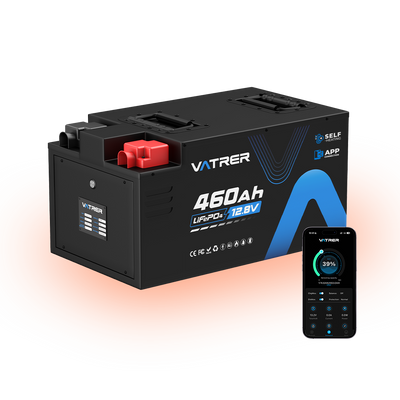
If you are planning to replace or upgrade a 12V battery system soon, the Vatrer 12V 100Ah heated lithium battery is worth comparing with your load and charging requirements. It provides 1,280Wh of rated energy, a built-in 100A BMS, Bluetooth monitoring, and up to 1,280W of listed load or inverter power. Its self-heating function also supports charging in cold conditions, which can be useful in compatible RV, marine, and off-grid installations.
Inverter Current Draw
An inverter converts DC battery power into AC power. Its AC output current and battery-side DC current can differ significantly because the two sides operate at different voltages.
Estimate battery current with:
Battery Amps = AC Load Watts ÷ Battery Voltage ÷ Inverter Efficiency
For a 1,500W load and 90% inverter efficiency:
- 12V system: approximately 139A
- 24V system: approximately 69A
- 48V system: approximately 35A
Actual current changes as battery voltage rises or falls. The inverter also consumes standby power, and its low-voltage cutoff may stop operation before the battery’s full rated energy is used.
Refrigerators, air conditioners, pumps, compressors, and power tools may require a short startup surge. The inverter surge rating and battery peak discharge limit must both support that event.
Amps vs Amp-Hours and Watts vs Watt-Hours
Amps and amp-hours describe different electrical quantities. Watts and watt-hours do as well. The added word “hours” changes the measurement from a rate to an amount accumulated over time.
Current and Capacity
Amps measure current at a specific moment. Amp-hours measure electrical charge capacity over time.
A 100Ah battery could theoretically support:
- 100A for 1 hour
- 50A for 2 hours
- 20A for 5 hours
- 10A for 10 hours
Real operating time changes with temperature, discharge rate, battery chemistry, BMS settings, state of charge, and equipment losses.
The 100Ah capacity rating also does not define continuous output current. A 100Ah battery may have a 50A, 100A, 150A, or 200A discharge limit depending on its cells and BMS.
Power and Energy
Watts describe the rate at which energy moves. Watt-hours describe the total energy stored or consumed over a period of time.
Use this formula for rated battery energy:
Watt-Hours = Volts × Amp-Hours
Energy Stored by 100Ah Batteries at Different Voltages
| Nominal Voltage | Capacity | Calculated Energy |
|---|---|---|
| 12.8V | 100Ah | 1,280Wh |
| 25.6V | 100Ah | 2,560Wh |
| 38.4V | 100Ah | 3,840Wh |
| 51.2V | 100Ah | 5,120Wh |
Batteries with the same Ah rating can store very different amounts of energy when their voltages differ.
One kilowatt-hour equals 1,000 watt-hours. A 5.12kWh battery therefore represents 5,120Wh of rated energy. One watt-hour is also equal to 3,600 joules.
Battery Runtime
A basic battery runtime calculation is:
Estimated Runtime = Usable Watt-Hours ÷ Load Watts
A 1,280Wh battery running a steady 100W DC load has an ideal runtime of:
1,280Wh ÷ 100W = 12.8 hours
If about 90% of the rated energy reaches the load:
1,280Wh × 0.90 ÷ 100W = 11.52 hours
Runtime can change because of:
- Inverter and converter losses
- Standby consumption
- Battery temperature
- Load cycling
- Discharge rate
- Battery age and condition
- BMS cutoff settings
Use the calculation as a planning figure. A measured load profile usually provides a better estimate than the appliance’s maximum label rating.
Reading Volts, Amps, and Watts on Device Labels
Product labels often combine input, output, continuous, peak, and capacity ratings. Start by identifying which side of the device each value describes.
Battery Labels
Battery labels and specification sheets commonly list voltage, capacity, energy, charging limits, and discharge limits.
Common Battery Specifications
| Battery Specification | What It Describes | How You Use It |
|---|---|---|
| Nominal voltage | Battery system voltage | Match chargers, inverters, and loads |
| Amp-hours | Charge capacity | Compare capacity at the same voltage |
| Watt-hours | Stored energy | Estimate runtime and compare voltages |
| Recommended charge current | Normal charging level | Select a suitable charger |
| Maximum charge current | Highest permitted charging current | Check fast-charging compatibility |
| Continuous discharge current | Sustained output limit | Size continuous loads |
| Peak discharge current | Short-duration output limit | Support startup or acceleration loads |
| Charge voltage | Required charger output | Confirm charging compatibility |
Read the voltage first, then compare energy capacity and current limits with the planned equipment.
Charger Labels
A charger normally has separate input and output specifications.
The input side may read:
- 100–240V AC
- 50/60Hz
- A stated maximum AC current
The output side may read:
- 14.6V DC
- 20A
- A calculated or listed output wattage
A charger delivering 14.6V at 20A has an approximate maximum DC output of:
14.6V × 20A = 292W
Do not multiply the charger’s AC input voltage by its DC output current. Those values describe opposite sides of the conversion process.
A higher-current charger may reduce charging time, but the battery must permit that current. The output voltage and charging profile must also suit the battery chemistry.
Inverter Labels
An inverter label may show:
- DC input voltage
- AC output voltage
- Continuous output watts
- Surge watts
- Maximum DC input current
- Frequency
- Efficiency
Continuous wattage covers normal operation. Surge wattage covers short startup events, often lasting seconds or less.
A 3,000W inverter could theoretically draw 250A from a 12V battery before conversion losses:
3,000W ÷ 12V = 250A
Installing a 3,000W inverter does not mean the battery bank, BMS, cables, fuse, or connections can deliver that current. Each part of the DC path needs a suitable rating.
Appliance Labels
Appliance labels may list voltage, current, watts, frequency, or several of these values.
A label reading 120V, 5A gives an apparent power calculation of:
120V × 5A = 600VA
For a resistive load with a power factor near 1, the real power may be close to 600W. Motors, transformers, and electronic power supplies can produce a different relationship between VA and watts.
Label values may represent rated input, maximum input, or normal running power. A refrigerator compressor also cycles, so its daily energy consumption will differ from its running wattage multiplied by 24 hours.
Choosing the Right Voltage, Amperage, and Wattage
A practical sizing process starts with voltage compatibility, then moves through power, current, and energy. Following that order keeps the calculations tied to the actual system.
Match System Voltage
Check the operating voltage of every major component before comparing capacity or power.
The list may include:
- Battery bank
- Charger
- Inverter
- Solar charge controller
- DC distribution panel
- Motor controller
- DC appliances
- Voltage converters
A 51.2V LiFePO4 battery normally belongs in equipment built for a nominal 48V lithium system. It should not be connected directly to 12V, 36V, or 72V equipment unless an approved conversion device sits between them.
Charging voltage needs a separate check. Two chargers sold for the same nominal voltage may use different charging profiles for lead-acid and LiFePO4 batteries.
Calculate Total Load
List the devices that may operate at the same time. Record running watts and startup watts separately.
Example Backup-Power Load Calculation
| Device | Example Running Power | Example Startup Power |
|---|---|---|
| Refrigerator | 150W | 900W |
| Wi-Fi equipment | 20W | 20W |
| LED lighting | 60W | 60W |
| Laptop charger | 65W | 65W |
| Small fan | 50W | 100W |
| Combined load | 345W | Up to 1,145W if startup overlaps |
The example needs at least 345W of continuous output and enough short-duration capacity to cover overlapping startup demand.
Use the actual labels or measured values from your equipment. Appliance designs vary widely.
Check Power Ratings
Compare the load with every major system limit.
Review:
- Battery continuous discharge power
- Battery peak discharge power and permitted duration
- Inverter continuous AC output
- Inverter surge output
- Charger output power
- Generator or shore-power input limit
- Solar charge controller limit
A system designed to operate at the absolute maximum rating of every component leaves little room for voltage movement, high temperatures, startup events, or future loads.
Verify Current Capacity
Convert the expected load into battery-side current, then compare the result with every component in the current path.
At 90% inverter efficiency, a 2,000W load requires approximately:
- 185A from a 12V system
- 93A from a 24V system
- 46A from a 48V system
Check that current against:
- Battery BMS ratings
- Cable capacity
- Fuse or breaker rating
- Connector rating
- Busbar rating
- Battery terminal limits
- Inverter DC input requirements
If your current golf cart battery is reaching the end of its service life, you can use the same voltage, current, and energy calculations to evaluate an upgrade. The Vatrer 48V 105Ah lithium golf cart battery stores 5.376kWh and includes a 58.4V 20A LiFePO4 charger, LCD display, and Bluetooth monitoring. These specifications give you practical reference points for comparing battery capacity, charging current, motor demand, and controller compatibility before replacing the existing battery system.
Estimate Energy Needs
Power determines whether the system can start and run the equipment. Watt-hours estimate how long operation can continue.
Calculate each device’s daily energy use:
- 100W for 5 hours = 500Wh
- 500W for 2 hours = 1,000Wh
- 1,500W for 30 minutes = 750Wh
The combined energy requirement is:
500Wh + 1,000Wh + 750Wh = 2,250Wh
The battery bank should also account for inverter losses, standby consumption, temperature, reserve capacity, and charging availability.
This calculation explains why a battery may support a high-power load but still provide a short runtime. Power capability and energy capacity need separate checks.
Common Amps, Volts, and Watts Mistakes
Most sizing problems begin when a correct specification is used to answer the wrong question. Matching each number to its purpose keeps the system calculation clear.
Comparing One Rating Alone
Higher volts, amps, watts, or amp-hours do not automatically make one product a better fit.
Use four separate checks:
- Voltage: Does it match the system?
- Current: Can the source and conductors carry the load?
- Power: Can the source support running and startup demand?
- Energy: Can the battery run the equipment for the required time?
A 12V 200Ah battery and a 48V 50Ah battery each calculate to roughly 2,400Wh using simplified nominal voltages. Their required chargers, inverters, cables, and current levels are very different.
Mixing Input and Output Values
Chargers, inverters, converters, and power supplies have separate input and output sides.
A charger may draw 3A from a 120V AC outlet while delivering 20A at 14.6V DC. Voltage conversion allows the output current to differ from the input current.
The same pattern appears in an inverter. A 10A AC load at 120V represents 1,200VA and may require more than 100A from a 12V battery after conversion losses.
Keep each calculation on one side of the device.
Treating Maximum as Actual
Maximum ratings describe limits rather than constant behavior.
Examples include:
- A 100A power supply may feed a load drawing only 15A.
- A 3,000W inverter does not consume 3,000W with a small load connected.
- A 200A battery peak rating may apply for only a few seconds.
- Charger output often decreases near the end of charging.
- Appliance labels may show maximum rather than average consumption.
Calculate from the expected load, then confirm that every component limit remains above that demand.
Ignoring Surge Loads
Motors, compressors, pumps, and transformers can require a short burst of power during startup.
Equipment that may have a starting surge includes:
- Refrigerators
- Air conditioners
- Well pumps
- Air compressors
- Power tools
- Microwave ovens
- Inductive motors
The startup demand can be several times higher than the running wattage, but the exact ratio varies by design. Use the manufacturer’s surge specification or a measured startup reading.
Assuming Higher Ratings Are Better
Larger electrical ratings only help when the rest of the system can use them.
A higher-current charger can exceed the battery’s charge limit. A higher-voltage battery will not operate a lower-voltage device without a suitable converter. A larger inverter can create very high battery current if it is used near full output.
Match each rating to the load and to every connected component.
Conclusion
Start with voltage because it determines which batteries, chargers, inverters, and electrical devices can connect. Next, calculate the running and surge watts. Convert that power into current at the battery voltage, then check the BMS, cables, terminals, busbars, and circuit protection. Use watt-hours last to estimate runtime and energy capacity.
Vatrer offers 12V batteries for RV, marine, and compact off-grid systems, lithium golf cart battery conversion kits, and 51.2V server-rack batteries for larger solar and backup installations. Compare the Vatrer specifications with your load calculations before choosing the battery bank and charging equipment.
Share