What Are The Best Lithium Batteries?
Reading time: 6 minutes

Share
Lithium batteries are no longer a niche technology reserved for electronics or electric vehicles. Today, they are widely used in RVs, solar energy systems, golf carts, marine equipment, and off-grid power setups. As more users replace traditional lead-acid batteries, the market has become crowded with products all labeled as lithium batteries, each claiming better performance, longer lifespan, or higher value.
This rapid expansion has created a new challenge: while many batteries look similar on paper, they are not built for the same purpose. Understanding what truly makes a lithium battery the best requires more than scanning a spec sheet.


Are All Batteries Lithium Batteries?
Despite how common the term has become, not all batteries are lithium batteries, and the differences go far beyond chemistry names.
Traditional lead-acid batteries are designed around low upfront cost, simple internal structure, and decades-old charging logic. This design choice results in heavier weight, limited usable capacity, and faster degradation when deeply discharged.
- From a cost-engineering perspective, lead-acid batteries rely on inexpensive raw materials but pay the price in short cycle life. Most lead-acid systems deliver only 300-500 cycles at 50% depth of discharge. In contrast, lithium batteries are engineered with higher-grade materials and more precise internal controls, allowing 3,000+ cycles at 80-100% depth of discharge. Over time, lithium batteries deliver significantly more usable energy per dollar spent.
- Another major difference lies in battery management. Lead-acid batteries operate without an active Battery Management System (BMS), meaning there is no internal protection against overcharging, deep discharging, or temperature extremes. Lithium batteries integrate a BMS as a core design element, continuously monitoring cell voltage, current, and temperature to maintain safety and performance.
- Usable capacity is also a defining distinction. A 100Ah lead-acid battery typically provides only about 50Ah of usable energy, while a lithium battery of the same rating can safely deliver 90–100Ah. Combined with higher safety stability, especially in chemistries like LiFePO4 lithium batteries represent a fundamentally different approach to energy storage, not just a newer version of the same idea.
Lithium Battery Types and Their Differences
The lithium battery includes several chemistries, and each behaves very differently in real-world use. Some prioritize compact size and energy density, while others focus on safety, thermal stability, and long service life. These differences directly affect the main differences in how the battery performs in different applications.
Among all options, LiFePO4 (lithium iron phosphate) has become the dominant choice for energy storage and recreational power systems because it balances safety, durability, and predictable performance.
Lithium Battery Chemistry Types Comparison
| Battery Type | Safety Level | Typical Cycle Life | Energy Density (Wh/kg) | Thermal Stability | Common Applications |
|---|---|---|---|---|---|
| LiFePO4 | Very high, non-thermal runaway | 3,000 – 6,000 cycles | 90 – 160 | Excellent | RV, solar, golf carts, marine |
| NMC | Medium, requires thermal management | 1,000 – 2,000 cycles | 150 – 250 | Moderate | EVs, power tools |
| LCO | Low, prone to overheating | <1,000 cycles | 180 – 240 | Poor | Consumer electronics |
Although NMC and LCO batteries offer higher energy density, they trade safety and lifespan for compactness. For users prioritizing long-term reliability and safety, LiFePO4 chemistry is widely considered the best LiFePO4 battery solution for stationary and recreational use.
What Determines the Best Lithium Batteries?
The best lithium batteries are defined by how consistently they perform over years of real-world use, not by a single headline specification. Several key factors work together to determine overall quality and suitability.
Safety and Chemical Stability
High-quality lithium batteries use stable chemistries and internal protections that minimize the risk of overheating, short circuits, or fire. LiFePO4 chemistry is especially valued because it resists thermal runaway even under extreme conditions.
Cycle Life and Degradation Rate
A battery rated for 4,000 cycles at 80% depth of discharge can last 8-10 years in daily-use systems. This dramatically lowers the cost per cycle compared to batteries rated for only 1,000 cycles.
Battery Management System (BMS)
The BMS is the battery's control system. A robust BMS provides over-voltage, under-voltage, over-current, short-circuit, and temperature protection. Without it, even the best lithium-ion battery chemistry becomes unreliable.
Usable Capacity vs Rated Capacity
Two batteries with the same rated capacity can deliver very different usable energy. Lithium batteries that allow 90-100% depth of discharge provide more real-world power from the same size unit.
Long-Term Value
Upfront price matters less than total energy delivered over the battery's lifespan. Batteries with longer warranties and slower degradation provide better long-term value, even if the initial cost is higher.
Best Lithium Batteries for Different Applications
Different applications place very different demands on lithium batteries. The best choice always depends on how much current is drawn, how often the battery cycles, and whether the system is mobile or stationary.
Lithium Battery Requirements by Application
| Application | Primary Requirements | Typical Current Demand | Recommended Capacity Range | Key Battery Features |
|---|---|---|---|---|
| RV Power Systems | Daily deep cycling, vibration resistance | 100 – 300A peaks | 100 – 300Ah | Stable voltage, built-in BMS |
| Solar Energy Storage | Long cycle life, inverter compatibility | Moderate continuous load | 200Ah – 500Ah | Parallel expansion support |
| Golf Carts | High discharge, durability | 200 – 400A bursts | 100 – 200Ah | High-current BMS |
| Trolling Motors | Steady output, lightweight | Continuous medium load | 50 – 100Ah | Efficient discharge curve |
Across RV, solar, marine, and mobility systems, LiFePO4 batteries consistently meet the electrical, thermal, and lifespan demands of these applications. This versatility explains why they are commonly selected as the best lithium battery solution across multiple use cases.
How to Choose the Best Lithium Batteries
Choosing the right lithium battery requires evaluating both technical specifications and system compatibility.
Capacity and Voltage Selection
Match battery voltage (12V, 24V, or 48V) to your system design. Capacity should be calculated based on daily energy use, not just peak load.
Charger and System Compatibility
Using the correct lithium battery charger is essential. Chargers must match lithium charging profiles to avoid overvoltage or incomplete charging.
Expandability
Systems that support parallel or series connections allow future capacity growth without replacing the entire battery bank.
Environmental Protection
For outdoor or mobile use, consider batteries with reinforced casing and temperature protection, especially for cold climates.
Warranty and Manufacturer Support
A long warranty (5-10 years) often indicates confidence in cell quality and BMS design, making it a strong indicator of long-term reliability.
Best Lithium Battery Brands to Consider
When evaluating lithium battery brands, the most important distinction is not marketing language but engineering priorities. Brands focused on LiFePO4 technology tend to design batteries around long cycle life, electrical stability, and real-world system integration rather than maximum energy density alone.
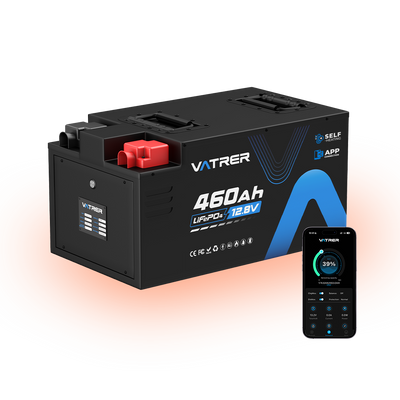
Vatrer Battery emphasizes LiFePO4 battery design optimized for RV, solar, marine, and electric low-speed vehicle applications. Key design advantages include integrated high-quality BMS protection, support for high discharge currents, stable voltage output under load, and battery architectures that allow safe parallel expansion. These design choices align with how lithium batteries are actually used in daily cycling systems, where reliability and safety outweigh compact size.
Conclusion
The best lithium batteries are not defined by marketing claims, but by how well they meet real-world demands over time. For RV, solar, marine, and mobility systems, LiFePO4 technology consistently proves to be the most balanced lithium battery solution.
Vatrer adheres to these principles, utilizing precise engineering design, a robust battery management system (BMS) safety system, and a structure specifically designed for deep cycle life, all to enhance user experience and long-term reliability.
Share