How Much Does an RV Battery Cost? Cost Guide for RV Owners
Reading time: 12 minutes

Share
RV batteries are one of those components most owners don't think much about until they stop working or no longer meet daily power needs. At that point, cost becomes a central question. The challenge is that RV battery prices vary widely, and the cheapest option upfront is not always the most economical choice over time.
In most real-world scenarios, RV battery costs range from about $100 for a basic lead-acid unit to over $1,500 for a lithium battery, while a complete RV battery system typically falls between $600 and $4,000 depending on capacity, setup, and usage needs.
How Much Does an RV Battery Cost
The average RV battery cost depends heavily on the type of battery you choose and how your RV electrical system is configured.
Traditional flooded lead-acid batteries remain the most affordable, while lithium batteries require a higher upfront investment but change how your system performs.
In real-world pricing, you’ll typically see:
- Lead-acid RV batteries: approximately $100–$250 per battery
- AGM RV batteries: approximately $200–$400 per battery
- Lithium RV batteries: approximately $700–$1,500+ per battery
These numbers reflect battery-only pricing. They don’t include installation, wiring, or charging upgrades.
Most RVs don’t run on a single battery. A Class C motorhome with a 12V system may use four Group 27 batteries. A Class B camper van might run one or two lithium batteries. That’s where total cost starts to scale.
It’s also important to understand that “average cost” only tells you what you pay once. It does not tell you how long that battery will last or how much energy you can actually use.


RV Battery Cost by Type: Lead-Acid vs AGM vs Lithium
Battery chemistry is the biggest driver of RV battery price differences.
- Lead-acid batteries: Have the lowest upfront cost. But they are sensitive to deep discharge and require regular maintenance. In daily use, you typically only access about 50% of the rated capacity.
- AGM batteries: Cost more than flooded lead-acid. They are sealed, require less maintenance, and handle vibration better. You’ll often see them installed in travel trailers or small motorhomes. But usable capacity and lifespan are still limited.
- Lithium LiFePO4 batteries: Cost more upfront, but they operate differently. They deliver stable voltage, support deep discharge, and include built-in battery management systems (BMS).
Two batteries with the same 100Ah rating can behave very differently. A lead-acid battery may only give you 50Ah usable energy, while a lithium battery can deliver close to the full 100Ah. That difference directly impacts how long your fridge, lights, or inverter will run overnight.
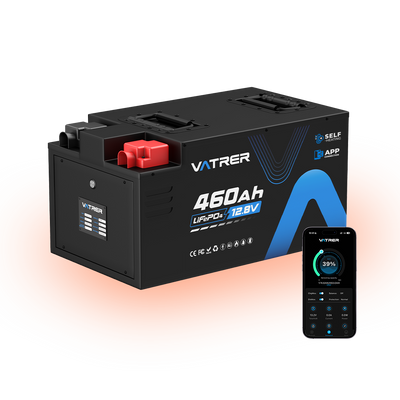
For example, a Vatrer 12V 100Ah lithium RV battery provides 1,280Wh usable energy, while a comparable lead-acid battery may only provide around 600Wh in real use. That’s not a small difference, it’s the difference between lasting through the night or needing to recharge before morning.
How Battery Size and Voltage Affect RV Battery Cost
Battery size and voltage directly affect both cost and system performance.
Capacity is measured in amp-hours (Ah), but that number alone doesn’t tell you how much energy you actually have.
To understand real energy, you need to look at watt-hours (Wh):
Wh = Voltage × Amp-hours
Specifically as follows:
| Battery | Voltage | Capacity | Energy |
|---|---|---|---|
| 12V 100Ah (12.8V) | 12V | 100Ah | 1,280Wh |
| 12V 200Ah (12.8V) | 12V | 200Ah | 2,560Wh |
| 48V 100Ah (51.2V) | 51.2V | 100Ah | 5,120Wh |
This is why comparing batteries based on price alone can be misleading. A higher-cost battery may actually deliver more usable energy per dollar.
Voltage also matters. Most RVs use 12V systems, especially in travel trailers and camper vans like a Winnebago Solis or Ford Transit conversion. Larger setups, especially those running air conditioners or high-power inverters, may move to 24V or 48V lithium systems to reduce current and improve efficiency.
System layout plays a role too. Four lead-acid batteries wired in parallel take more space, weigh more, and require more maintenance than a single lithium unit with equivalent usable energy.
Weight becomes a real factor when you’re loading your RV. A typical 12V 100Ah lead-acid battery weighs around 60–70 lbs. A lithium battery with the same capacity is closer to 25–30 lbs. In a setup with four batteries, that can mean reducing total battery weight by over 100 lbs, which affects fuel efficiency and installation flexibility.
What's the Real Cost of Replacing RV Batteries
Many RV owners underestimate replacement cost because they focus on one battery, not the system.
In reality, replacement usually involves the full battery bank. If your RV uses four batteries, all four should be replaced together to maintain balance and performance.
Lead-acid batteries typically need replacement every 2–4 years. If you use your RV frequently, especially off-grid, that cycle can be shorter.
Lithium batteries operate on a different timeline. Most LiFePO4 batteries last 8–10 years or longer under normal use.
Replacement costs may also include:
- Recycling old batteries
- Installation labor
- System rewiring
These costs are often overlooked when comparing options.
RV Battery Replacement Cost Breakdown
| Battery Type | Setup | Cost per Replacement | Frequency | 10-Year Cost |
|---|---|---|---|---|
| Lead-Acid | 4 × 12V | $600–$1,000 | Every 2–4 years | $1,800–$3,000 |
| AGM | 4 × 12V | $1,200–$1,600 | Every 3–5 years | $2,400–$3,200 |
| Lithium | 1–2 batteries | $900–$2,000 | Once in 8–10 years | $900–$2,000 |
RV Battery Replacement Cost by RV Type
| RV Type | Setup | Cost | 10-Year Cost |
|---|---|---|---|
| Class B Van | 1–2 batteries | $400–$1,800 | $800–$2,000 |
| Class C RV | 2–4 batteries | $800–$2,500 | $1,600–$3,500 |
| Class A Motorhome | 4–8 batteries | $1,500–$4,000 | $2,500–$5,000+ |
Larger RVs amplify the impact of battery choice. A Class A diesel pusher running multiple appliances can quickly multiply replacement costs if using short-lifespan batteries.
RV Battery Common Hidden Costs
| Cost Category | Typical Add-On | Estimated Cost Range | Why It Adds Cost |
|---|---|---|---|
| Installation & Labor | Professional battery installation | $150–$500 | Complex wiring, system testing, and safety checks |
| Charger Upgrade | Lithium-compatible converter/charger | $200–$600 | Required for proper lithium charging profiles |
| DC–DC Charger | Alternator-to-battery charging | $150–$400 | Protects alternator and improves charging efficiency |
| Bluetooth Monitoring | Built-in or external monitoring system | $50–$200 | Enables real-time battery status and diagnostics |
| Low-Temperature Protection | Cold-charge cutoff or protection circuit | $0–$150 | Prevents lithium damage in freezing conditions |
| Self-Heating Function | Internal battery heating system | $150–$400 | Allows safe charging below freezing |
| Mounting & Cables | Brackets, cables, fuses, connectors | $50–$300 | Required for secure and compliant installation |
RV Battery Cost: Upfront Price vs Long-Term Value
When RV owners compare batteries, the first thing you usually look at is the upfront price. While that number matters, it rarely tells the full story. The real cost of an RV battery is determined by how long it lasts, how much usable energy it delivers, and how often you need to replace or upgrade parts of your system.
To understand long-term value, you need to combine battery cost, hidden system costs, and how your RV type affects total energy demand.
RV Battery Total Cost of Ownership by RV Type
| RV Type | Battery Type | Typical Setup | Initial Battery Cost | Hidden Costs (Install + Charger + Wiring) | Total Initial Cost | Replacement Frequency (10 yrs) | Estimated 10-Year Total Cost |
|---|---|---|---|---|---|---|---|
| Class B Van (Camper Van) | Lead-Acid | 1–2 × 12V | $200–$500 | $100–$300 | $300–$800 | 3–4 times | $900–$2,000 |
| AGM | 1–2 × 12V | $400–$800 | $150–$400 | $550–$1,200 | 2–3 times | $1,200–$2,500 | |
| Lithium | 1–2 × LiFePO4 | $900–$1,800 | $300–$800 | $1,200–$2,600 | 1 time | $1,200–$2,600 | |
| Class C RV | Lead-Acid | 2–4 × 12V | $600–$1,000 | $150–$300 | $750–$1,300 | 3–4 times | $2,500–$4,300 |
| AGM | 2–4 × 12V | $1,200–$1,600 | $200–$400 | $1,400–$2,000 | 2–3 times | $3,700–$5,200 | |
| Lithium | 1–2 × LiFePO4 | $900–$2,000 | $300–$800 | $1,200–$2,800 | 1 time | $2,100–$3,800 | |
| Class A Motorhome | Lead-Acid | 4–8 × 12V | $1,500–$3,000 | $200–$500 | $1,700–$3,500 | 3–4 times | $4,000–$7,000+ |
| AGM | 4–8 × 12V | $2,500–$4,000 | $300–$600 | $2,800–$4,600 | 2–3 times | $5,000–$8,000+ | |
| Lithium | 2–4 × LiFePO4 | $2,000–$4,000 | $500–$1,000 | $2,500–$5,000 | 1 time | $2,500–$5,000 |
- In a Class B camper van like a Ford Transit conversion, lithium systems cost more upfront but eliminate repeated replacement cycles and reduce system complexity.
- In a Class C RV running a 12V fridge, water pump, and inverter, lithium batteries reduce voltage drop and allow longer overnight runtime without recharge.
- In a Class A motorhome with multiple appliances and higher inverter loads, lead-acid systems quickly become expensive due to repeated replacements and maintenance demands.
Hidden costs also scale with system complexity. Larger RVs often require DC-DC chargers, upgraded converters, and additional wiring, especially when upgrading to lithium.
Over time, the pattern becomes clear. Lower upfront cost does not always mean lower total cost. Systems that require fewer replacements, deliver more usable energy, and integrate built-in protection features tend to stabilize long-term expenses and reduce unexpected failures.
How to Choose the Right RV Battery Based on Cost and Usage
Choosing the right RV battery is not about picking the cheapest option or the highest capacity. It comes down to how you actually use your RV day to day.
Step 1: Identify How You Actually Use Your RV
Start by looking at your typical usage pattern, not your ideal one. If you mainly stay at RV parks with hookups, your battery is only supporting basic 12V loads like lights and control panels. In that case, a simple lead-acid or AGM setup may be enough.
If you're driving a Class B van like a Sprinter conversion and parking off-grid for a night or two, your battery will be running a 12V fridge, roof fan, and device charging. That shifts the requirement toward deeper usable capacity and more stable output.
Step 2: Estimate Your Daily Power Usage
Once you understand how you use your RV, estimate how much energy you consume per day. This is where many RV owners make mistakes by only looking at amp-hours.
Think in watt-hours:
- 12V fridge: ~60W × 8h = 480Wh
- Roof fan: ~30W × 10h = 300Wh
- LED lights: ~20W × 5h = 100Wh
That’s roughly 900Wh per day in a typical off-grid scenario.
For example, a 12V 100Ah lead-acid battery gives you about 600Wh usable energy. A 12V 100Ah lithium battery gives you about 1,280Wh. That difference directly determines whether your system lasts through the night or not.
Step 3: Match Battery Type to Usage Intensity
After estimating your usage, match it to the right battery type.
- Occasional use (weekend trips, hookups): Lead-acid or AGM batteries can handle light loads at a lower upfront cost.
- Moderate use (short off-grid stays, van life): AGM or entry-level lithium batteries provide more stable performance and longer runtime.
- Heavy use (full-time RV, boondocking, inverter loads): Lithium batteries are more reliable due to higher usable capacity, stable voltage, and longer cycle life.
For example, a 12V 300Ah lithium battery can deliver over 3,840Wh usable energy, enough to support overnight loads in a Class C RV without voltage drop issues.
Step 4: Factor in System Costs and Compatibility
Battery cost is only part of the system. You also need to consider how everything connects and operates together.
If you’re upgrading from lead-acid to lithium, you may need:
- A lithium-compatible converter or charger
- A DC-DC charger for alternator charging
- Updated wiring or fusing
In a van build or travel trailer, these upgrades can add $300–$800 to your initial cost. However, systems with built-in features can reduce that need.
For example, Vatrer lithium RV batteries include built-in BMS protection, Bluetooth monitoring, and low-temperature cutoff. This reduces the need for external monitoring systems and helps prevent system damage during real-world use.
Step 5: Consider Space, Weight, and Environment
Physical constraints matter more than most people expect.
A typical lead-acid battery weighs around 60–70 lbs, while a lithium battery of the same capacity weighs about 25–30 lbs. In a multi-battery setup, that difference can reduce total system weight by over 100 lbs.
Space is also a factor. Four Group 27 lead-acid batteries take up significantly more room than one or two lithium units.
Temperature is another consideration. If you camp in cold environments like Colorado or Montana, lithium batteries need low-temperature protection or self-heating features to operate safely.
Step 6: Choose a Setup That Matches Your Long-Term Plans
Finally, think beyond your next trip.
If you plan to keep your RV for several years or travel frequently, a higher upfront investment in lithium often leads to lower long-term cost and fewer system issues.
Here’s a simplified guide:
- Weekend camping: 12V 100Ah AGM
- Moderate travel: 12V 100–200Ah lithium
- Full-time RV: 200–600Ah lithium + solar + inverter
Choosing based on actual usage, not assumptions, helps you avoid overspending on capacity you won’t use or underbuilding a system that can’t keep up.
Why Lithium RV Batteries Cost More and When It Makes Sense
Lithium batteries cost more because they do more.
They deliver higher usable energy. They maintain stable voltage under load. They include built-in protection systems.
They also simplify your system. Instead of managing multiple batteries, you often install one or two units.
For example, a Vatrer 12V 300Ah lithium battery can replace multiple lead-acid batteries while delivering over 3,840Wh usable energy, with 4,000+ cycle life and built-in BMS protection.
Lithium makes the most sense when you:
- Travel frequently
- Camp off-grid
- Run appliances daily
For occasional campground use with shore power, traditional batteries may still work.
Conclusion
RV battery cost is not just about what you pay today. It’s about how your system performs over time.
When you’re running a fridge overnight, charging devices in the desert, or relying on battery power during a cold morning, the difference between battery types becomes clear.
Vatrer lithium RV batteries are designed around real RV usage. With 4,000+ cycles, built-in BMS protection, low-temperature cutoff, and available self-heating features, they deliver consistent power across changing environments. If you’re planning an upgrade, choosing a system that matches your actual energy use is what makes the cost worthwhile.
FAQs
How Much Does It Cost to Replace RV Batteries Completely?
Replacing a full RV battery bank typically costs $600–$4,000 depending on battery type and system size. A Class C RV with four 12V lead-acid batteries costs about $800–$1,000 per replacement, while 1–2 lithium batteries cost $900–$2,000 but last 8–10 years instead of 2–4 years.
Is It Cheaper to Use Lithium RV Batteries in the Long Run?
In most cases, yes. Lithium batteries cost $700–$1,500 upfront but last 4–5 times longer and deliver nearly 100% usable capacity. Over 10 years, they usually result in lower total cost.
How Many Batteries Does an RV Typically Need?
Most RVs use 1–8 batteries depending on size and power demand:
- Class B vans: 1–2 batteries
- Class C RVs: 2–4 batteries
- Class A motorhomes: 4–8 batteries
Lithium systems often reduce battery count due to higher energy density.
Do I Need to Upgrade My Charger When Switching to Lithium RV Batteries?
Yes. Lithium batteries require a 14.2–14.6V charging profile (12V system). Using a lead-acid charger can cause incomplete charging or trigger BMS protection, so a lithium-compatible charger or DC-DC charger is usually needed.
Why Do RV Battery Prices Vary So Much?
Prices vary due to battery chemistry, capacity, and features. Lithium batteries cost more because they include BMS protection, higher usable energy, faster charging, and stable output, while cheaper batteries often need additional components, increasing total cost.
Share