LiFePO4 Charging Temperature: How Cold Is Too Cold?
Author:
LarsonEmma
Published: Sep 20, 2026
Updated: Sep 20, 2026
Reading time: 12 minutes
Table of Contents

Larson Emma
Emma Larson has more than 15 years of experience in the energy storage battery industry. At Vatrer, she researches and writes about lithium batteries and energy storage, translating technical information into clear, practical guidance that helps more people make better battery decisions.
Share
For most standard LiFePO4 batteries, 32°F is the practical lower limit for normal charging. Below that point, charging usually needs to stop until the battery warms back into its approved range. Some LiFePO4 batteries support controlled low-temperature charging or built-in heating, so the charging limit for your specific battery model still comes first.

What Is the Safe LiFePO4 Charging Temperature?
A common LiFePO4 charging temperature range for standard batteries is about 32°F to 113°F. The lower end deserves the most attention in winter because charge acceptance falls as the battery gets colder. Some models allow limited charging below freezing at a reduced current, but only if that battery model explicitly supports it.
Typical Charging Temperature Range
The ranges below provide a practical reference for a standard LiFePO4 battery. Battery construction, BMS settings, and allowable charging current vary by model, so use the limits listed for your exact battery whenever they differ from these general ranges.
LiFePO4 Charging Temperature Reference
| Battery Temperature | General Charging Guidance | Main Consideration |
|---|---|---|
| Above 32°F | Normal charging is commonly allowed | Stay within the battery’s approved charging current and voltage |
| Near 32°F | Charging needs closer attention | Battery temperature may still be lower than the surrounding air |
| Below 32°F | Normal charging usually stops | Low-temperature BMS protection may activate |
| Well below freezing | Warm the battery before charging | Keep temperature protection active |
A battery that is below its stated minimum charging temperature should warm first, even if the charger is ready and the charging source has plenty of available power.
The 32°F Reference Point
The 32°F threshold appears frequently in LiFePO4 charging guidance because low temperature slows lithium-ion movement and reduces the rate at which the negative electrode can accept lithium during charging. The change is gradual rather than abrupt, but 32°F gives battery systems a practical point for controlling normal charging.
Battery Temperature vs. Ambient Temperature
Battery temperature can lag behind ambient temperature by hours. A battery that spent the night in an exterior RV compartment, boat compartment, golf cart battery tray, or unheated garage may still be below freezing after the air warms into the 40s. Use the temperature reported by the battery BMS or a battery-mounted sensor whenever that information is available.
Why Is LiFePO4 Low Temperature Charging Risky?
LiFePO4 low temperature charging becomes risky because the battery cannot accept lithium ions at the same rate it can at warmer temperatures. If charging current remains too high for the actual battery temperature, lithium can begin depositing on the negative electrode instead of being stored through the normal charging process.
Cold-Temperature Charging Behavior
Lower temperature slows ion movement through the electrolyte and raises resistance inside the battery. At the same time, the negative electrode accepts lithium more slowly. A charging current that is routine at 70°F can become unsuitable at a much lower battery temperature, especially near or below freezing.
Lithium Plating and Battery Damage
Lithium plating occurs when metallic lithium deposits on the negative electrode during charging instead of being stored normally in the electrode structure. Unlike the temporary drop in output that often appears while a battery is cold, damage from lithium plating can remain after the battery warms.
Possible effects include:
- Reduced usable battery capacity
- Higher internal resistance
- Shorter cycle life
- Greater risk of internal damage if plating becomes severe
A cold battery that simply delivers less power can recover much of that performance after warming. Repeated charging outside the approved temperature range can create permanent degradation.
Reduced-Current Charging Exceptions
Some LiFePO4 batteries support a lower charging current or C-rate at temperatures below the normal range. That allowance only applies when the battery maker explicitly lists a cold-weather charging current. There is no universal reduced C-rate that makes every standard LiFePO4 battery safe to charge below 32°F.
How Do LiFePO4 Charging and Discharging Temperatures Differ?
A LiFePO4 battery temperature range usually separates charging, discharging, and storage limits. A common reference is about 32°F to 113°F for charging and roughly -4°F to 140°F for discharging, although individual battery models can differ. The wider discharge range explains why a cold battery may still run equipment while the BMS blocks charging.
Charging vs. Discharging Limits
Charging moves lithium ions back into the negative electrode, where low temperature can interfere with normal lithium storage. Discharging moves energy in the opposite direction and can continue at much lower temperatures. A battery may still power an RV refrigerator, trolling motor, inverter, or golf cart at 20°F even though normal charging at that same temperature is outside its approved range.
Cold-Weather Discharge Performance
Low temperature can reduce usable capacity, increase voltage sag, and limit available power under load. High-current equipment often makes the effect more noticeable because internal resistance rises as the battery gets colder. Much of this temporary performance loss can improve again after the battery warms, provided the battery has not been damaged by improper charging.
Charging, Discharging, and Storage Limits
These three temperature limits are usually treated separately because each operating condition affects the battery differently. Check the allowed charging range before connecting a charger in freezing weather. A low storage temperature or discharge temperature does not mean the battery can safely accept charging current at the same temperature.
How Does a BMS Protect a LiFePO4 Battery in Cold Weather?
A BMS with low-temperature charging protection monitors battery temperature and blocks charging once the battery reaches its programmed cutoff. This matters most in systems where charging can begin automatically, such as solar installations, RV converter systems, DC-DC charging, shore power, and permanently connected vehicle chargers.
Low-Temperature Cutoff and Recovery
Temperature sensors inside the battery feed data to the BMS. When the battery reaches the low-temperature charging threshold, the BMS can open the charging path and stop current from entering the battery. The recovery threshold may be set several degrees higher than the cutoff so charging does not switch on and off repeatedly near the limit.
What a Cold-Weather Cutoff Looks Like
Low-temperature protection can resemble a charger fault if you only watch the charging source. The charger may be powered, solar panels may be producing energy, or a DC-DC charger may be active while the battery still accepts no charging current. An App, LCD, or battery monitor may show 0A charging together with a low-temperature protection state.

Troubleshooting After the Battery Warms
If charging does not resume after the battery reaches its approved recovery temperature, check the rest of the circuit. Look at charger output voltage, battery voltage, cable and terminal connections, fuse or breaker status, charger compatibility, SOC, and any other active BMS protections. Repeatedly reconnecting the charger or bypassing the BMS is not a safe response to a low-temperature cutoff.
How Can You Charge a LiFePO4 Battery Safely in Cold Weather?
Safe cold-weather charging for a LiFePO4 battery requires the battery to be inside its approved charging range before normal charging begins. Occasional cold events can be handled by warming the battery first. Regular winter use is better served by automatic battery heating, temperature-aware charging control, or a battery location that stays above the low-temperature cutoff.
Warming the Battery Before Charging
Pause charging if the battery is below its stated charging range and let the battery itself warm, not just the surrounding air. A removable battery can be moved into a warmer space, while a fixed battery can use a controlled heating system or conditioned battery compartment. Avoid open flames, heat guns, and concentrated high-temperature sources because they can create hot spots and damage nearby wiring or battery components.
Self-Heating LiFePO4 Batteries
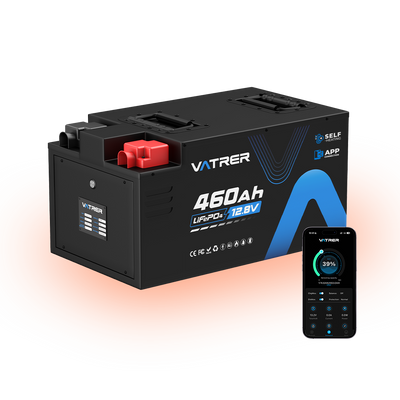
A self-heating LiFePO4 battery uses incoming power to warm the battery before normal charging starts. Low-temperature protection stops unsafe charging; self-heating raises battery temperature so charging can resume. The exact heating logic varies by battery, so check the trigger temperature, stop temperature, required input current, heater power, and charging recovery behavior.
If freezing nights are a regular part of RV travel, move to a battery that handles the warm-up process inside the battery system. Vatrer 12V 300Ah self-heating LiFePO4 battery provides 3.84kWh, supports 200A continuous output, and includes Bluetooth monitoring plus low-temperature protection, which gives you direct visibility into battery status while reducing manual cold-weather charging steps.
External Heating and Insulation
An insulated enclosure slows heat loss but does not create heat. Pairing insulation with a thermostat-controlled heater pad or heated battery compartment can keep a standard LiFePO4 battery above its charging cutoff during repeated cold periods. The heater circuit still needs suitable wiring, fuse protection, and temperature control so it stops heating after the battery reaches the target range.
Temperature-Aware Charging Control
Solar charge controllers, DC-DC chargers, converters, and AC chargers can all have power available before a cold battery is ready to accept it. Automatic systems work best when the charging source responds to battery temperature through the BMS, a temperature sensor, or heating logic. This matters during unattended charging, since power can become available while you are asleep, away from the vehicle, or waiting for sunrise.
How Should Different Application LiFePO4 Cold-Weather Charging Be Managed?
The same charging limit creates different system problems depending on how power reaches the battery. RV charging may start minutes after the engine starts, solar charging can begin shortly after sunrise, and a golf cart charger may stay connected all night in an unheated garage. The charging controls need to match those operating patterns.

RV and Van Systems
RV batteries may receive charge from shore power, a converter, solar panels, alternator charging, or a DC-DC charger. A battery inside a heated living space can stay much warmer than one mounted in an exterior compartment, even on the same trip. Regular winter camping benefits from self-heating, compartment heating, or a charging setup that blocks current until battery temperature is back inside the approved range.
Off-Grid and Solar Systems
Cold mornings create a timing mismatch in solar systems. Panels may begin producing usable power soon after sunrise while a battery in a shed, garage, or outdoor enclosure is still below freezing. A heated battery or controlled enclosure can shorten that no-charge period, but the heater uses stored or incoming energy, so winter system sizing should include the energy needed to warm the battery.
Marine and Golf Cart Systems
Boat batteries can remain cold for long periods because compartments near the hull track outside temperatures closely. Golf cart batteries stored in unheated garages face a similar issue when chargers remain connected overnight. Automatic low-temperature cutoff is especially useful in both cases because charging can begin without anyone checking battery temperature first.
What Should You Check Before Charging a LiFePO4 Battery Below Freezing?
A reliable pre-charge check answers three questions: what temperature the battery has actually reached, what charging range applies to that battery, and what the BMS will do if the battery is too cold. This quick review is especially useful in automatic charging systems where a charger can turn on without direct supervision.
Use this cold-weather charging checklist:
- Check the minimum charging temperature for your battery model.
- Read actual battery temperature rather than ambient temperature alone.
- Confirm that the BMS includes low-temperature charge cutoff.
- Review App or display alarms if the battery provides monitoring.
- Verify how self-heating is activated if the battery has that feature.
- Check whether reduced charging current is allowed at low temperature.
- Give a cold-soaked battery enough time to warm internally.
- Include heater energy use in winter solar planning.
- Keep the BMS temperature protection active during charging.
- Use automatic thermal management if the battery regularly operates below freezing.
A battery that repeatedly reaches freezing temperatures needs a system-level cold-weather plan rather than a one-time workaround.
Most Common LiFePO4 Charging Temperature Questions
Cold-weather battery systems often raise practical questions that do not show up until the first freezing week of the season. These situations usually involve warm-up behavior, heaters, insulation, and charging time rather than the basic 32°F charging limit.
Can I Charge Right After Bringing a Frozen Battery Indoors?
Wait until the battery itself has warmed into its allowed charging range. The case and surrounding air can warm faster than the battery’s internal components, especially with a large-capacity battery. Moving a very cold battery into warm, humid air can also create condensation around terminals and connections, so let any moisture clear before charging.
Does Insulation Alone Keep a LiFePO4 Battery Warm Enough to Charge?
Insulation slows heat loss but cannot replace heat that has already escaped. It works well for extending the time a battery stays warm after use or heating, but a battery left in prolonged subfreezing conditions will eventually approach the surrounding temperature. Fixed winter systems often pair insulation with a thermostatically controlled heat source.
Can a Battery Heater Run Before the Battery Starts Charging?
A built-in self-heating battery may use incoming charger power for heating before the BMS allows normal charging current into the battery. An external heater works differently and usually has its own power path and temperature control. The wiring plan needs to keep the heater available even while the BMS is blocking battery charging.
Does Cold Weather Make Charging Take Longer?
It can. A self-heating battery may spend part of the available charging period warming itself before normal charging begins, while other systems may limit charging current near the low end of the allowed temperature range. The total delay depends on battery size, starting temperature, heater output, and the power available from the charging source.
Can a Self-Heating Battery Drain Itself While Parked?
Many self-heating batteries activate heating only when charging power is available and the internal temperature meets the heater trigger condition. Heating logic varies between models, so confirm whether the heater uses external charging power, battery energy, or a combination of both before leaving the system parked for long periods in cold weather.
Conclusion
A good winter setup removes daily temperature checks from normal operation. Place the battery where its temperature can be monitored, keep low-temperature cutoff active, and use controlled heating if the installation regularly falls below freezing. This keeps solar, shore power, or vehicle charging from becoming a manual routine every cold morning.
Long winter trips and extended off-grid stays also put more pressure on usable capacity. For an RV system that needs both cold-weather charging support and longer runtime, use a larger self-heating battery rather than adding several smaller batteries and more parallel connections. Vatrer 12V 600Ah self-heating LiFePO4 battery stores 7.68kWh, supports 300A continuous output, and combines self-heating, low-temperature protection, and Bluetooth monitoring in one battery. Choose that setup when you want more energy for multi-day RV use while keeping winter charging and battery status easier to manage.