RV Batteries in Series vs Parallel: Which Setup Is Better?
Author:
LarsonEmma
Published: Aug 28, 2026
Updated: Aug 28, 2026
Reading time: 12 minutes
Table of Contents

Larson Emma
Emma Larson has more than 15 years of experience in the energy storage battery industry. At Vatrer, she researches and writes about lithium batteries and energy storage, translating technical information into clear, practical guidance that helps more people make better battery decisions.
Share
The better way to wire an RV battery bank depends on three things: the voltage your RV uses, how much stored energy you need, and how much power your inverter and DC loads can draw. Parallel wiring keeps the battery bank at the same voltage and adds capacity. Series wiring raises battery bank voltage. That difference affects the inverter, charger, solar controller, DC-DC charger, cable size, circuit protection, and 12V equipment throughout the RV.
A typical existing 12V RV usually benefits more from parallel expansion. A new 24V or 48V build can make series wiring or a single battery at the required higher voltage a better fit when high inverter power drives DC current upward.
Which RV Battery Setup Is Better: Series or Parallel?
Parallel is usually the better setup if your RV already has a 12V house electrical system and you want longer runtime. Series fits a different goal: reaching a higher battery bank voltage, such as 24V or 48V, or connecting two 6V deep-cycle batteries to supply a 12V system. Series-parallel wiring has a place when both voltage and capacity need to increase.
RV Battery Setup Quick Comparison
| RV Goal | Better Fit | Electrical Result |
|---|---|---|
| Keep an existing 12V system | Parallel | Voltage stays the same |
| Add more battery capacity and runtime | Parallel | Ah and Wh increase |
| Connect two 6V batteries to a 12V RV | Series | Voltage adds to 12V |
| Build a 24V or 48V system | Series or a battery at that nominal voltage | Battery bank voltage increases |
| Reduce DC current for a large inverter | Higher-voltage system | Current falls as voltage rises |
| Increase voltage and capacity together | Series-parallel | Voltage and Ah both increase |
For most existing 12V RVs, parallel is the more practical capacity upgrade. Series becomes more attractive when higher system voltage is part of the electrical design from the beginning.


How Do Series vs Parallel Batteries Change an RV Battery Bank?
Series and parallel connections use the same batteries in very different ways. Series adds voltage while keeping Ah capacity unchanged. Parallel keeps voltage unchanged while adding Ah capacity. Both arrangements increase total stored energy when another battery is added, so comparing battery banks only by Ah can give the wrong impression.
Series Raises Battery Bank Voltage
A series connection links the positive terminal of one battery to the negative terminal of another. With two common 12.8V LiFePO4 batteries, voltage doubles while Ah stays at the rating of one battery.
Vbattery bank = V1 + V2
12.8V + 12.8V= 25.6V
Capacity = 100Ah
Energy = 25.6V × 100Ah = 2.56kWh
Two 12.8V 100Ah batteries in series therefore create a 25.6V 100Ah battery bank with 2.56kWh of nominal energy. In another familiar RV arrangement, two 6V deep-cycle batteries can be wired in series to supply a 12V house electrical system.
Parallel Adds Battery Capacity
A parallel connection joins positive terminals together and negative terminals together. Voltage stays at the rating of one battery, while Ah capacity adds. This is why parallel wiring works well for an RV that already operates at 12V but needs more stored energy.
Vbattery bank = 12.8V
Capacity = 100Ah + 100Ah = 200Ah
Energy = 12.8V × 200Ah = 2.56kWh
Two 12.8V 100Ah batteries in parallel produce a 12.8V 200Ah battery bank. Actual runtime still changes with load profile, inverter efficiency, temperature, battery state of charge, and charging conditions.
Series-Parallel Raises Voltage and Capacity
A series-parallel battery bank combines both connection methods. Four identical 12.8V 100Ah batteries can form two series strings, then those strings can be connected in parallel. The result is a 25.6V 200Ah battery bank, so both voltage and Ah rise.
2S2P = 25.6V, 200Ah
Energy = 25.6V × 200Ah = 5.12kWh
This configuration can support a larger 24V RV battery bank, but it also creates more interconnects and parallel current paths. Cable resistance, branch protection, battery matching, and BMS connection limits all matter more as the number of batteries grows.
Compare Battery Banks by Wh
Amp-hours describe charge capacity at a stated voltage. Watt-hours are more useful when comparing battery banks with different nominal voltages because Wh reflects the total stored energy.
Wh = V × Ah
Equal-Energy Battery Bank Comparison
| Battery Configuration | Nominal Voltage | Capacity | Nominal Energy |
|---|---|---|---|
| Two 12.8V 100Ah batteries in parallel | 12.8V | 200Ah | 2.56kWh |
| Two 12.8V 100Ah batteries in series | 25.6V | 100Ah | 2.56kWh |
The two battery banks store the same nominal energy. Their main difference is the voltage used to deliver that energy, which changes the current and the equipment required around the battery bank.
Why Is Parallel Better for Most 12V RV Battery Banks?
An established 12V RV already has an electrical system built around that voltage. Parallel wiring increases battery capacity without changing the voltage supplied to the RV, so it usually requires fewer system-wide changes. That makes it well suited to boondocking upgrades, solar-equipped RVs, and lithium battery conversions where the main goal is more usable energy.
12V Equipment Stays on 12V
A house battery bank may supply lighting, water pumps, vent fans, furnace controls, refrigerator electronics, USB outlets, monitoring devices, and other 12V DC equipment. Parallel expansion keeps the battery bank at the same nominal voltage, allowing those circuits to remain on the voltage they were built to use.
The rest of the 12V electrical system still needs to match the battery chemistry and current requirements. A lithium battery conversion may call for changes to the converter/charger, solar charge controller, alternator charging path, or DC-DC charger even if the nominal system voltage remains 12V.
Capacity Grows Without a Voltage Change
Parallel wiring directly addresses an RV that runs out of battery energy too early. More Ah at the same voltage means more Wh for refrigeration, fans, pumps, electronics, and inverter loads. A larger single battery can also provide the needed capacity while reducing the number of parallel branches, cables, terminals, and protection points.
If you are adding energy to an existing 12V RV and want to compare multiple smaller batteries with one larger battery, capacity, continuous discharge current, battery compartment dimensions, weight, and charging time should all be evaluated together.

Scale Your 12V RV Power
Compare 12V LiFePO4 battery options for your next RV power upgrade. You can choose models that support 4S4P expansion, Bluetooth monitoring, and self-heating for cold-weather travel.
High Current Remains the Main Limitation
Keeping a high-power system at 12V means high DC current. As inverter demand rises, conductor ampacity, fuse rating, busbar rating, terminal resistance, and voltage drop become more demanding. A common design target for high-current DC runs is roughly 2–3% voltage drop, while cable ampacity still has to support the full continuous current of the circuit.
This is where a 24V or 48V system can start to make more sense. The stored energy may be similar, but the current required to move that energy at high power can be much lower.
When Is Series Better for a High-Power RV Battery Setup?
Series wiring is most useful when the RV electrical system is intentionally moving to a higher voltage. A 24V or 48V battery bank can supply a large inverter with much less DC current than a 12V battery bank. That can reduce voltage drop and lower the current rating required from cables, busbars, switches, and other high-power DC components.
Higher Voltage Cuts DC Current
Many quality pure sine wave inverters operate around 85–95% efficiency under useful load conditions. Using 90% efficiency as a calculation example shows how quickly battery-side current drops as nominal battery voltage rises.
IDC = PAC ÷ (VDC × η)
For a 2,000W AC load:
Approximate Battery Current at a 2,000W Load
| LiFePO4 Battery System | Calculation | Approx. DC Current |
|---|---|---|
| 12.8V | 2000/(12.8×0.90) | 174A |
| 25.6V | 2000/(25.6×0.90) | 87A |
| 51.2V | 2000/(51.2×0.90) | 43A |
Actual current moves with battery voltage, inverter efficiency, wiring loss, and load behavior. The relationship is still clear: doubling voltage cuts current to about half at the same power.
24V and 48V Fit Larger Electrical Builds
A higher-voltage battery system becomes more attractive with large inverter loads, long battery-to-inverter cable runs, or a full electrical rebuild. Air conditioners, induction cooktops, microwaves, and other AC appliances can push a 12V battery bank into very high current territory, particularly when several loads operate together.
A new 24V build can also use a battery already made for that nominal voltage instead of creating every 24V battery bank from pairs of 12V batteries. If that matches your RV design, consider Vatrer 24V 200Ah and 24V 300Ah lithium batteries, which provide 5.12–7.68kWh of nominal energy and use 200A BMS ratings. Bluetooth monitoring and low-temperature protection are available across the listed range, with self-heating on selected models.
Higher Voltage Requires Matching Equipment
Changing battery bank voltage changes the requirements of the equipment connected to it. A 24V battery bank needs a compatible inverter and charging system, while any remaining 12V loads need a properly sized DC-DC converter. Circuit protection also needs both the correct current rating and a DC voltage rating above the maximum circuit voltage.
Check these components as one system:
- Inverter: DC input range, continuous output, surge output, and low-voltage cutoff.
- Charging equipment: converter/charger, solar charge controller, and alternator or DC-DC charging voltage.
- DC distribution: fuses, breakers, disconnects, busbars, battery monitors, and conductor ratings.
- 12V loads: total DC-DC converter output required for pumps, lighting, controls, fans, and other 12V circuits.
A higher-voltage battery system earns its keep when the lower DC current provides enough benefit to justify these hardware changes.
What Should You Check in an RV Lithium Battery Setup?
An RV lithium battery setup needs one check that older lead-acid battery banks often did not have: each battery's BMS has defined connection and current limits. A LiFePO4 battery may support series, parallel, both, or only a specified number of each. The battery specification has to match the wiring plan before multiple batteries are connected.
BMS Connection Limits
The BMS controls overvoltage, undervoltage, overcurrent, short-circuit, and temperature protection. Its design also affects how the battery can be combined with other batteries, so the maximum series and parallel configuration should come from the exact battery model rather than a general LiFePO4 rule.
Confirm these ratings before installation:
- Maximum number of batteries allowed in series
- Maximum number of batteries allowed in parallel
- Permitted series-parallel arrangement
- Continuous and peak discharge current
- Maximum charging current
- Connection or state-of-charge requirements specified by the manufacturer
A BMS opening in one battery can affect the behavior of the entire battery bank, especially in a series string where current passes through every battery.
Matched Batteries and SOC
Batteries sharing one battery bank should have the same chemistry, nominal voltage, capacity, and preferably the same model. Similar age and usage history also reduce the chance that one battery reaches a charge or discharge limit well before the others.
State of charge deserves particular attention before parallel connection. Batteries connected in parallel immediately move current toward voltage equalization. A substantial voltage difference can create a large equalization current because interconnect resistance is low. Bring the batteries to closely matched voltage and state of charge using the battery manufacturer's procedure before connecting them.
Charging Compatibility
Changing battery chemistry, capacity, or voltage can change charging requirements. A common 12.8V LiFePO4 battery typically uses a charging range around 14.2–14.6V, while a 25.6V LiFePO4 battery commonly uses about 28.4–29.2V. The exact battery specification remains the controlling value.
Review all charging paths together:
- Shore-power converter/charger
- Solar charge controller
- Alternator or DC-DC charger
- Generator-fed charger, if used
- Battery maximum charging current
A larger parallel battery bank stores more energy, but a charger with the same current rating still replaces energy at the same rate. More battery capacity can therefore mean a longer recharge period unless charging capability also increases.
How Should RV Battery Wiring Be Balanced and Protected?
Parallel RV battery wiring needs careful current sharing because every cable, lug, terminal, and busbar adds resistance. Small resistance differences can make one battery carry more current than another. LiFePO4 battery banks can also deliver high fault current, so overcurrent protection needs to match both the conductors and the available battery current.
Balanced Parallel Connections
A parallel battery bank works best when the resistance from each battery to the main load and charging points is as similar as practical. Pulling both the main positive and main negative connections from the same battery can give that battery a lower-resistance path than batteries farther down the chain.
With two parallel batteries, taking the main positive connection from one battery and the main negative connection from the other can improve current sharing. Larger battery banks often use dedicated positive and negative busbars so each battery has its own branch.
Busbars and Equal-Length Cables
Busbars give each battery branch a common connection point and make current paths easier to control. Parallel branch cables should use the same conductor size and similar lengths, with properly crimped lugs and terminal hardware tightened to the specified torque.
Good parallel battery wiring includes:
- Similar cable lengths for each battery branch
- The same cable gauge across equivalent branches
- Busbars rated above expected continuous current
- Short high-current cable runs where the layout permits
- Clean, low-resistance terminal connections
Cable size must satisfy both ampacity and voltage-drop requirements. One calculation cannot substitute for the other.
Fuses and Disconnects
The main battery fuse protects the primary cable leaving the battery bank. In larger parallel battery banks, individual battery branches may also need overcurrent protection so one battery cannot feed a fault through another branch without a suitable protective device in that path.
A complete protection layout can include a main fuse, branch fuses, a DC-rated battery disconnect, correctly rated busbars, and circuit-specific breakers. The voltage rating, current rating, interrupt rating, and location of each protective device need to match the circuit and the applicable RV standards and local electrical requirements.
What Is the Best RV Battery Bank Setup for Your Build?
Your daily energy demand and maximum power draw should drive the decision, not the number of batteries you happen to have room for. Keep a 12V battery bank and use parallel expansion when the RV already has a suitable 12V electrical system and you mainly need more runtime. Move toward 24V or 48V when high inverter power makes 12V current difficult to manage and you are prepared to match the inverter, charging equipment, protection, and 12V conversion around the higher voltage.
Series-parallel wiring is useful when voltage and capacity both need to rise, but it also adds more wiring and more interaction between batteries. A battery at the required nominal voltage or a higher-capacity single battery can sometimes produce a cleaner RV electrical system with fewer connections.
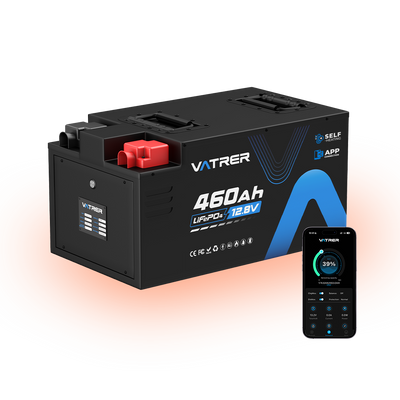
If your current 12V battery bank needs substantially more energy and you would rather reduce the number of parallel branches, consider a larger-capacity RV battery before adding several smaller batteries. Vatrer 12V RV lithium battery includes 300–600Ah options with 3.84–7.68kWh of nominal energy; selected RV models support up to 300A continuous discharge, with Bluetooth monitoring and self-heating options for high-load and cold-weather use. Matching one of those options to your actual inverter current, battery compartment, and charging system can keep a 12V RV architecture while cutting down on interconnects.
Share