Battery Charger vs Inverter vs Converter: RV Power Guide
Reading time: 13 minutes

Share
A battery charger puts energy back into your battery. An inverter turns battery DC power into 120V AC power so you can run regular plug-in appliances. A converter usually turns 120V AC shore power into 12V DC power for your RV lights, fans, water pump, control boards, and sometimes battery charging.
The difference comes down to direction. A battery charger and RV converter usually move power AC to DC. An inverter moves power DC to AC. In an RV, that one difference decides whether you are charging a battery, running built-in 12V equipment, or powering a microwave while camping without shore power.


Battery Charger vs Inverter vs Converter: Quick Comparison
Main Differences Between a Battery Charger, Inverter, Converter, and Inverter Charger
| Device | Power Flow | Main Job | Common RV Use | Typical Range |
|---|---|---|---|---|
| Battery charger | 120V AC → 12V/24V/48V DC | Charges and maintains a battery | Charging an RV, marine, golf cart, or backup battery | 5A–100A charging output |
| Converter | 120V AC → usually 12V DC | Powers RV DC loads and may charge the battery | Running lights, fans, water pump, USB outlets, and control boards while plugged in | 30A–100A DC output |
| Inverter | 12V/24V/48V DC → 120V AC | Runs AC appliances from battery power | Powering TV, laptop charger, coffee maker, microwave, or selected RV outlets off-grid | 300W–3000W+ AC output |
| Inverter charger | 120V AC ↔ 12V/24V/48V DC | Charges batteries and creates AC power from batteries | Larger RV, van, marine, and off-grid systems | 1000W–5000W inverter, 20A–150A charging |
If you choose a battery charger when your main goal is charging, a converter when your RV needs 12V power while plugged in, and an inverter when you want battery power to run 120V AC appliances. An inverter charger combines charging and AC output in one unit.
AC vs DC Power: Why RV Owners Mix These Up
RV electrical systems use both AC and DC power, often at the same time.
- AC power: This is the 120V power you get from household-style outlets. It runs appliances like a microwave, TV, coffee maker, laptop charger, toaster, or small power tool. In an RV, AC power usually comes from shore power, a generator, or an inverter.
- DC power: This is battery-based power, usually 12V in most RVs. Larger RV, marine, and off-grid systems may use 24V or 48V. DC power runs interior lights, vent fans, water pumps, USB outlets, furnace control boards, slide motors, power awnings, and other built-in equipment.
A converter and a battery charger both turn AC into DC, but they do not always do the same job. A converter is usually tied into the RV’s 12V electrical system. A battery charger is focused on charging the battery.
Think of the battery as your water tank. A charger fills the tank. A converter feeds the RV’s low-voltage plumbing when you are plugged in. An inverter lets that tank run appliances that normally expect household power.


What Is a Battery Charger?
A battery charger converts AC power into controlled DC power so a battery can recharge. In an RV setup, the AC input may come from a wall outlet, generator, or shore power source.
A charger is not there to run your microwave or RV outlets from the battery. Its job is to put energy back into the battery at the right voltage and current.
How a Battery Charger Works
A battery charger takes 120V AC input and outputs DC charging power matched to the battery system. A 12V LiFePO4 battery commonly charges around 14.2V–14.6V, depending on the battery manufacturer’s specs. A 24V or 48V battery bank needs a higher charging voltage.
A good charger controls both voltage and current. It does not just push power until you unplug it. For lead-acid batteries, many smart chargers use stages such as bulk, absorption, and float. For LiFePO4 batteries, the charger should use a lithium-compatible profile that matches the battery’s BMS and voltage limits.
When You Need a Battery Charger
Choose a battery charger when charging is the main task.
- Standalone charging: A charger works well for an RV battery, marine battery, golf cart battery, backup battery, or a battery that is not tied into a full RV electrical system.
- Storage charging: If your RV sits for weeks or months, a charger can help bring the battery back up before use. For many lithium batteries, long-term storage is usually best around 40%–60% state of charge, not fully charged for months at a time.
- Simple setups: If your system does not have a converter charger or inverter charger, a standalone charger is often the most direct option.
- Battery-specific charging: You can choose charging amps based on battery capacity. For a 12V lithium battery setup, a 20A–40A charger is common for moderate battery banks, while larger banks may use 60A–100A charging.
If you are upgrading to a LiFePO4 battery, check the charger before you keep using it. A charger made only for flooded lead-acid batteries may charge too slowly, stop too early, or fail to reach the recommended lithium charging voltage.
What Is an Inverter?
An inverter converts DC battery power into 120V AC power. That lets your RV battery run devices that normally plug into a wall outlet.
A regular inverter does not charge the battery. It only pulls energy from the battery and turns it into AC output. If you want one device that can both charge the battery and create AC power from the battery, you need an inverter charger.
How an Inverter Converts DC to AC
Most RV inverters take 12V, 24V, or 48V DC from the battery bank and output 120V AC. That AC output may power one outlet, a few dedicated outlets, or selected RV circuits if the inverter is wired into the system correctly.
Inverter size affects how much load you can run.
- Small inverter, 300W–700W: Good for laptop chargers, small TVs, routers, camera chargers, and low-draw electronics.
- Mid-size inverter, 1000W–2000W: Often used for coffee makers, microwaves, small kitchen appliances, and several smaller loads at once.
- Large inverter, 3000W and above: Used for heavier RV loads, but it needs a large battery bank, high-current wiring, proper fusing, and enough ventilation.
What an Inverter Can Power
An inverter helps when you want AC power without shore power.
- Electronics: A laptop charger may draw 45W–100W. A small TV often uses 50W–150W. These are easy loads for most inverters.
- Kitchen appliances: Coffee makers, microwaves, blenders, and induction cooktops often draw 700W–1800W while running. Some also have surge loads.
- RV outlets: Your outlets will not automatically run from the battery just because you have a converter. They need inverter output, and the wiring must be set up for that.
- High-demand loads: Air conditioners and electric heaters are much harder on the system. A rooftop RV air conditioner may need a 3000W+ inverter, a large LiFePO4 battery bank, and careful installation.
Basic Inverter Sizing
Add up the running watts of the AC appliances you want to use at the same time. Then add about 25% extra capacity so the inverter is not running at its limit.
Inverter Sizing Examples for RV Use
| Appliances Running Together | Estimated Running Watts | With 25% Margin | Practical Inverter Size |
|---|---|---|---|
| Laptop + TV + phone chargers | 250W | 313W | 500W inverter |
| Coffee maker + laptop + small electronics | 850W | 1063W | 1200W–1500W inverter |
| Microwave + TV + small appliance | 1550W | 1938W | 2000W inverter |
| RV air conditioner + small loads | 2500W+ | 3125W+ | 3000W+ inverter |
A larger inverter lets you run bigger loads, but it does not add battery capacity. A 12V 100Ah lithium battery stores about 1280Wh of energy before losses. After typical inverter losses of about 5%–15%, a 1000W appliance can drain that battery quickly.
That is why inverter size and battery capacity need to match. A 2000W inverter on a small battery may work for a short burst, but it will not create long off-grid runtime.
What Is a Converter in an RV Power System?
An RV converter usually turns 120V AC shore power into 12V DC power. When you plug into campground power, home power, or a generator, the converter supplies DC power to the RV’s 12V system.
Many converters also charge the RV house battery. That is why you may see the term converter charger. Still, a converter is not just a loose battery charger. It is often part of the RV power distribution system.
How an RV Converter Works
When the RV is plugged into shore power, the converter receives 120V AC. It steps that down and changes it into DC output, often around 13.2V–14.6V in a 12V RV system, depending on converter design and charging mode.
That DC output supports many built-in loads.
- Interior lights: Most RV lights run on 12V DC, so they can work from the battery or converter.
- Vent fans and water pump: These are common DC loads and usually keep working even when AC outlets are not active.
- Control boards: Furnaces, refrigerators, water heaters, and other appliances may use 12V control circuits even when they also use propane or 120V AC.
- Slide motors and awnings: These can pull higher DC current for short periods. A stable 12V system helps them operate without voltage sag.
Converter vs Battery Charger
A converter and a battery charger overlap because both may convert AC power into DC power. Their priorities are different.
Converter vs Battery Charger
| Comparison Point | Battery Charger | RV Converter |
|---|---|---|
| Main purpose | Charge or maintain a battery | Power the RV 12V system while plugged in |
| Battery charging | Primary function | Often included, but depends on the model |
| Common system voltage | 12V, 24V, or 48V battery systems | Usually 12V RV systems |
| Typical output range | 5A–100A charging output | 30A–100A DC output |
| Best fit | Standalone charging or battery maintenance | Shore power support for RV DC loads |
A battery charger serves the battery first. A converter serves the RV’s 12V system first, and battery charging may be one of its jobs.
What Is an Inverter Charger?
An inverter charger combines battery charging and inverter output in one device. It can charge the battery when AC input is available, then use that battery to create 120V AC power when you are off-grid.
This type of device is common in full-time RVs, van builds, bus conversions, boats, and larger off-grid lithium battery systems.
How an Inverter Charger Works
An inverter charger can work in two directions.
- Plugged into shore power: It can pass 120V AC through to selected RV AC circuits and use part of that input to charge the battery. Many units include an automatic transfer switch.
- Camping off-grid: It draws DC power from the battery bank and creates 120V AC power for selected outlets or appliances.
- Charging from a generator: It can use generator AC output to recharge the battery bank, as long as the generator and charger settings are compatible.
The appeal is fewer separate devices. Instead of having one unit for charging, another for AC output, and a separate transfer setup, an inverter charger can combine those functions in one system.
Inverter Charger vs Converter Charger
These names sound close, but they solve different problems.
Inverter Charger vs Converter Charger
| Feature | Converter Charger | Inverter Charger |
|---|---|---|
| AC to DC charging | Yes, if designed for charging | Yes |
| DC to AC output | No | Yes |
| Runs RV 12V DC loads | Yes | Not usually its main role |
| Runs 120V AC appliances from battery | No | Yes |
| Automatic transfer switch | Usually no | Often yes |
| Best use case | RV 12V support while plugged in | Off-grid AC power plus battery charging |
If you mostly stay at campgrounds with shore power, a converter charger may be enough. If you boondock often and want to use AC appliances, an inverter charger may fit better.
Battery Charger, Inverter or Converter: Which One Do You Need?
Start with what you want the system to do. The device name matters less than the job.
If You Only Need to Charge a Battery
Choose a battery charger.
- Battery maintenance: Good for seasonal RV use, storage charging, marine batteries, golf cart batteries, and backup batteries.
- Separate battery charging: Works well when the battery is not part of a built-in RV charging system.
- Controlled charging: You can match charger voltage and amps to the battery. That is useful when switching from lead-acid to LiFePO4.
If You Need 12V Power While Plugged In
Choose an RV converter or converter charger.
- Campground use: Your lights, fans, water pump, and control boards can run while the RV is plugged into shore power.
- Factory RV systems: Many modern RVs already include a converter charger near the distribution panel.
- Battery support: If the converter has a charging function, it can help keep the house battery charged while plugged in.
If You Need AC Power Off-Grid
Choose an inverter.
- Boondocking: You can run selected 120V AC appliances without shore power.
- Targeted loads: A smaller inverter can handle a laptop, TV, or coffee maker without powering the entire RV.
- Battery matching: Check the battery’s continuous discharge rating before using a large inverter. A 2000W load on a 12V system can draw roughly 167A before efficiency losses.
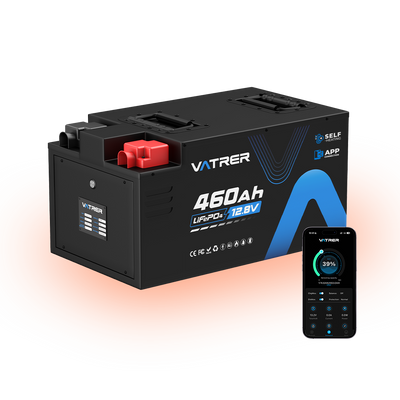
The Vatrer batteries are designed for RV and off-grid use, but inverter size still needs to match the battery bank’s BMS current limits and total capacity.
If You Want Charging and AC Output in One Unit
Choose an inverter charger.
- Full-time RV use: It makes sense when you switch between shore power, generator power, and battery power often.
- Van or bus builds: A combined unit can keep the system cleaner when you are building from scratch.
- Larger lithium battery banks: Higher-capacity LiFePO4 systems often pair well with an inverter charger because charging, inverting, and transfer switching are handled together.
Lithium Battery Compatibility and Common Mistakes
A lithium battery upgrade can reveal weak points in the rest of the RV electrical system. The battery may be ready for deeper cycling and faster charging, but the charger, converter, inverter, wiring, and fusing still need to match.
Check the Charging Profile
LiFePO4 batteries usually need a different charging profile than flooded lead-acid batteries. A lead-acid-only charger or old RV converter may stop too early, charge slowly, or fail to bring the lithium battery to full capacity.
For a 12V LiFePO4 battery, many charging systems target about 14.2V–14.6V during charging. Always follow the battery manufacturer’s listed charging voltage and maximum charge current.
Avoid These Common Mix-Ups
- Thinking an inverter charges the battery: A regular inverter only turns DC battery power into 120V AC power. It drains the battery while running AC loads.
- Thinking a converter runs AC appliances from the battery: A converter usually works in the other direction. It takes AC input and creates DC output.
- Assuming RV outlets work off-grid: Many RV outlets only work when plugged into shore power unless an inverter is installed and wired to power them.
- Choosing by watts alone: Inverter wattage is only one part of the system. Battery voltage, battery capacity, surge watts, charger amps, wire size, fuse protection, and ventilation all affect whether the setup works safely.
- Keeping an old converter without checking specs: Some older RV converters were built for lead-acid batteries. They may not charge LiFePO4 batteries properly.
Keep Installation Safety in Mind
RV upgrades can involve both high-current DC wiring and 120V AC wiring. A 2000W inverter on a 12V system can pull about 167A before efficiency losses, so cable size and fuse protection are not optional details.
Use the correct wire gauge, fuses, grounding, ventilation, and mounting location. If the project touches the RV breaker panel, transfer switch, shore power wiring, or a large battery bank, have a qualified RV technician or electrician review the setup.
Conclusion
The right device depends on what you want your RV power system to do. Use a battery charger when the job is battery charging. Use a converter charger when you need 12V RV power while plugged into shore power. Use an inverter when you want 120V AC power from your battery. Use an inverter charger when you want charging, off-grid AC output, and transfer switching in one integrated setup.
Before buying anything, check the whole chain: battery chemistry, system voltage, inverter wattage, charger output, wire size, fuse protection, and the battery’s BMS limits. That is what keeps the system practical, not just powerful.
Share