Do Batteries Work Better in Cold or Warm Temperatures?
Reading time: 13 minutes

Share
Ever notice how your car struggles to start on a freezing morning, or how your RV battery seems to run out of power faster during winter camping? Temperature plays a big role in how batteries perform. Cold weather can reduce available power, while extreme heat can shorten battery life.
Batteries generally work better in moderately warm temperatures than in extreme cold. Around 68–77°F is a favorable environment for many common battery types. Cold temperatures slow internal chemical reactions and reduce available capacity. High temperatures may improve short-term power delivery, but prolonged heat exposure accelerates battery aging.
The ideal battery temperature also depends on the battery chemistry and how you're using it. Charging, discharging, and storage each have different temperature requirements.
Do Batteries Perform Better in Cold or Warm Weather?
Most batteries deliver better short-term performance in mild temperatures than in freezing conditions. At moderate temperatures, the chemical reactions that generate electrical power occur more easily, allowing the battery to maintain voltage and deliver energy efficiently.
Cold weather increases internal resistance, making it harder for a battery to deliver power under load. You might notice slower engine cranking, shorter equipment runtime, or reduced capacity from an RV battery bank.
Heat presents a different problem. A battery may deliver strong power at 90°F, but continued exposure to elevated temperatures accelerates chemical degradation. Over time, this reduces the energy the battery can store.
Battery Performance in Cold, Warm, and Hot Temperatures
| Performance Factor | Cold (Below 32°F) | Moderate (68–77°F) | Hot (Above 95°F) |
|---|---|---|---|
| Available capacity | Often reduced | Typically near rated capacity | May remain high initially |
| Power output | Reduced, especially under heavy loads | Generally favorable | Can be strong until thermal limits apply |
| Internal resistance | Increases | Generally lower | Often lower initially |
| Battery lifespan | Depends on charging and freezing conditions | Generally favorable | Faster aging with prolonged exposure |
| Charging | May require restrictions | Generally favorable | May require reduced current or cooling |
These temperature categories illustrate general performance patterns rather than universal operating limits. Actual results depend on battery chemistry, electrical load, and operating conditions.
How Temperature Affects Battery Performance
Battery temperature affects how easily ions move through the electrolyte and how efficiently chemical reactions occur at the electrodes. Those changes influence internal resistance, voltage, usable capacity, and the amount of power available to your equipment.
The effects become especially noticeable during heavy electrical loads, such as starting an engine or running a large inverter.
Battery Performance in Cold Weather
Cold temperatures slow the electrochemical reactions inside a battery. As internal resistance rises, the battery experiences a greater voltage drop when supplying current. This can limit how much power reaches connected equipment.
Consider a winter camping trip. Your RV battery may be fully charged when you arrive, but freezing temperatures can reduce the energy available to run lights, fans, and other appliances. A large inverter load can make the problem more noticeable because it draws substantial current.
Similar effects occur with electric tools and electronic devices. A cordless drill may feel weaker in cold weather, while a phone may shut down even though its battery indicator previously showed some charge remaining.
Battery University explains that lithium-ion battery discharge capacity can fall significantly at low temperatures. Its discharge-temperature comparisons show how lower temperatures can reduce usable capacity under load, even when the battery retains stored energy.
This helps answer a common question: does cold weather drain batteries faster? Cold weather often makes batteries appear to drain faster because less of their stored energy is immediately accessible. The battery may reach its minimum operating voltage before delivering the same amount of energy it would at room temperature.
Once the battery warms up, much of that temporarily unavailable capacity can return, provided the battery has not suffered permanent damage.
Battery Performance in Hot Weather
Warm temperatures generally improve ion movement and reduce internal resistance, allowing many batteries to supply current more easily. This helps explain why some batteries deliver better immediate performance in warm weather than on freezing mornings.
At 95°F, a battery may still operate normally, depending on its specifications. Sustained exposure to temperatures around 104°F or higher can accelerate aging, particularly in lithium-ion and lead-acid batteries.
Excessive heat can also trigger protective controls. Batteries equipped with temperature monitoring may reduce charging or discharging current, while some battery management systems disconnect the battery when its temperature exceeds the permitted range.
In a solar battery installation, for example, an enclosed compartment exposed to direct summer sunlight can become much hotter than the surrounding air. The battery may initially operate normally, even though the elevated temperature increases wear over time.
Does Cold or Heat Damage Batteries More?
Prolonged heat generally causes more long-term battery aging, while cold temperatures more often cause temporary performance loss. Heat accelerates unwanted chemical reactions inside the battery, gradually degrading electrodes, electrolytes, and other internal components. This damage accumulates and cannot be reversed simply by cooling the battery.
Battery University describes a common lead-acid battery aging guideline: service life may be reduced by roughly half for each sustained 15°F increase above a reference temperature near 77°F. This is an approximation for lead-acid aging, not a universal rule for lithium batteries.
Cold weather presents different risks. Although ordinary low-temperature performance loss is often reversible, certain conditions can cause permanent damage.
- Lithium plating: Charging conventional lithium-ion batteries below 32°F can cause metallic lithium to deposit on the anode, potentially reducing capacity and creating safety risks.
- Electrolyte freezing: Discharged lead-acid batteries have more water-like electrolyte, making them vulnerable to freezing. Frozen electrolyte can damage battery plates or crack the case.
- Excessive discharge under heavy loads: Severe cold can produce greater voltage drops. Continuing to draw power beyond permitted cell voltage limits may damage a battery, especially when protective controls are absent or ineffective.
The risk also changes with exposure time. A brief period in cold weather may simply reduce output, while repeated exposure to excessive heat can gradually shorten a battery's useful life. Improper charging or freezing can make a single cold-weather event damaging.
Lithium vs. Lead-Acid Batteries in Cold and Hot Weather
Lithium-ion and lead-acid batteries respond differently to temperature changes. Their chemistry affects charging behavior, cold-weather capacity, and the types of damage most likely to occur.
For vehicle owners and RV users, these differences can influence both daily performance and battery replacement decisions.
Lithium Battery Temperature Performance
Lithium-ion batteries offer high energy density and efficient power delivery, but their charging behavior requires particular attention in freezing temperatures.
Many lithium batteries continue supplying power below 32°F, although usable capacity and maximum output decrease. LiFePO4 batteries, commonly used in RV and solar energy storage systems, also experience these effects.
Low-temperature charging is a separate concern. Conventional lithium-ion cells generally cannot accept normal charging currents below freezing without risking lithium plating. Some specially designed cells support charging below 32°F under controlled conditions, but standard LiFePO4 batteries typically use temperature protection to prevent improper charging.
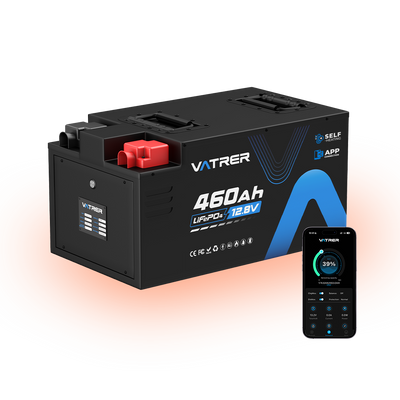
For RV owners who regularly camp in freezing conditions, a self-heating battery can address this charging limitation. The Vatrer 12V 300Ah Self-Heating LiFePO4 Battery includes a 90W heating system designed to warm the cells before cold-weather charging. Its heating function is designed to begin below 32°F and stop at 41°F when the required charging conditions are met. Bluetooth monitoring also allows you to check battery temperature through the Vatrer app. Check its heating requirements and compatibility with your existing charging system before choosing it for your winter setup.
Lithium batteries also need protection from sustained high temperatures. Heat accelerates side reactions inside the cells and can cause faster capacity loss, particularly during long periods at a high state of charge. Over time, the battery may provide fewer hours of operation even after a full charge.
Lead-Acid Battery Temperature Performance
Lead-acid batteries are widely used in gasoline-powered vehicles and older RV electrical systems. Their ability to deliver large starting currents makes them suitable for automotive applications, but freezing temperatures can significantly reduce their performance.
At approximately 32°F, a typical lead-acid battery may deliver around 80% of its rated capacity under comparable discharge conditions. At 0°F, usable capacity can fall to roughly 50%, depending on discharge rate, battery condition, and test method.
The problem becomes more noticeable when starting an engine. Cold weather reduces the battery's available power while engine oil becomes thicker, increasing the work required from the starter motor.
Lead-acid batteries also have a temperature-dependent freezing point. A fully charged battery has a relatively low electrolyte freezing temperature, while a heavily discharged battery can freeze at much warmer temperatures.
According to Battery Council International figures discussed by Battery University, lead-acid electrolyte with a specific gravity of 1.15 can freeze near 5°F. Electrolyte with a specific gravity of 1.265 has a freezing point around -67°F.
In hot weather, lead-acid batteries experience faster positive-grid corrosion and, in flooded designs, increased water loss. Charging voltage also needs to account for temperature: colder conditions generally call for a higher charging voltage, while warmer conditions require a lower voltage to limit overcharging.
Lithium vs. Lead-Acid Temperature Comparison
| Factor | Lithium Batteries | Lead-Acid Batteries |
|---|---|---|
| Cold-weather discharge | Reduced capacity and output | Reduced capacity and starting power |
| Charging below 32°F | Generally restricted unless specifically designed for it | Possible with suitable charging controls |
| High-temperature exposure | Accelerates chemical aging and capacity loss | Accelerates corrosion, water loss, and aging |
| Main cold-weather risk | Lithium plating during improper charging | Electrolyte freezing when discharged |
| Temperature management | BMS protection and optional heating | Temperature-compensated charging and charge maintenance |
If you're comparing cold weather batteries for an RV or off-grid system, check the temperature at which each battery can accept a charge. That limit often determines how easily you can use solar or shore power during freezing weather.
What Is the Best Temperature for Batteries?
For many common rechargeable batteries, 68–77°F is a favorable reference range for everyday operation and long-term battery health. The exact ideal temperature depends on the chemistry, and the conditions that produce the highest short-term output may differ from those that best preserve lifespan.
Battery temperature is also different from ambient air temperature. A battery running a high electrical load may become warmer than its surroundings, while one stored overnight in an unheated compartment may remain cold well into the morning.
The lithium battery temperature range deserves particular attention because the maximum and minimum permitted temperatures for charging, discharging, and storage are often different.

Charging and Discharging Temperature Limits
Charging generally has narrower temperature limits than discharging. This is particularly relevant to lithium-ion batteries, which may supply power in freezing weather but cannot accept a normal charging current at the same cell temperature.
Battery University provides the following representative temperature ranges for conventional rechargeable battery chemistries.
Typical Battery Charging and Discharging Temperature Ranges
| Battery Type | Charging Temperature | Discharging Temperature |
|---|---|---|
| Conventional lithium-ion | 32–113°F | -4–140°F |
| Lead-acid | -4–122°F | -4–122°F |
| Nickel-based (NiCd/NiMH) | 32–113°F | -4–149°F |
These are representative operating boundaries rather than recommended temperatures for maximum performance. Specialized batteries may use different limits, and some chemistries require reduced charging current near the ends of their permitted ranges.
For many conventional rechargeable batteries, charging around 50–86°F is favorable. Outside that range, the charging system may need to adjust current or voltage to account for temperature.
Storage also has different requirements. A cool, dry environment within the manufacturer's specified range generally helps slow long-term aging. Appropriate storage charge levels depend on chemistry; lead-acid batteries are typically stored charged, while lithium-ion batteries are often stored partially charged for extended periods.

How to Protect Batteries in Cold and Hot Weather
Temperature-related battery problems are easier to manage when you consider where the battery is installed, how much current it supplies, and when it receives a charge.
A few adjustments can help reduce unexpected shutdowns and unnecessary battery wear.
Cold-Weather Battery Tips
Freezing temperatures require some advance planning, especially if your battery powers essential RV equipment or an off-grid electrical system.
1. Keep batteries away from unnecessary cold exposure. Use a suitable insulated compartment or protected installation area when permitted by the battery manufacturer. Keep required vents and cooling paths unobstructed.
2. Account for reduced winter capacity. Plan for shorter runtimes when operating refrigerators, fans, or inverter-powered appliances. A battery bank sized for summer conditions may have less available energy on freezing nights.
3. Check charging conditions before reconnecting power. If your lithium battery has been stored below 32°F, confirm its cell temperature and permitted charging range before charging. Temperature-sensitive charging systems should follow the battery manufacturer's requirements.
4. Use approved heating where needed. Self-heating LiFePO4 batteries and properly controlled external heating systems can help prepare batteries for cold-weather charging. Check whether the heater requires incoming charging power to operate.
5. Warm batteries gradually. Move the battery to an appropriate environment or use an approved heater. Never place it next to an open flame or direct intense heat at the case.
For lead-acid batteries, maintaining an appropriate state of charge is especially important before severe cold arrives. A deeply discharged battery faces greater freezing risk.
Hot-Weather Battery Tips
Summer heat can shorten battery life even when you don't notice an immediate drop in performance. Installation conditions play a major role, particularly in RV storage compartments, garages, and enclosed solar equipment cabinets.
- Avoid direct sunlight. Position batteries away from windows, exposed metal surfaces, and other areas that become extremely hot during the day.
- Provide suitable ventilation. Follow the battery manufacturer's clearance and ventilation instructions. Lead-acid batteries may have additional venting requirements because they can release gas during charging.
- Watch battery temperature under heavy loads. High-current charging and inverter use can generate internal heat. Reduce loading if the battery approaches its rated temperature limit.
- Respect over-temperature protection. If the BMS interrupts charging or discharging, allow the battery to cool according to its instructions before restarting.
- Choose a better storage location. A shaded, temperature-controlled area is generally preferable to a hot vehicle or an unventilated metal enclosure.
If your battery supports temperature monitoring, check its internal temperature during periods of heavy use. The reading can reveal heat buildup that isn't obvious from the surrounding air.
FAQ
Do batteries lose charge faster when stored in the cold?
No, cold temperatures generally reduce a battery's self-discharge rate rather than increase it. However, a cold battery may temporarily deliver less usable capacity, making it seem as though it has lost charge. Extremely low temperatures can still damage certain batteries, so storage conditions must remain within the manufacturer's limits.
Can a battery recover after getting too cold?
Yes, a battery can often recover much of its normal capacity and power after warming to a suitable temperature. This applies when the performance reduction results from temporarily slower chemical reactions and increased internal resistance. Permanent damage from freezing, lithium plating, or other faults may prevent full recovery.
Should you warm up a cold battery before using it?
It depends on the battery chemistry, its temperature, and whether you plan to charge or discharge it. Many lithium batteries can discharge below freezing but need to reach a higher temperature before accepting a normal charging current. Use gradual warming or an approved heating system, following the manufacturer's temperature requirements.
Conclusion
Temperature management can make a noticeable difference in how reliably your battery powers equipment throughout the year. A battery that works well during mild weather may provide less runtime on a freezing night, while one exposed to repeated summer heat can gradually lose capacity long before its expected service life.
For RVs, vehicles, and solar energy systems, start by identifying the battery's charging and discharging temperature limits. Consider the temperatures inside its installation compartment, not simply the outdoor forecast, and account for seasonal changes in available power.
Keeping batteries within suitable temperature conditions can reduce unexpected interruptions, protect their usable capacity, and help extend their service life.