What Are Lithium Batteries Used For? 10 Common Uses
Reading time: 13 minutes

Share
Lithium batteries power many devices you use every day, from smartphones and laptops to electric vehicles, cordless tools, and medical equipment. They also store electricity for RVs, boats, golf carts, solar energy systems, and home backup power. Their widespread use comes from their ability to store substantial energy in compact spaces, deliver power efficiently, and support repeated charging cycles in rechargeable designs.
Different lithium battery applications call for different battery designs. A smartphone needs a small, lightweight cell, while an RV needs a battery that can handle frequent deep discharges. Here are 10 common lithium battery uses, how they work in everyday situations, and why different devices rely on this technology.
10 Common Uses of Lithium Batteries
Lithium batteries serve three main purposes: powering portable electronics, driving electric motors, and storing electricity for later use. The U.S. Environmental Protection Agency (EPA) identifies electronics, cordless tools, electric vehicles, and electrical energy storage as major lithium-ion battery applications.
| Application | Common Devices or Systems | Main Purpose |
|---|---|---|
| Consumer electronics | Smartphones, laptops, wearables | Portable device power |
| Electric vehicles | Electric cars, e-bikes, scooters | Electric propulsion |
| Power tools | Drills, saws, lawn equipment | Cordless operation |
| RVs and camper vans | RV house battery systems | Onboard living power |
| Marine equipment | Trolling motors, boat electronics | Propulsion and onboard power |
| Golf carts | Golf carts, utility vehicles | Electric drive power |
| Solar energy storage | Home solar, off-grid systems | Store electricity for later use |
| Backup power | Home batteries, power stations, UPS | Emergency and portable power |
| Medical devices | Medical monitors, mobility equipment | Portable medical and mobility power |
| Industrial equipment | Robots, warehouse equipment, telecom | Equipment power and backup |
Consumer Electronics and Wearable Devices
Your smartphone, laptop, tablet, and wireless earbuds probably use rechargeable lithium-ion batteries. These batteries pack substantial energy into small spaces, allowing manufacturers to build thin, portable devices that can run for hours without being plugged in.
Digital cameras and handheld gaming systems benefit from the same technology. Their compact designs leave little room for large battery packs, making energy density especially valuable.
Wearable devices take this requirement further. Smartwatches and fitness trackers need batteries small enough to fit on your wrist while powering sensors, wireless connections, and displays throughout the day.
Many consumer electronics use lithium-ion pouch or cylindrical cells, depending on their physical design and power requirements. You can recharge these devices without completely draining their batteries first.
Electric Vehicles and E-Bikes
Lithium-ion batteries are the main energy source for most modern electric cars. Instead of burning gasoline to power an engine, an electric vehicle stores electricity in a battery pack and delivers it to one or more electric motors.
The U.S. Department of Energy's Alternative Fuels Data Center identifies lithium-ion batteries as the technology used in most all-electric vehicles and plug-in hybrids. Their advantages include high energy per unit of weight, efficient energy use, and substantial power output.
Lithium batteries also power smaller electric transportation systems:
- E-bikes: Supply electricity to pedal-assist or throttle-controlled motors.
- Electric scooters: Provide rechargeable energy for short-distance travel.
- Electric buses: Use large battery packs for passenger transportation.
- Electric cars: Store energy for propulsion and supporting electrical systems.
Vehicle manufacturers choose different lithium-ion chemistries according to their needs. Nickel manganese cobalt (NMC), nickel cobalt aluminum (NCA), and lithium iron phosphate (LFP) are among the options used in automotive batteries.
A vehicle's range depends on more than battery capacity. Driving speed, terrain, temperature, and vehicle efficiency all affect how quickly it uses stored energy.
Cordless Power Tools and Lawn Equipment
A cordless drill needs a different kind of power delivery than a smartphone. Driving screws into hardwood or cutting through thick lumber can place a sudden, heavy load on the motor.
Lithium-ion batteries can supply the high currents these tools need without requiring a power cord. That's why rechargeable battery packs are widely used in cordless drills, impact wrenches, circular saws, and electric grinders.
The same technology powers outdoor equipment such as lawn mowers, leaf blowers, hedge trimmers, and string trimmers.
You can work across your yard or move between job sites without dragging extension cords behind you. Swappable battery packs also let you replace a depleted pack with a charged one and continue working.
Power-tool batteries typically use cells designed for substantial current delivery. A high-demand saw may draw considerably more current than a small cordless screwdriver, even when both tools operate at similar battery voltages.
RVs and Camper Vans
In an RV, the house battery powers the equipment that makes the vehicle comfortable when you're away from campground hookups. It operates separately from the starting battery responsible for cranking the vehicle's engine.
Common RV electrical loads include:
- Interior and exterior lighting
- 12V refrigerators
- Water pumps
- Ventilation fans
- Control panels and onboard electronics
- AC appliances connected through an inverter
These devices may run throughout the day and overnight. An RV battery therefore needs to provide usable energy through repeated discharge and recharge cycles.
Lithium iron phosphate (LiFePO4) batteries are popular for RV house systems because they support deep-cycle operation and offer more usable capacity at a lower weight than many comparable lead-acid battery banks.
A camper running a refrigerator overnight can replenish the battery the next day through a compatible solar charging system, shore power charger, or vehicle charging equipment.
Cold-weather charging deserves attention. Standard LiFePO4 cells generally should not be charged below 32°F without an approved heating arrangement.
For RVs used during winter, the Vatrer 12V 100Ah self-heating LiFePO4 battery addresses this problem with charger-activated heating that warms the cells before charging in freezing conditions. It stores 1,280Wh of nominal energy, while Bluetooth monitoring lets you check battery status without opening a battery compartment.
Boats and Marine Equipment
On a fishing boat, the trolling motor may run for hours while the boat moves slowly along a shoreline. At the same time, a fish finder, navigation display, and onboard lighting need their own electrical supply.
Lithium batteries can support both kinds of equipment, although the battery requirements differ.
Marine lithium battery uses generally fall into two categories:
- Electric propulsion: Supplying power to trolling motors and compatible electric drive systems.
- House and auxiliary power: Running navigation electronics, lighting, pumps, and onboard appliances.
Weight matters on smaller boats. Replacing a heavy lead-acid battery bank with a lighter lithium system can reduce the amount of weight carried onboard while maintaining useful energy capacity.
LiFePO4 batteries are particularly well suited to deep-cycle marine applications, where repeated discharge and recharge are part of normal operation.
Marine starting batteries serve a different function. They must deliver enough current to crank an engine, which a conventional deep-cycle battery may not be designed to do.
For anglers who fish during the cold season, the Vatrer 12V 300Ah dual-purpose lithium battery is an excellent choice; it combines deep-cycle energy storage capabilities with a built-in heating function that allows for charging in low-temperature environments, while also delivering 1500 CCA of starting power.
Golf Carts and Utility Vehicles
Electric golf carts use battery power for acceleration, hill climbing, and everyday driving. Golf courses, neighborhoods, resorts, and large private properties all use these vehicles.
Many older carts rely on multiple flooded lead-acid batteries connected in series. Replacing that bank with a compatible LiFePO4 system can reduce weight and eliminate routine electrolyte watering.
Battery performance is especially noticeable on hilly routes or when the cart carries several passengers. The motor draws more current under these conditions, making sustained power delivery a major consideration.
Lithium batteries also power electric utility carts used for transporting tools, supplies, and equipment around farms, warehouses, and commercial properties.
The Vatrer 48V 105Ah lithium battery upgrade kit integrates a LiFePO4 battery, a dedicated charger, and a battery monitoring system. The battery features a 200A continuous discharge capability, easily handling high-load driving demands, while the included charging equipment simplifies the process of replacing old lead-acid battery packs. The kit is designed for excellent compatibility with major brands such as Yamaha, E-Z-GO, and Club Car.
Solar Energy Storage Systems
Solar panels produce electricity during daylight hours, but your household may need much of its power after sunset. Lithium batteries allow you to store excess solar generation and use it when production drops.
A basic DC-coupled storage arrangement follows this energy path:
Solar panels → Charge controller or hybrid inverter → Battery storage → Electrical loads
Actual connections vary between DC-coupled and AC-coupled systems.
Solar battery storage serves several practical needs. Homeowners can use daytime solar generation during the evening, while off-grid cabins rely on stored energy to operate lights, refrigeration, and other equipment after dark. Commercial installations may also store electricity for use during periods of greater demand.
LiFePO4 batteries are commonly used in stationary solar storage because daily charging and discharging make cycle life a major consideration.
Grid-connected solar storage and outage backup are different functions. A battery may store solar energy for nighttime use yet shut down with the grid unless the system includes backup-capable equipment. The U.S. Department of Energy explains that solar-plus-storage systems need suitable inverter controls to operate independently during an outage.
Home Backup Power and Portable Power Stations
When the power goes out, a lithium battery system can keep selected household equipment operating. What it can run depends on the battery's stored energy and the electrical output of the connected system.
A home backup installation might support a refrigerator, lighting, internet router, or water pump. Portable power stations serve a different role: they package a rechargeable battery, inverter, and output ports into a unit you can carry to a campsite, job site, or temporary work area.
Uninterruptible power supply (UPS) systems are designed to respond quickly to utility interruptions. They commonly protect computers, networking equipment, and other systems that need time to continue operating or shut down safely.
| Measurement | What It Tells You |
|---|---|
| Energy capacity (Wh or kWh) | How much electrical energy the battery stores |
| Power output (W) | How much electrical power the system can supply at a time |
For a rough runtime estimate:
Runtime (hours) = Usable battery energy (Wh) ÷ Average load (W)
Suppose a battery system provides 1,000Wh of usable energy and the connected equipment draws a steady 100W.
1,000Wh ÷ 100W = 10 hours
That's the theoretical runtime. Inverter losses, auxiliary power consumption, and changes in appliance demand can reduce actual operating time.
A refrigerator or pump may also need a brief surge of power during startup. The inverter must be able to handle that surge, even when the appliance's normal running wattage is much lower.
Medical Devices and Mobility Equipment
Portable medical equipment allows healthcare professionals to move devices between rooms or use them away from fixed electrical outlets.
Rechargeable lithium-ion batteries appear in equipment such as portable ultrasound machines, patient monitors, and infusion pumps. Their compact size makes it easier to design equipment that can travel with patients without requiring a large external power supply.
Electric wheelchairs and mobility scooters have another requirement: enough energy to move the rider throughout the day. Some use lithium-ion or LiFePO4 battery systems to reduce weight and support repeated charging.
Implantable medical devices operate under different conditions. Conventional pacemakers commonly use specialized non-rechargeable lithium batteries designed to provide a small amount of power over many years.
Medical battery packs are selected and qualified for specific devices. Replacement batteries must meet the equipment manufacturer's requirements for electrical performance and safety.
Industrial Equipment and Backup Systems
Warehouse robots and automated guided vehicles (AGVs) depend on batteries to move materials between workstations. They can travel across a facility, complete assigned tasks, and return to charging stations without permanent power connections.
Lithium-ion batteries are also used in industrial cleaning machines, electric carts, and portable inspection equipment. These machines may operate repeatedly throughout a workday, making rechargeability valuable.
Backup systems have different operating patterns. Telecommunications equipment and industrial control systems may rely on lithium batteries to maintain essential functions during a power interruption.
Other devices consume very little energy and remain in remote locations for years. Smart utility meters, environmental sensors, and certain alarm systems may use primary lithium batteries with low self-discharge rather than rechargeable packs.
The equipment's operating pattern determines which battery characteristics matter most: high power for moving machinery, repeated cycling for daily operations, or long standby life for remote monitoring.
Why Are Lithium Batteries Used in So Many Devices?
Lithium batteries can be manufactured with different cell chemistries and pack configurations, allowing manufacturers to balance energy storage, weight, power output, and service life.
High energy density is one of the main reasons lithium-ion technology became widespread. The EPA notes that this characteristic has helped manufacturers develop smaller portable and cordless products without sacrificing stored energy.
| Battery Characteristic | Practical Benefit | Relevant Applications |
|---|---|---|
| High energy density | Stores more energy in limited space | Phones, laptops, EVs |
| Lightweight design | Reduces equipment weight | E-bikes, marine systems, portable tools |
| Rechargeability | Supports repeated daily use | EVs, tools, solar storage |
| Long cycle life | Reduces battery replacement frequency | RVs, golf carts, stationary storage |
| High power output | Supports motors and demanding loads | Tools, vehicles, industrial equipment |
| Low maintenance | Reduces routine servicing | RVs, golf carts, backup systems |
Cycle life is particularly relevant to equipment used every day. Many LiFePO4 battery products are rated for several thousand charge-discharge cycles under specified test conditions, although actual service life depends on temperature, discharge depth, charging behavior, and cell quality.
Power output matters just as much for motor-driven equipment. A battery designed for steady solar storage loads may not support the short bursts of current required by a powerful motor, even if its energy capacity appears sufficient.
Temperature can also affect battery operation. Conventional LiFePO4 cells generally have restricted charging below 32°F, which is why low-temperature charging protection or internal heating is valuable in winter applications.
Lithium vs. Lithium-Ion vs. LiFePO4: Common Uses
Lithium batteries include both non-rechargeable and rechargeable technologies. The difference helps explain why a household smoke alarm may operate for years on one battery while a smartphone needs regular charging.
| Battery Type | Rechargeable? | Common Applications |
|---|---|---|
| Primary lithium batteries | No | Watches, smoke alarms, utility meters, remote sensors, selected medical implants |
| Lithium-ion batteries | Yes | Smartphones, laptops, EVs, power tools, portable electronics |
| LiFePO4 (LFP) batteries | Yes | RVs, marine house batteries, golf carts, solar storage, home backup, selected EVs |
LiFePO4 is a type of lithium-ion chemistry, so the last two rows describe overlapping categories rather than separate battery families.
Primary lithium batteries are designed for one-time discharge. Their long shelf life and low self-discharge make them useful in devices that consume small amounts of energy over extended periods.
Rechargeable lithium-ion batteries are used where frequent energy consumption and recharging are expected. The chemistry varies: consumer electronics often prioritize compact dimensions and energy density, while LiFePO4 is widely chosen for deep-cycle applications such as RV electrical systems and solar storage.
Battery voltage, charging requirements, discharge limits, and protective electronics differ between these designs. Check the equipment specifications before replacing one battery chemistry with another.
FAQ About Lithium Battery Uses
What everyday items use lithium batteries?
Smartphones, laptops, tablets, wireless earbuds, cameras, and smartwatches commonly use rechargeable lithium-ion batteries. Some watches, smoke alarms, utility meters, and remote sensors use non-rechargeable lithium batteries. The battery label or device manual identifies the required type.
What are LiFePO4 batteries commonly used for?
LiFePO4 batteries are commonly used in solar energy storage, RV house systems, marine equipment, golf carts, home backup systems, and some electric vehicles. These applications often involve frequent charging and discharging, making cycle life and stable power delivery valuable.
Are all lithium batteries rechargeable?
No. Primary lithium batteries are non-rechargeable, while lithium-ion batteries, including LiFePO4, are designed for repeated charging. Never put a primary lithium battery in a charger. Rechargeable batteries also require charging equipment compatible with their specific chemistry and voltage.
Choosing Lithium Batteries for Your Application
The equipment you plan to power determines which battery characteristics deserve attention. An RV refrigerator needs steady energy over many hours, a trolling motor draws substantial current during operation, and a golf cart must supply enough power for acceleration and hills.
Before replacing an existing battery, identify your system voltage, daily energy consumption, and maximum electrical load. Check the charging setup and operating temperature as well. Those factors determine whether a battery can do the job in normal use.
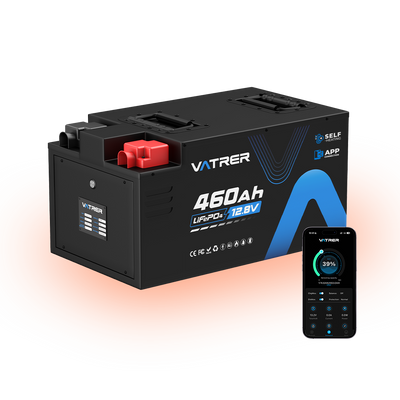
Vatrer lithium batteries are designed for RVs, marine vessels, golf carts, and off-grid power systems. You can choose models with built-in heating for low-temperature charging, deep-cycle systems for reliable onboard power, or specialized golf cart conversion kits. Please consult the product specifications and compatibility information to select the best battery for your equipment.