What Is the Best RV Battery in 2026? Full Comparison Guide
Reading time: 7 minutes
Introduction
By 2026, the expectations placed on RV electrical systems have reached an unprecedented level. Modern RV owners rely heavily on high-power appliances such as air conditioners, induction cooktops, electric grills, and large entertainment systems. At the same time, off-grid camping (boondocking) has become mainstream, and rooftop solar systems have grown in both size and efficiency. These trends place enormous demands on RV batteries, making the choice of energy storage more critical than ever.
Selecting the right RV battery now directly affects comfort, safety, and long-term cost. This article provides a technical evaluation of the major RV battery technologies available in 2026 and offers a professional assessment of Vatrer Power’s leading LiFePO4 RV battery lineup, which has become one of the most capable and reliable solutions for modern RV users.


Understanding RV Battery Types in 2026
RV electrical systems rely on deep-cycle batteries designed to deliver steady power over extended periods. The four major battery chemistries in 2026 include Flooded Lead-Acid (FLA), AGM, Gel, and Lithium Iron Phosphate (LiFePO4).
Flooded Lead-Acid batteries remain the lowest-cost option but offer limited usable capacity, require regular maintenance, and degrade quickly under deep-cycle conditions.
AGM batteries improve on maintenance and vibration resistance but still provide only about 50% usable capacity and have a shorter cycle life compared to lithium.
Gel batteries offer better deep-cycle performance but charge slowly and are less compatible with high-power inverter loads.
LiFePO4 batteries dominate the 2026 RV market. They provide 80-100% usable capacity, extremely long cycle life, fast charging, low weight, and superior thermal and chemical stability. Their integrated Battery Management Systems (BMS) offer advanced protection, making them ideal for modern RV electrical demands.
Key Factors That Determine the Best RV Battery
Choosing the best RV battery requires evaluating several engineering-level parameters.
Capacity and usable capacity determine how long an RV can operate off-grid. LiFePO4 batteries deliver nearly their full rated capacity, unlike lead‑acid batteries.
Cycle life determines long-term cost. High-quality LiFePO4 batteries can exceed 4,000-6,000 cycles, dramatically reducing cost per cycle.
Discharge rate determines compatibility with high-power inverters. Many RVers now run 2,000-5,000W inverters, requiring batteries capable of sustained high-current output.
Charging speed and solar compatibility are essential for off-grid users. LiFePO4 batteries accept high charging currents and pair efficiently with MPPT solar controllers.
Weight and energy density influence payload and fuel efficiency. Lithium batteries provide far more energy per kilogram than lead-acid.
Safety depends on BMS design, thermal stability, and chemical composition. LiFePO4 is the safest lithium chemistry available.
Low-temperature performance is critical for winter camping. Heated LiFePO4 batteries or low-temperature charging protection ensure safe operation below freezing.
Cost per cycle is the most accurate measure of long-term value. Even if lithium batteries cost more upfront, their lifespan makes them significantly cheaper over time.
Best RV Battery Categories in 2026
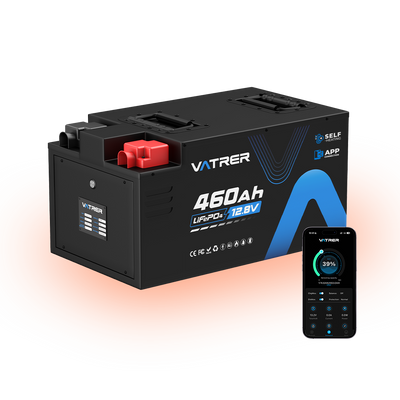
Vatrer Power 12V 460Ah LiFePO4 Heated Battery
The 12V 460Ah Heated LiFePO4 is one of the most balanced and capable RV batteries available in 2026. It combines massive usable capacity with strong discharge performance and cold-weather charging capability.
Key Specifications
- Nominal Voltage: 12.8V
- Capacity: 460Ah
- Usable Energy: 5,888Wh
- Max Continuous Discharge: 300A
- Peak Discharge: 600A (3 seconds)
- Max Load Power (Theoretical): 3,840W
- Recommended Inverter Size: 3,000W–3,500W (to account for inverter efficiency losses)
- Cycle Life: 5,000+ cycles
- Heating Function: Automatic; activates below 32°F, stops at 41°F
- Low-Temp Charging Protection: Charging disabled below 32°C
- Bluetooth Monitoring: Yes (Vatrer App)
- Weight: 104 lbs
- Dimensions: L 18.78 × W 10.75 × H 9.92 in
Why It’s the Best Overall
It offers long off-grid runtime, supports large inverters, and maintains safe charging in cold climates. For most RV users, this is the ideal “do-everything” battery.
Best Lithium RV Battery for Off-Grid / Solar Systems
Vatrer Power 12V 300Ah LiFePO4 Smart Battery
Designed for long-term boondocking and solar-heavy RV setups, the 300Ah Smart Battery provides excellent energy density and advanced monitoring.
Key Specifications
- Nominal Voltage: 12.8V
- Capacity: 300Ah
- Usable Energy: 3,840Wh
- Max Continuous Discharge: 200A-300A
- Cycle Life: 5,000+ cycles
- Bluetooth Monitoring: Yes
- Solar Compatibility: Supports high-current MPPT charging
Why It’s Ideal for Solar Users
Fast charging, high cycle life, and real-time monitoring make it perfect for off‑grid systems that rely heavily on solar replenishment.
Best Budget Lithium RV Battery
Vatrer Power 12V 100Ah LiFePO4 Battery
A lightweight, maintenance-free, and cost-effective lithium option for weekend campers and light-duty RV electrical systems.
Key Specifications
- Nominal Voltage: 12.8V
- Capacity: 100Ah
- Usable Energy: 1,280Wh
- Max Continuous Discharge: 100A
- Cycle Life: 5,000+ cycles
- Weight: 24.2 lbs, Lightweight and easy to install
Why It’s the Best Budget Choice
It delivers reliable lithium performance at an accessible price point and fits most RV electrical systems without modification.
Best High-Capacity RV Battery for Large Inverters
Vatrer Power 12V 560Ah LiFePO4 Battery
This is the flagship option for RVers running high-load appliances such as air conditioners, induction cooktops, microwaves, and 3000W–5000W inverters.
Key Specifications
- Nominal Voltage: 12.8V
- Capacity: 560Ah
- Usable Energy: 7,168Wh
- Max Continuous Discharge: 300A
- Peak Discharge: 600A (3 seconds)
- Max Load Power: 3,840W
- Recommended Inverter Size: 3,000W–3,500W (for long-term stability)
- Cycle Life: 5,000+ cycles
- Bluetooth Monitoring: Yes
- Series/Parallel Support: Up to 4S4P (supports 24V, 48V, or ultra-large banks)
Why It’s the Best for High-Load Systems
A 3000W inverter can draw over 250A. Smaller batteries cannot sustain this load without triggering BMS shutdown.
The 560Ah model’s 300A continuous discharge rating makes it ideal for powering energy-intensive appliances safely and reliably.
Full Comparison Table
| Battery Model | Usable Capacity | Cycle Life | Weight | Max Discharge | LowTemp Charging | Ideal For |
|---|---|---|---|---|---|---|
| 12V 460Ah Heated | High | Very Long | Moderate | High | Yes (Heated) | Allpurpose RV use |
| 12V 300Ah Smart | High | Very Long | Light | High | Optional | Solar + OffGrid |
| 12V 100Ah | Medium | Long | Very Light | Medium | Optional | Budget Lithium |
| 12V 560Ah | Very High | Very Long | Heavy | Very High | Optional | Large Inverters |
Smart Connectivity: The 2026 Expectation
Modern RV owners expect real-time visibility into their battery systems. Vatrer Power’s smart batteries integrate with a mobile app that provides detailed telemetry, including:
- Per-cell voltage
- Battery temperature
- Remaining cycle life
- State of charge (SOC)
- Charge/discharge current
- Historical usage data
- OTA firmware updates
This level of transparency allows RVers to diagnose issues early, optimize solar charging, and manage power consumption with precision.
How to Choose the Right RV Battery for Your Needs
Selecting the right battery depends on your travel style and electrical demands. Short-distance travelers with minimal power needs may choose smaller lithium batteries, while long-distance or full-time RVers benefit from high-capacity packs. Off-grid campers require fast-charging lithium batteries compatible with solar systems. Users running large inverters must ensure the battery’s discharge rating matches peak loads. Weight-restricted RVs benefit from lithium’s superior energy density. Cold-climate travelers should choose heated batteries. Budget, desired lifespan, and monitoring features such as Bluetooth also influence the final decision.
Installation and Compatibility Considerations
Upgrading from lead-acid to lithium requires attention to several technical factors. The charger must support LiFePO4 charging profiles. Solar controllers must be configured for lithium voltage ranges. The BMS must be compatible with the inverter’s surge and continuous current requirements. Cable gauge and fuse ratings must match the system’s maximum current. Parallel or series configurations require identical batteries and proper balancing. Low-temperature charging protection is essential for winter use.
A critical consideration is alternator charging. Lithium batteries have very low internal resistance and can draw excessive current from an RV’s alternator, potentially causing overheating. A DC‑DC charger is recommended to regulate current and protect the alternator during driving.
Common Mistakes RV Owners Should Avoid
Many RV owners focus only on rated capacity without considering usable capacity. Others overlook cycle life, resulting in higher long‑term costs. Using incompatible chargers can damage lithium batteries. Charging in freezing temperatures without heating protection can cause permanent damage. Ignoring BMS discharge ratings can lead to inverter shutdowns. Reusing old cables may cause voltage drop or overheating. Choosing batteries based solely on price often results in poor cost-per-cycle performance. Purchasing non‑heated lithium batteries for cold climates is another common mistake.
Conclusion
There is no single “best” RV battery for every user in 2026. The ideal choice depends on travel patterns, power requirements, climate, and budget. However, LiFePO4 batteries clearly dominate the modern RV landscape due to their high usable capacity, long lifespan, fast charging, and superior safety. Vatrer Power’s lineup—including high-capacity heated batteries, smart solar-ready models, and budget-friendly lithium options—offers solutions for nearly every RV scenario. Their combination of intelligent BMS protection, cold-weather capability, and strong discharge performance makes them one of the most compelling RV battery brands of 2026.
FAQ
What size RV battery do I need?
It depends on your inverter size, daily energy usage, and whether you camp off-grid.
Is LiFePO4 safe for RV use?
Yes. It is the safest lithium chemistry and includes BMS protection.
Can I replace AGM with lithium directly?
Yes, but you may need a lithium-compatible charger and a DC-DC charger to protect your alternator.
Do I need a new charger for lithium?
Most RVs do. Lithium requires specific charging voltages.
How long do RV batteries last?
LiFePO4 batteries can exceed 4,000–6,000 cycles, far longer than AGM.
Can RV batteries charge from solar?
Yes. Lithium batteries pair extremely well with MPPT solar systems.
Is a heated lithium battery necessary for winter camping?
Yes, if temperatures drop below freezing during charging.
What is the difference between usable capacity and rated capacity?
Rated capacity is the theoretical maximum; usable capacity is what you can actually draw without damaging the battery.
Share