Understanding Batteries in Series and Parallel: A Complete Guide
Reading time: 15 minutes

Share
Connecting multiple batteries changes how a battery bank delivers voltage, stores nominal energy, and supplies current to the rest of a DC system. In RVs, solar battery banks, marine systems, golf carts, and other applications, the connection method also affects charger selection, cable sizing, protection, and equipment compatibility.
The same group of batteries can produce very different voltage and Ah ratings depending on the wiring. Two 12V 100Ah batteries, for example, can form a 24V 100Ah battery bank or a 12V 200Ah battery bank. That change affects connected equipment, current, cabling, charging, and future battery bank expansion.


What Are Batteries in Series and Parallel?
A series and parallel battery connection describes how the terminals of multiple batteries are linked. Series wiring places batteries one after another in the electrical path, while parallel wiring places batteries across common positive and negative connection points. The first arrangement builds voltage; the second builds Ah capacity at the same nominal voltage.
Batteries in Series
In a series connection, the positive terminal of one battery connects to the negative terminal of the next battery. The remaining open negative and positive terminals become the output terminals for the complete battery bank. Voltage increases with every matched battery added to the series battery string, while the Ah rating remains the same as one battery.
2 × 12V 100Ah batteries in series = 24V 100Ah battery bank
Total series voltage = V₁ + V₂ + V₃ + ...
Series battery bank capacity (Ah) = Ah rating of one matched battery
Batteries in Parallel
In a parallel connection, all positive battery terminals are connected together and all negative battery terminals are connected together. The battery bank stays at the nominal voltage of one battery, while the Ah capacity increases as additional matched batteries are added.
2 × 12V 100Ah batteries in parallel = 12V 200Ah battery bank
Parallel battery bank voltage = nominal voltage of one matched battery
Total parallel capacity = Ah₁ + Ah₂ + Ah₃ + ...
Key Electrical Differences
Series and parallel wiring organize the same battery specifications in different ways. Voltage and Ah change differently, but each added battery contributes its own nominal Wh to the total battery bank energy.
Series vs. Parallel Battery Connection Comparison
| Electrical Property | Series Connection | Parallel Connection |
|---|---|---|
| Total voltage | Battery voltages add | Stays at one battery's nominal voltage |
| Capacity (Ah) | Stays at one matched battery's Ah rating | Battery Ah ratings add |
| Total nominal energy (Wh) | Energy from all batteries adds | Energy from all batteries adds |
| Primary use | Reach a higher system voltage | Add capacity at the existing voltage |
| Charger voltage | Matches the complete battery bank | Matches the battery bank's nominal system voltage |
| Main wiring pattern | Positive to negative between batteries | Positive to positive and negative to negative |
Series wiring changes the voltage level available to the system, while parallel wiring changes how much Ah capacity is available at that voltage.
How Do Battery Voltage, Ah, Wh, and Current Change in Series and Parallel?
Voltage, amp-hours, watt-hours, and current describe different parts of battery system behavior. Ah measures charge capacity, Wh combines voltage and Ah into nominal energy, and current depends on what the load is asking the battery bank to deliver at a given voltage.
Voltage and Amp-Hours
Series wiring adds battery voltages because the batteries are arranged in one electrical path. Parallel wiring keeps the same nominal voltage across every battery and adds Ah capacity instead. With four matched 12V 100Ah batteries, the same four batteries can form either a 48V 100Ah battery bank in series or a 12V 400Ah battery bank in parallel.
Series:
12V + 12V + 12V + 12V = 48V
Battery bank = 48V 100Ah
Parallel:
100Ah + 100Ah + 100Ah + 100Ah = 400Ah
Battery bank = 12V 400Ah
Watt-Hours and Total Energy
Watt-hours give the clearer nominal-energy comparison for battery banks operating at different voltages because Wh combines voltage and Ah. With two 12.8V 100Ah LiFePO4 batteries, series and parallel wiring produce different voltage/Ah combinations while the combined nominal energy stays the same.
Energy (Wh) = Voltage (V) × Capacity (Ah)
One 12.8V 100Ah LiFePO4 battery: 12.8V × 100Ah = 1,280Wh
Two in series: 25.6V × 100Ah = 2,560Wh
Two in parallel: 12.8V × 200Ah = 2,560Wh
System labels such as 12V, 24V, and 48V are often rounded categories. Energy calculations should use the exact nominal voltage listed for the battery chemistry and model.
Current at the Same Power
For a load drawing the same power, raising system voltage reduces the current needed to deliver that power. Lower current can reduce conductor voltage drop and resistive heating, but cable length, conductor size, connection resistance, equipment efficiency, and actual operating voltage still affect real system losses. The examples below use simplified nominal system voltages.
Power (W) = Voltage (V) × Current (A)
For a 2,400W load in an ideal calculation:
- 12V system: 2,400W ÷ 12V = 200A
- 24V system: 2,400W ÷ 24V = 100A
- 48V system: 2,400W ÷ 48V = 50A
The inverter, motor controller, DC loads, charger, and other connected equipment must all be rated for the selected system voltage.
How Does a Series-Parallel Battery Configuration Work?
A series-parallel battery configuration is used when a battery bank needs both a higher voltage and more Ah capacity. Matching batteries first form identical series battery strings to reach the target voltage, then those battery strings are connected in parallel to increase capacity at that voltage.
Series and Parallel Battery Strings
Each parallel battery string should contain the same number and type of batteries. The series part establishes battery bank voltage, while the number of parallel battery strings determines combined Ah capacity. Every battery still contributes its nominal Wh to the completed battery bank.
2S2P and 4S2P Notation
S/P notation describes the electrical arrangement. The number before S shows how many batteries are connected in series within each battery string, and the number before P shows how many identical battery strings are connected in parallel.
- 2S2P: 2 batteries per series battery string × 2 parallel battery strings = 4 batteries total
- 4S2P: 4 batteries per series battery string × 2 parallel battery strings = 8 batteries total
- 4S4P: 4 batteries per series battery string × 4 parallel battery strings = 16 batteries total
Series-Parallel Calculation
A 4S2P example shows both values changing at once. With eight matched 12.8V 100Ah LiFePO4 batteries, each four-battery series battery string reaches 51.2V while remaining 100Ah. Connecting two identical battery strings in parallel doubles the battery bank capacity to 200Ah.
Per 4S battery string
4 × 12.8V = 51.2V
Capacity = 100Ah
Two battery strings in parallel
100Ah × 2 = 200Ah
Final battery bank = 51.2V 200Ah
Nominal energy = 51.2V × 200Ah = 10,240Wh
What Should You Check Before Connecting Batteries?
Battery chemistry, nominal voltage, BMS limits, state of charge, current ratings, cable sizing, and overcurrent protection all affect whether a planned battery bank can operate correctly. These checks belong before the first inter-battery connection because a wiring layout that is mathematically correct can still exceed battery or equipment limits.
Battery Compatibility
Batteries used in the same battery bank should follow the manufacturer's requirements for multi-battery operation. Using the same battery model, chemistry, nominal voltage, capacity, and similar age and condition reduces differences in charge and discharge behavior. The battery manufacturer's multi-battery guidance should govern any arrangement that mixes battery models, capacities, ages, or chemistries. Lithium batteries and lead-acid batteries generally require different charging behavior and should be treated as different battery systems unless a documented system design explicitly supports both.
Voltage and SOC Matching
Battery voltage and state of charge should be checked before connection, especially before batteries or completed battery strings are connected in parallel. Parallel batteries share the same electrical nodes, so a voltage difference can drive equalization current from the higher-voltage battery toward the lower-voltage battery as soon as the connection is made. Follow the battery manufacturer's preparation procedure for the acceptable voltage or SOC difference before connection.
Series and Parallel Limits
A lithium battery's BMS and internal switching components place limits on how many batteries can be connected together. Check the exact battery model for maximum series count, maximum parallel count, support for series-parallel operation, continuous charge and discharge current, and any charger or system-voltage restrictions. A single battery at the required nominal voltage can reduce inter-battery cables and connection points when the system does not need several smaller batteries for modular expansion.
Cables and Overcurrent Protection
Cable size should be selected from actual current, conductor length, allowable voltage drop, installation conditions, and the ratings of the battery and connected equipment. Parallel wiring increases the battery bank's available current capability, but load current still comes from the connected equipment. Fuse and circuit-breaker placement depends on the battery bank architecture, conductor ampacity, available fault current, and manufacturer requirements rather than one universal layout.
BMS Functions
A lithium battery BMS monitors and protects the battery's internal cells. Depending on the battery model, protection can include overcharge, over-discharge, overcurrent, short-circuit, high-temperature, low-temperature, and cell-balancing functions. Battery-bank-level design still needs proper current sharing, battery matching, conductor sizing, and protection between multiple independent batteries.
Pre-Connection Checklist
A final check can catch polarity errors, incompatible voltages, and missing protection before the battery bank is energized. Confirm the completed electrical layout against both the battery specifications and the ratings of the charger, inverter or controller, cables, connectors, and protective devices.
- Battery match: Chemistry, model, nominal voltage, capacity, age, and condition are suitable for the same battery bank.
- Connection approval: The planned series, parallel, or series-parallel battery configuration falls within the battery manufacturer's limits.
- Voltage and SOC: Batteries or parallel battery strings meet the required pre-connection conditions.
- Polarity: Positive and negative terminals are identified before interconnects are installed.
- Cabling: Conductors and connectors are rated for the expected current and installation.
- Protection: Fuses, circuit breakers, and disconnects are selected for the actual battery bank design.
- Charger: Charger voltage and charging profile match the completed battery bank.
- Equipment: Inverter, controller, motor, DC-DC converter, and other loads support the final system voltage.
- Isolation: Loads and charging sources are disconnected while the battery bank is being assembled.
How Do You Connect Batteries in Series and Parallel?
The wiring pattern follows the battery bank voltage and capacity target. Series wiring links batteries end to end, parallel wiring connects batteries across common positive and negative points, and a series-parallel battery bank combines matched series battery strings through a parallel connection.
Series Wiring
For a basic series connection, connect the positive terminal of the first battery to the negative terminal of the second battery and continue the same pattern through the series battery string. The unused negative terminal at one end and unused positive terminal at the other become the main battery bank terminals. After the interconnects are installed, measure total battery bank voltage before reconnecting loads or charging equipment.
- Disconnect charging sources and loads.
- Confirm the batteries are approved for series operation.
- Connect Battery 1 positive to Battery 2 negative.
- Continue the same positive-to-negative pattern for any additional batteries.
- Use the two remaining open terminals as the battery bank output.
- Measure battery bank voltage before reconnecting the system.
Parallel Wiring
For a parallel connection, connect each positive battery terminal to a common positive path and each negative battery terminal to a common negative path. The completed battery bank remains at the nominal voltage of one battery while Ah capacity adds. Larger parallel battery banks should use a layout that keeps conductor resistance comparable between batteries so one battery does not carry a disproportionate share of current.
- Disconnect loads and charging sources.
- Confirm battery voltage and SOC meet the connection requirements.
- Connect all battery positive terminals to the positive connection path.
- Connect all battery negative terminals to the negative connection path.
- Check polarity, terminal tightness to the manufacturer's specification, cable routing, and protection placement.
- Measure final battery bank voltage before reconnecting equipment.
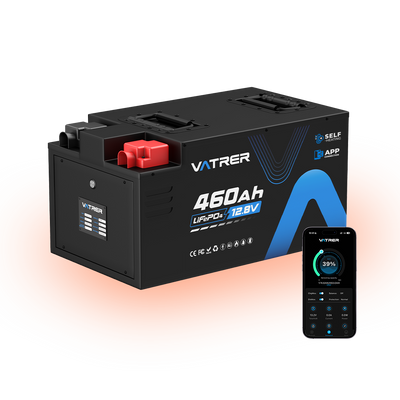
If you're expanding a 12V RV battery but want to avoid adding several parallel branches, consider moving to a larger single-battery capacity instead. The Vatrer 12V 600Ah self-heating lithium battery has 7.68kWh of usable energy, a 300A BMS, and self-heating capabilities; using this battery in a large-capacity 12V system configuration can reduce the number of battery interconnects required.
Series-Parallel Wiring
A series-parallel battery bank is assembled in two stages. Build each identical series battery string first and verify its voltage, then connect the positive ends of the battery strings to the common positive path and the negative ends to the common negative path. Keep the battery strings electrically equivalent, including battery count, battery model, and conductor arrangement to the common busbars or distribution points.
- Build the first series battery string.
- Build each additional battery string to the same configuration.
- Measure and compare battery string voltages.
- Connect matched battery strings in parallel.
- Measure the completed battery bank voltage before attaching loads or charging equipment.
How Do You Charge Batteries in Series and Parallel?
Charging follows the electrical configuration of the completed battery bank. Charger output and charging profile must match the battery bank voltage and battery chemistry, while charging current must stay within the ratings of the batteries, BMS, conductors, connectors, and other components in the charging path.
Series Battery Charging
A series battery bank is charged at the voltage required by the complete series battery string. Two 12V batteries wired into a 24V battery bank therefore need charging equipment intended for the corresponding 24V battery system and battery chemistry. The same charging current passes through every battery in the series battery string, so battery matching and manufacturer-approved series charging remain important.
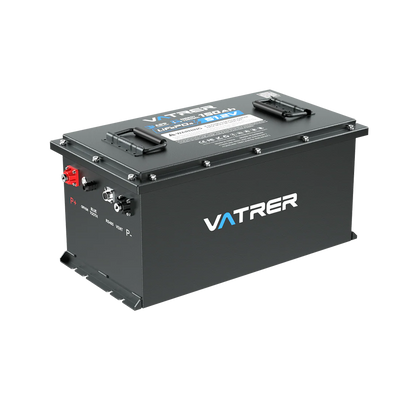
If you're replacing a multi-lead-acid battery bank in a 48V golf cart and want fewer series connections to manage, consider a single 48V lithium battery conversion instead. The Vatrer 48V 105Ah lithium golf cart battery includes a matching charger and LCD display, and supports continuous output up to 10.24kW via a 200A BMS, simplifying the selection of accessories required during the conversion process.
Parallel Battery Charging
A parallel battery bank is charged at the same nominal system voltage as one battery. Two or more matched 12V batteries wired in parallel still form a 12V battery bank, but the combined Ah capacity is larger. With the same charger current, the larger battery bank generally takes longer to charge; a higher charging current can shorten charge time only if every battery, the BMS, cabling, connectors, and charger all support that current.
Series-Parallel Charging
A series-parallel battery bank is charged according to its final battery bank voltage, battery chemistry, and permitted charging current. Parallel battery strings should remain closely matched so charging current can divide predictably between them. Check individual batteries or battery strings as required after installation, service work, or battery replacement.
How Do You Choose a Series, Parallel, or Series-Parallel Connection?
Battery bank configuration should start with the voltage required by the connected equipment, followed by the energy and runtime target. The final arrangement also has to stay inside the battery manufacturer's connection limits and the voltage, current, and charging limits of the rest of the DC system.
Required System Voltage
Check the nominal DC voltage required by the inverter, motor controller, trolling motor, DC distribution system, or other loads. Series wiring is useful when several lower-voltage batteries are needed to reach that required voltage. If one battery already provides the target system voltage and required capacity, using that battery can reduce interconnects compared with building the same voltage from several lower-voltage batteries.
Required Energy and Runtime
After system voltage is set, size the battery bank around expected energy use. Watt-hours are the more useful planning value because they combine voltage and Ah, while actual runtime also depends on usable battery capacity, conversion losses, temperature, discharge rate, reserve capacity, and BMS operating limits.
Required energy (Wh) = Load power (W) × Runtime (hours)
For an idealized 500W load running for four hours:
500W × 4h = 2,000Wh
At a fixed system voltage, parallel batteries can add Ah and Wh. If the system also needs a higher voltage, a series-parallel battery configuration can raise both voltage and Ah.
Battery and Equipment Limits
The calculated voltage and Ah target still has to fit the hardware. Check the battery maximum series and parallel configuration, BMS continuous and peak current limits where applicable, maximum charging current, charger output, inverter or controller input range, conductor ampacity, connector ratings, and fuse or circuit-breaker ratings before finalizing the battery bank.
Example Battery Configurations
The required system voltage and energy target determine the connection method. RV, marine, solar, and vehicle systems can each operate at several nominal voltages, so the examples below focus on the electrical result of each arrangement.
Example Battery Bank Configurations
| System Goal | Batteries | Configuration | Result |
|---|---|---|---|
| Raise 12V batteries to 24V | 2 × 12V 100Ah | 2S | 24V 100Ah |
| Raise 12V batteries to 48V | 4 × 12V 100Ah | 4S | 48V 100Ah |
| Increase capacity at 12V | 2 × 12V 100Ah | 2P | 12V 200Ah |
| Increase capacity at 12V | 4 × 12V 100Ah | 4P | 12V 400Ah |
| Raise voltage and capacity | 4 × 12V 100Ah | 2S2P | 24V 200Ah |
| Raise voltage and capacity | 8 × 12V 100Ah | 4S2P | 48V 200Ah |
The equipment voltage sets the first boundary, and the energy target sets the second. Series, parallel, or series-parallel wiring is then selected within those two requirements and the approved battery limits.
If you're building a 48V-class home or off-grid battery system and want to avoid assembling multiple 12V batteries into long series strings, a native 51.2V battery can simplify system architecture. A Vatrer 51.2V 100Ah server rack battery provides 5.12kWh per battery, CAN/RS485 communication, and Bluetooth monitoring, with a rack-based format that also supports incremental capacity expansion.
What Should You Remember About Batteries in Series and Parallel?
A sound battery bank design uses voltage to define the electrical platform, Wh to size stored energy, and expected current to size the current path. Series, parallel, and series-parallel wiring then become ways to reach those targets within the limits of the battery, charger, BMS, and connected equipment.
The number of inter-battery connections also matters once the system grows. A native-voltage battery or a higher-capacity battery can reduce wiring, connection points, and ongoing battery-bank management compared with building the same specification from many smaller batteries.
1 comment
Mit Bestem Dank und Freundlichen Grüßen