Will Your RV Fridge Run Off Battery While Driving?
Author:
LarsonEmma
Published: Oct 12, 2026
Updated: Oct 12, 2026
Reading time: 11 minutes
Table of Contents

Larson Emma
Emma Larson has more than 15 years of experience in the energy storage battery industry. At Vatrer, she researches and writes about lithium batteries and energy storage, translating technical information into clear, practical guidance that helps more people make better battery decisions.
Share
Six hours into an RV trip, the refrigerator may still feel cold, but that tells you little about how much power it has used. A house battery that was partly discharged at departure could be running low by the time you reach your campsite. The outcome depends on the refrigerator's cooling system, its electrical demand, and the charging equipment connected to the house battery while the vehicle moves.
The Two Types of RV Refrigerators
Most purpose-built RV refrigerators use either absorption or compressor cooling. The difference determines which power sources can actually keep food cold on the road; a 12V wire behind the refrigerator does not always mean the cooling system runs on 12V.

Absorption Refrigerators (Gas/Electric)
An absorption refrigerator uses heat to circulate refrigerant through a sealed cooling system, without a mechanical compressor. Depending on the model, that heat comes from a propane burner or an electric heating element. Absorption cooling is quiet, although it responds more slowly to a warm load and needs proper ventilation.
A 2-way absorption fridge typically uses propane or 120V AC for cooling. A 3-way model adds a 12V DC heating mode, often intended to maintain an already chilled compartment during travel. The 12V supply on a 2-way unit may run only its electronics, interior light, or ignition system. Check the mode settings and electrical specifications in the appliance manual before counting on battery-powered cooling.
Absorption units also have leveling limits, particularly when parked and operating for extended periods. Follow the manufacturer's operating instructions for slopes, travel, and propane use rather than treating the fridge's power selector as permission to run it in every situation.
Compressor Refrigerators (12V DC)
A 12V compressor fridge uses an electrically driven compressor and runs directly from the RV's DC electrical system. It can cool while the vehicle is moving without a propane flame or a 120V inverter, and it tolerates uneven terrain better than an absorption unit.
Its compressor cycles as needed rather than drawing full running current all day. That makes it well suited to a battery system, although the actual daily consumption changes with cabinet size, room temperature, thermostat setting, and door openings. A low battery or a protective voltage cutoff can still shut the refrigerator down.
Can Your RV Fridge Run on Battery Power While Driving?
If its cooling mode accepts power from the house electrical system. A residential refrigerator that uses 120V AC can also run from a battery, but only through a correctly sized inverter.
RV Refrigerator Power Options While Driving
| Fridge Type | Runs on Battery While Driving? | Key Requirement |
|---|---|---|
| Absorption (3-way, 12V mode) | Yes, with relatively high power draw | Working 12V cooling mode and sufficient DC supply |
| Absorption (propane mode) | Battery may run controls, but propane supplies cooling heat | Approved gas operation and required travel precautions |
| 12V Compressor | Yes | Fused 12V circuit and adequate battery capacity |
| Residential (120V AC via inverter) | Yes | Inverter with suitable running and startup capacity |
A 3-way absorption fridge drawing 10–15A continuously in 12V mode would consume 80–120Ah over an eight-hour drive without charging. Some models draw more or less; the nameplate current is the figure to use for your own calculation. The 12V element may also be intended to hold an existing temperature rather than chill warm groceries quickly.
For comparison, a small 12V compressor fridge might draw 2–5A while its compressor runs, then cycle off between cooling periods. An illustrative daily use of 30–60Ah gives a starting point for planning, but a larger refrigerator or hot RV interior can fall outside that range. Measure your appliance or consult its energy-consumption specification.
How Long Can an RV Fridge Run on Battery?
Suppose a 12V compressor fridge uses 45Ah in 24 hours. Its average current is 1.875A, even though the compressor draws more than that whenever it switches on. During a six-hour drive with no charging input, the fridge would use about 11.25Ah.
Fridge consumption during drive (Ah) = Daily consumption (Ah/day) × Driving hours ÷ 24
45Ah × 6 ÷ 24 = 11.25Ah
A 3-way absorption fridge drawing a continuous 12A uses 72Ah over the same six hours. Starting at 60% state of charge would leave far less operating time than the full-battery estimates below, especially in a small lead-acid bank.
Estimated Battery-Only RV Fridge Runtime
| Battery Type | Assumed Usable Capacity | Fridge Type | Estimated Runtime |
|---|---|---|---|
| Lead-acid Group 27 (100Ah example) | ~50Ah (50% depth of discharge) | 12V Compressor (45Ah/day) | ~27 hours |
| Lead-acid Group 27 (100Ah example) | ~50Ah (50% depth of discharge) | Absorption 12V mode (12A) | ~4 hours |
| LiFePO4 12V 100Ah | ~90Ah (90% depth of discharge) | 12V Compressor (45Ah/day) | ~48 hours |
| LiFePO4 12V 100Ah | ~90Ah (90% depth of discharge) | Absorption 12V mode (12A) | ~7.5 hours |
| LiFePO4 12V 200Ah | ~180Ah (90% depth of discharge) | 12V Compressor (45Ah/day) | ~96 hours |
| LiFePO4 12V 200Ah | ~180Ah (90% depth of discharge) | Absorption 12V mode (12A) | ~15 hours |
These are planning estimates, not refrigerator tests. They assume a fully charged battery, no other loads, no charging, and the stated usable depth of discharge. Real capacity and runtime change with battery age, temperature, discharge rate, and the appliance's duty cycle.
Runtime (hours) = Usable battery capacity (Ah) ÷ Average fridge current (A)
For systems operating at different nominal voltages, compare energy in watt-hours instead of amp-hours alone. The conversion is straightforward:
watt-hours = nominal battery volts × amp-hours
On a sample eight-hour trip, the 45Ah-per-day compressor fridge would use 15Ah, or about 192Wh at 12.8V. For compact RV refrigerators and shorter stops without shore power, the Vatrer 12V 100Ah self-heating lithium battery offers 1,280Wh of usable capacity and supports low-temperature charging. Before purchasing this battery for your RV, it is recommended to verify the available installation space and the battery's specified operating parameters.
How to Charge Your RV Battery While Driving
Battery-only runtime is useful for overnight stops, but it does not tell you what happens while the engine is running. The alternator first serves the vehicle's electrical system; the house battery receives charging current only if the RV has a suitable connection and control equipment.

- The problem with basic isolators. Some RVs use an isolator, solenoid, or voltage-sensitive relay to connect the starter and house batteries when charging voltage is present. This can work with a compatible system, but it does not actively control charge current or deliver a battery-specific charging profile. Variable-voltage alternators, long cable runs, and a low-resistance lithium battery can make direct charging unreliable or put too much demand on the charging circuit.
- The solution: a DC-DC charger. A lithium-compatible DC-DC charger regulates the current and charging voltage delivered to the house battery. Units rated around 20–50A are common examples, but the right size depends on available alternator output, cable length and gauge, fusing, cooling, and the battery's charge-current limit. Some RVs use other engineered charging arrangements; a DC-DC charger is a common approach rather than a universal requirement.
A 30A charger operating at its full output could deliver 30Ah over one hour. With the example fridge averaging 1.875A, the theoretical net charge is approximately 28Ah in that hour before other loads. Actual current may be lower, and charging slows or stops when the battery reaches its charge limits. A full battery cannot store the calculated surplus.
A travel trailer needs special attention. The tow vehicle's 7-pin connector should not be assumed capable of supplying a 30A charger at full output. Check the charge wire, connector rating, fuses, voltage drop, and tow vehicle capacity, or use a properly designed dedicated charging circuit.
Why LiFePO4 Batteries Work Well for RV Fridges
A lead-acid bank can run an RV refrigerator, but repeated deep discharges tend to shorten its service life. Using roughly 50% of rated capacity as a planning target helps preserve many lead-acid deep-cycle batteries. LiFePO4 batteries can generally supply a larger share of their nameplate capacity, with operating limits set by the particular battery and its management system.
- Usable capacity: At an assumed 90% depth of discharge, a 100Ah LiFePO4 battery provides about 90Ah for planning, compared with about 50Ah from a 100Ah lead-acid battery planned around 50% discharge. That difference matters most during long stops without a charging source.
- Cycle life: While a lead-acid battery might deliver 300 to 500 cycles before significant capacity loss, a quality LiFePO4 battery is rated for 2,000 to 3,000+ cycles. Even with daily deep cycling, that is 5 to 10 years of service life, making the total cost of ownership lower despite the higher upfront price.
- Fast charging: LiFePO4 batteries can accept substantial charging current through much of their charge range when temperature, charger output, and battery specifications permit. A 30A charging current would take at least about 2.7 hours to replace 80Ah in an ideal calculation, with additional time for charging limits and losses.
- Weight: A 12V 100Ah LiFePO4 battery often weighs roughly 25–35 lb, while a similarly rated lead-acid battery may weigh around 60–70 lb. The difference frees up payload capacity, though actual weights vary by design and enclosure.
- Safety: LiFePO4 chemistry has relatively high thermal stability compared with several other lithium-ion chemistries. It still needs correct fusing, secure mounting, suitable cabling, and protection against overcharge, short circuits, and extreme temperatures.
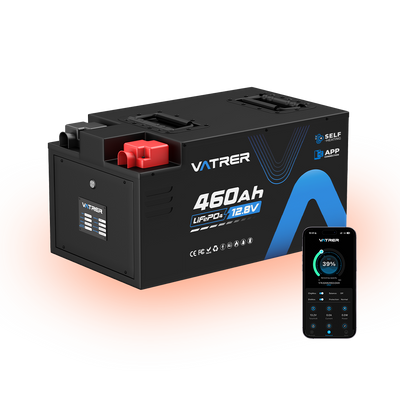
- Cold-weather charging and battery monitoring: Many LiFePO4 batteries restrict charging near or below 32°F to prevent cell damage; a low-temperature cutoff alone does not warm the cells. Some heated designs use incoming charging power to bring the cells into the permitted charging range. If you are planning winter travel or extended off-grid stays, the Vatrer 12V 460Ah self-heating RV battery offers 5,888Wh of energy storage and supports Bluetooth monitoring. When the battery receives a charging current exceeding 5A at temperatures below 32°F, it automatically heats the cells and resumes charging.
RV Fridge Battery and Charging Setup
Consider a 12V compressor fridge in an RV that also runs cabin lights, a water pump, and phone chargers. The design has to account for those loads alongside the refrigerator, with each component serving a different purpose.

- Battery: A 12V 100Ah LiFePO4 battery offers a substantial reserve for overnight use and extended stops. Size it using your combined daily watt-hour demand and the number of days you want to operate without charging, rather than treating 100Ah as a required minimum for every RV.
- DC-DC charger: A properly installed 30A charger can replace energy while you drive, subject to the vehicle and battery limits described above. If your loads average 5A and the charger actually supplies 25A to the house system, the battery gains about 20Ah per hour until charging tapers or it reaches its charge limit.
- Solar (optional but nice): A 200–400W roof array can contribute energy while parked or driving in daylight. For example, 400W × 4 peak-sun-hours × an assumed 75% system yield gives 1,200Wh, or roughly 94Ah at 12.8V; shade, weather, mounting angle, and battery acceptance can lower actual production.
- Inverter (if needed): A 120V residential fridge needs an inverter sized for both running demand and compressor startup. At 180W AC load and 90% inverter efficiency, the battery supplies about 200W before the inverter's idle consumption, equal to roughly 16A at 12.8V. Use the fridge's actual energy consumption for daily battery sizing rather than treating its running current as a continuous 24-hour load.
Common RV Fridge Battery Mistakes
- Running propane while driving without checking restrictions. Gas absorption refrigerators have a burner that must be off during refueling, and some travel routes or carriers restrict propane use. Check the refrigerator manual and applicable tunnel, ferry, and local rules before departure; do not rely on automatic energy selection to make every stop safe.
- Keeping a basic isolator after a lithium upgrade without checking the system. A relay-only charging circuit may have insufficient voltage regulation or excessive current for the new battery and existing alternator. Have the wiring, charging path, and battery specifications assessed before connecting the replacement bank.
- Undersizing the battery bank. Refrigerator consumption is only part of the daily load. Add lights, fans, pumps, controls, inverter losses, and a reserve for unexpected stops, then decide whether 100Ah, 200Ah, or a larger bank suits your travel pattern.
- Overlooking inverter standby draw. Even when an AC refrigerator's compressor is off, its inverter may still consume power. Read the inverter's idle-power specification and include that demand across the hours it remains switched on.
- Planning only for mild weather. High interior temperatures increase cooling demand, while cold battery cells can restrict lithium charging even when the fridge continues operating. Measure consumption on demanding travel days and check charging status before relying on energy from the alternator.
FAQ
Should I cool my RV refrigerator before driving?
Yes. Pre-chill the refrigerator and food before leaving, especially with a 3-way absorption model whose 12V mode may be intended mainly to maintain temperature. Loading warm groceries just before departure adds a cooling demand that can persist for hours.
Why does my 12V RV fridge stop even when the battery still shows a charge?
A low-voltage cutoff, voltage drop through undersized wiring, a blown fuse, or a battery-management-system shutdown may interrupt power before the battery appears empty. Check voltage at the refrigerator while its compressor attempts to start, then inspect the circuit and any fault indicators.
How cold should an RV refrigerator stay during a drive?
Keep the fresh-food compartment at 40°F or below, with the freezer at 0°F if it is storing frozen food. Use an appliance thermometer to check actual compartment temperature; a battery-monitoring app reports electrical conditions, not food temperature.
Final Thoughts
Check the house battery's state of charge after the first stretch of driving and compare it with the reading at departure. That check shows whether your charging system is gaining ground or falling behind while the fridge and other equipment run. Explore Vatrer RV LiFePO4 batteries, which feature long cycle life, deep-cycle capabilities, and built-in battery protection; select the appropriate battery capacity based on your driving needs and the duration of stationary use without an external power source.
Share