How Lithium-Ion Batteries Work?
Reading time: 17 minutes

Share
Lithium-ion batteries power everything from smartphones to golf carts, RVs, boats, and home solar systems. Although these applications have different energy demands, they rely on the same basic process: lithium ions move between electrodes to store and release electrical energy.
Understanding that process helps explain why lithium batteries need specific charging voltages, how they deliver power under heavy loads, and what happens when temperatures drop below freezing. It also makes battery specifications easier to interpret when comparing lithium-ion chemistries or replacing an existing lead-acid system.
How Lithium-Ion Batteries Store and Release Energy
A lithium-ion battery stores energy through reversible electrochemical reactions. Inside each cell are two electrodes: a positive electrode, commonly called the cathode, and a negative electrode, commonly called the anode. Lithium ions move between these electrodes through an electrolyte while electrons travel through an external electrical circuit.
During charging, an external power source drives lithium ions from the cathode toward the anode. In a typical lithium-ion cell with a graphite anode, the ions enter spaces between graphite layers. The battery's stored chemical energy increases as charging continues.
When the battery powers a golf cart motor or an RV refrigerator, the process reverses. Lithium ions move back toward the cathode, and electrons flow through the connected equipment, delivering electrical energy.
This reversible movement is sometimes called the rocking-chair mechanism. The electrode materials accommodate lithium ions repeatedly without being completely consumed during normal operation. Side reactions and structural changes still occur over time, which gradually reduce battery capacity and contribute to aging.
The Four Main Components of a Lithium-Ion Battery
Every conventional lithium-ion cell contains four essential components. Their materials and construction influence the battery's voltage, energy density, charging performance, lifespan, and safety.

Cathode (Positive Electrode)
The cathode determines much of the battery's electrochemical behavior. Common cathode materials include lithium iron phosphate (LiFePO4 or LFP), lithium nickel manganese cobalt oxide (NMC), and lithium nickel cobalt aluminum oxide (NCA).
LiFePO4 uses an iron-phosphate structure with strong phosphorus-oxygen bonds. This structure provides relatively high thermal stability and supports repeated charging and discharging, making LFP suitable for deep-cycle applications such as RV house batteries, electric golf carts, and stationary energy storage.
Anode (Negative Electrode)
Graphite is widely used as the anode material in conventional lithium-ion batteries. Its layered structure provides spaces where lithium ions can be stored during charging and released during discharge.
Anode quality affects charging speed, internal resistance, and battery aging. Poor operating conditions, especially rapid charging at low temperatures, can cause metallic lithium to deposit on the graphite surface instead of entering its structure. This process, known as lithium plating, can reduce capacity and increase safety risks.
Electrolyte
The electrolyte carries lithium ions between the electrodes. Many conventional lithium-ion cells use a lithium salt, such as lithium hexafluorophosphate (LiPF6), dissolved in organic carbonate solvents.
The electrolyte conducts ions while providing very little electronic conductivity. This separation allows ions to move inside the cell while electrons travel through the external circuit. Electrolyte composition also affects low-temperature performance, charging behavior, and cell aging.
Separator
The separator is a thin, porous membrane positioned between the anode and cathode. It allows lithium ions to pass through while keeping the electrodes physically separated, reducing the risk of an internal electrical short circuit.
Polyethylene and polypropylene are common separator materials. Some separator designs can close their pores when heated, reducing ion transport, but this shutdown behavior depends on the specific construction and cannot eliminate every thermal runaway risk.
How LiFePO4 Batteries Differ From Other Chemistries
LiFePO4 belongs to the lithium-ion battery type. Its iron-phosphate cathode gives it different characteristics from nickel-based lithium-ion chemistries, particularly in thermal stability, energy density, and cycle life.
For golf carts, RVs, marine equipment, and solar storage, the main considerations are how much usable energy the battery stores, how often it can be cycled, and how it performs under the expected loads.
Comparison of LiFePO4, Nickel-Based Lithium-Ion, and Lead-Acid Batteries
| Feature | LiFePO4 (LFP) | NMC / NCA | Lead-Acid (Flooded/AGM/Gel) |
|---|---|---|---|
| Nominal cell voltage | 3.2 V | 3.6–3.7 V | 2.0 V |
| Cycle life | Commonly thousands of cycles | Varies widely; hundreds to thousands | Commonly hundreds; depends on depth of discharge |
| Thermal behavior | Generally more resistant to thermal runaway | Lower thermal stability under comparable abuse conditions | Different hazards, including acid exposure and gas generation |
| Typical usable capacity | Often 80–100% DoD, depending on specifications | Depends on design and lifespan requirements | Often sized around 50% DoD for longer service life |
| Weight for comparable usable energy | Much lighter than lead-acid | Often lighter than LFP | Generally heaviest |
| Maintenance | No watering | No watering | Flooded types need watering; AGM/Gel types do not |
LiFePO4 cells generally offer a useful combination of long cycle life and thermal stability. Their iron-phosphate structure is more resistant to oxygen release under elevated temperatures than many nickel-rich cathode materials. However, LFP cells still contain flammable electrolyte and can experience thermal runaway under severe abuse.
The trade-off is energy density. NMC and NCA cells can store more energy per pound, which makes them attractive for applications with strict weight or space limits. LFP's advantages become particularly useful in systems where installation space can accommodate the battery and frequent deep cycling is expected.
Cycle-life comparisons also depend heavily on operating conditions. Depth of discharge, temperature, charging rate, and the capacity-retention threshold used in testing can substantially change the reported results. A cycle-life rating should therefore be evaluated together with its stated test conditions.
How Lithium-Ion Batteries Charge and Discharge
Charging and discharging involve opposite movements of lithium ions and electrons. The direction of that movement determines whether the battery absorbs energy or supplies it to an external load.
During charging, lithium ions leave the positive electrode, pass through the electrolyte and separator, and enter the graphite anode. Electrons supplied through the external charging circuit balance this movement. As the process continues, the anode becomes increasingly rich in lithium.
A typical LiFePO4 charger uses a constant-current/constant-voltage (CC/CV) charging profile. It first supplies controlled current while battery voltage rises, then holds a specified voltage as charging current gradually decreases. The maximum charge voltage for a conventional LFP cell is commonly around 3.65 V, although the battery manufacturer's recommended charging settings may be lower.
During discharge, lithium ions move back toward the positive electrode while electrons flow through the connected load. The battery's stored energy decreases as this process continues.
Battery energy capacity is commonly expressed in watt-hours (Wh) or kilowatt-hours (kWh). It can be estimated using nominal voltage and amp-hour capacity:
Nominal energy (Wh) = Nominal voltage (V) × Capacity (Ah)
For a 51.2V 100Ah LiFePO4 battery:
51.2 V × 100 Ah = 5,120 Wh = 5.12 kWh
This represents nominal stored energy. At an 80% depth of discharge, the corresponding energy amount is approximately:
5,120 Wh × 0.80 = 4,096 Wh
Actual energy delivered to appliances may be lower because of inverter losses, temperature, discharge rate, and other operating conditions.
LiFePO4 batteries also have a relatively flat discharge-voltage curve. Voltage remains within a comparatively narrow range through much of the discharge cycle before falling more rapidly near depletion.
In an electric golf cart, this characteristic can help maintain more consistent electrical performance as the battery discharges. Actual vehicle speed and acceleration still depend on the motor controller, current limits, terrain, and load. A flat voltage curve also makes voltage-only state-of-charge estimates less accurate through the middle of the discharge range.
How the Battery Management System (BMS) Works
A Battery Management System (BMS) monitors and controls important operating limits within a lithium battery pack. Depending on its design, it measures cell voltages, current, and temperature, then restricts charging or discharging when specified limits are exceeded.
BMS protection thresholds and current ratings vary between battery models. The system also cannot compensate for incorrect wiring, incompatible charging equipment, or loads that exceed the battery's electrical design.
Overcharge Protection
Overcharge protection prevents individual cells from exceeding their permitted voltage range. If a cell reaches its upper protection threshold, the BMS can interrupt charging to reduce the risk of accelerated degradation, gas generation, or other cell damage.
The protection threshold may differ from the charger's normal target voltage. Charging equipment should regulate voltage during routine operation rather than repeatedly relying on a BMS shutdown.
Over-Discharge Protection
When a cell reaches its minimum permitted voltage, the BMS can disconnect the load. This protects the cell from excessive discharge, which may cause permanent capacity loss and other damage.
Some protected batteries may show little or no voltage at their external terminals after a shutdown. Recovery procedures depend on the battery design, and prolonged storage in a deeply discharged condition can still damage the cells.
Over-Current Protection
A BMS limits current according to its rated continuous and peak-discharge capabilities. Heavy acceleration, motor startup, and inverter surge loads may briefly demand substantially more current than normal operation.
For example, a 12.8V battery with a 100A continuous-discharge rating has approximately 1,280W of nominal DC output capability before accounting for voltage changes and system losses. An inverter's startup demand may exceed that limit even when its normal operating power appears acceptable.
Temperature Protection
Temperature sensors allow the BMS to restrict operation outside the battery's permitted range. For conventional LiFePO4 batteries, low-temperature charging protection commonly prevents charging when cell temperatures approach or fall below 32°F.
High-temperature protection can also interrupt charging or discharging. The allowable operating temperatures and recovery thresholds depend on the cell specifications and BMS design.
Cell Balancing
Cells connected in series gradually develop small differences in voltage and state of charge. These differences arise from variations in capacity, internal resistance, temperature, and aging.
Cell balancing helps reduce these differences. Passive balancing typically dissipates a small amount of energy from higher-voltage cells, while active balancing systems can transfer charge between cells. The balancing method and current determine how effectively the system can correct imbalances.
Current rating is another specification worth checking before selecting a replacement battery.
Take specialized vehicles (such as UTVs) that frequently carry heavy loads or climb steep slopes as an example: you can compare two Vatrer 48V lithium battery models—one is a standard 48V 105Ah lithium battery with a continuous discharge current rating of 200A, while the other is a dedicated UTV lithium battery with a rating of 300A. Before placing an order, be sure to verify the controller's continuous and peak current requirements to ensure they fall within the rated limits of the chosen battery model.
Building 36V, 48V, and 72V LiFePO4 Battery Packs
A single LiFePO4 cell has a nominal voltage of approximately 3.2 V. Higher-voltage battery packs connect multiple cells in series, adding their voltages to achieve the required system voltage.
For example, sixteen 3.2V cells connected in series produce a nominal voltage of 51.2 V. This configuration is commonly used in batteries sold for 48V electrical systems.
Common LiFePO4 Battery Pack Configurations
| System Class | Cell Configuration | Nominal Voltage | Approx. Full-Charge Voltage | Typical Use |
|---|---|---|---|---|
| 36V | 12S | 38.4 V | 43.8 V | 36V golf carts and utility equipment |
| 48V | 16S | 51.2 V | 58.4 V | 48V golf carts, utility vehicles, and energy storage |
| 72V | 22S | 70.4 V | 80.3 V | Selected 72V electric vehicle systems |
| 72V | 24S | 76.8 V | 87.6 V | Selected higher-voltage traction systems |
Full-charge voltages are calculated using 3.65 V per cell. Actual charging targets depend on battery specifications.
The same voltage-class label can refer to different internal cell arrangements, particularly in higher-voltage systems. Battery manufacturers may also specify charging targets below the maximum calculated cell voltage. The controller's allowable voltage range must accommodate the complete battery operating range.
Parallel connections increase capacity without increasing nominal voltage. A 16S2P arrangement, for example, uses 16 series-connected groups with two cells in parallel per group.
If each cell has a capacity of 100Ah, the resulting configuration provides:
Nominal voltage = 16 × 3.2 V = 51.2 V
Pack capacity = 2 × 100 Ah = 200 Ah
Cell configuration also affects physical dimensions, internal wiring, protection-system design, and installation requirements.
These principles apply to stationary energy storage as well. A 51.2V 100Ah LiFePO4 battery stores approximately 5.12 kWh of nominal DC energy, but providing household AC power requires a compatible inverter. A backup installation also needs appropriate switching, electrical protection, and isolation from the utility supply.
For golf cart conversions, physical fit must be checked alongside electrical compatibility. Replacing a bank of six 8V lead-acid batteries with a single lithium pack may free up battery-compartment space, but the new pack still needs suitable mounting, cable routing, fusing, and connections. Cart model, controller specifications, and accessory loads determine the remaining installation requirements.
Benefits of Upgrading From Lead-Acid to LiFePO4
The economic case for a lithium upgrade depends on purchase cost, expected battery life, maintenance, and the amount of usable energy delivered over time.
Lead-acid batteries usually have a lower initial purchase price. Lithium iron phosphate batteries generally cost more upfront but can reduce replacement frequency under comparable deep-cycle service conditions.
A useful ownership-cost calculation includes all the battery sets purchased over the planned service period, together with installation and maintenance expenses:
Total battery cost = Initial purchase + Replacement batteries + Installation + Maintenance
The expected number of replacements depends on actual usage rather than calendar age alone. A golf cart used daily may accumulate charge-discharge cycles much faster than one driven only a few weekends each month. Storage temperature and charging practices also affect both chemistries.
Routine maintenance differs by battery type. Flooded lead-acid batteries require electrolyte-level checks and periodic watering, while sealed AGM and gel batteries do not. LiFePO4 batteries eliminate watering and routine lead-acid equalization, although terminals, cables, mounting hardware, and battery condition still require occasional inspection.
Weight and usable energy are particularly relevant for RV and marine applications. Lead-acid banks are often sized around a 50% depth of discharge to support longer cycle life, while many LiFePO4 systems permit substantially deeper routine discharge.
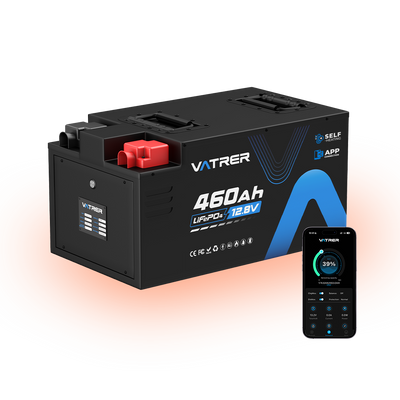
For example, a 12.8V 300Ah LiFePO4 battery provides approximately 3.07 kWh when discharged to 80% of its rated capacity. A 12V 460Ah lead-acid bank provides approximately 2.4 kWh at a 50% depth of discharge. These are approximate energy comparisons, and actual delivered energy depends on voltage under load, discharge rate, temperature, and battery condition.
Replacing a larger lead-acid bank with a smaller LiFePO4 system can therefore reduce battery weight and free up usable installation space. In RVs, that may leave more payload capacity for equipment and supplies. In boats, battery placement and weight distribution still need to be considered.
Charging behavior offers another practical difference. LiFePO4 batteries can accept relatively high charging currents within their rated limits and can be recharged after partial use without a memory-effect penalty. Total charging time depends on capacity, charger output, battery temperature, and the current taper near the end of charging.
How Cold Weather Affects LiFePO4 Batteries
Low-temperature charging is a significant operating limitation for conventional LiFePO4 batteries. As cell temperature falls, lithium-ion transport and graphite-anode reaction rates slow down.
Charging under unsuitable conditions can cause lithium plating on the graphite anode. Some deposited lithium may become electrochemically inactive, reducing usable capacity. Repeated plating can also increase internal resistance and contribute to conditions associated with internal short circuits.
Many LiFePO4 batteries therefore restrict charging at or below approximately 32°F. The exact limit depends on cell chemistry, charging current, and the manufacturer's specifications. A battery stored overnight in freezing conditions may remain too cold to charge even after the surrounding air begins to warm.
Discharging is different. LiFePO4 batteries can generally supply power at temperatures below freezing if the temperature remains within their specified discharge range. However, available capacity and power decrease as internal resistance rises, so a battery may deliver less runtime in winter than it does in mild weather.
Self-heating batteries address cold-weather charging by warming the cells before normal charging begins. The heating system may use external charging power or another permitted power source, depending on its design. Heating time varies with battery size, initial cell temperature, heater output, and insulation.
For golf carts stored in unheated garages, the Vatrer 48V 105Ah heated lithium battery features a 200W self-heating system; it preheats the cells when charging conditions are met and initiates charging only after the battery temperature reaches the permissible range. Before purchasing this model, please be sure to review the activation criteria for the heating function and your specific requirements for winter charging setups.
Matching Chargers and Controllers to LiFePO4 Batteries
A lithium battery replacement must work with the charging system and connected electrical equipment. Existing lead-acid components should be evaluated against the lithium battery's voltage and current specifications before installation.
Lead-acid chargers commonly use bulk, absorption, and float stages. Some also include equalization or desulfation modes, which may apply voltages unsuitable for LiFePO4 batteries.
LiFePO4 batteries generally use CC/CV charging without requiring a continuous lead-acid-style float charge. A common charging range for a 12.8V LiFePO4 battery is approximately 14.4–14.6 V, subject to the manufacturer's stated requirements.
A charger with a lithium setting may be compatible, but the label alone is insufficient. Its voltage, current limit, charging termination behavior, and any automatic maintenance functions must meet the battery specifications.
Charging time can be estimated from the amount of capacity that needs to be replaced and the charger's output current:
Approximate bulk charging time (hours) = Capacity to replace (Ah) ÷ Charging current (A)
For example, replacing 80Ah with a charger delivering 20A requires approximately four hours during the constant-current portion. The full charging process may take longer because current decreases during the constant-voltage stage, and some systems limit charging current under particular operating conditions.
Golf cart motor controllers present a different compatibility issue. They must tolerate the lithium pack's full-charge voltage and operate correctly across its discharge range. A controller originally designed for lead-acid batteries may have voltage cutoffs or charging-related functions that do not match the lithium pack.
Controller current demand must also remain within the battery's continuous and peak-discharge ratings. High-power motors, upgraded controllers, larger tires, and heavy vehicle loads can increase current demand beyond the capability of a basic replacement pack.
Regenerative braking deserves separate attention where applicable. A motor controller that returns energy to the battery during deceleration can raise battery voltage or request charging current even when the pack is nearly full. Battery and controller settings must accommodate that behavior.
Before installing a lithium replacement, verify the following:
- Battery voltage: Nominal voltage, full-charge voltage, and permitted operating range.
- Controller requirements: Continuous current, peak current, low-voltage cutoff, and regenerative charging behavior.
- Charger compatibility: LiFePO4 charging profile, voltage, current, and termination settings.
- Electrical connections: Cable size, fusing, terminals, connectors, and required communication interfaces.
- Physical installation: Battery dimensions, secure mounting, ventilation requirements, and accessory connections.
A matched conversion kit can simplify component selection, but it does not eliminate the need to check vehicle-specific compatibility.
FAQs
How can I tell when a LiFePO4 battery is nearly empty?
Use a compatible battery monitor or BMS state-of-charge reading rather than relying on voltage alone. Because LiFePO4 voltage remains relatively flat through much of the discharge cycle, voltage-only readings can give a misleading estimate of remaining capacity.
Can I connect two LiFePO4 batteries in parallel?
Yes, if the battery manufacturer permits parallel operation for those models. Batteries should meet the specified voltage, state-of-charge, protection, and connection requirements before being connected. Some models are not designed for parallel expansion.
How should I store a LiFePO4 battery for several months?
Store it in a cool, dry location within the manufacturer's specified temperature range, generally at a partial state of charge rather than fully depleted. Disconnect unnecessary loads, and check battery condition periodically according to the product's storage instructions.
Can I connect a solar panel directly to a LiFePO4 battery?
A solar panel generally requires a compatible solar charge controller between the panel and battery. The controller regulates charging voltage and current according to the battery's requirements. Connecting a panel directly can expose the battery to unsuitable charging conditions.
Conclusion
Understanding lithium-ion battery operation provides a practical way to evaluate an upgrade. Start with the electrical demands of the complete system: operating voltage, required current, daily energy consumption, charging sources, and expected temperatures. Then compare those requirements against the battery's capacity, BMS ratings, and operating limits.
A correctly selected LiFePO4 system can provide long cycle life, lower weight, and reduced maintenance compared with lead-acid batteries. Its performance still depends on compatible equipment and suitable operating conditions. Explore Vatrer LiFePO4 batteries and complete conversion kits, and contact the Vatrer technical team with your system requirements to select a battery with suitable BMS protection, compatible charging equipment, and the monitoring or cold-weather features your installation needs.