Can I Run an AC on Lithium Battery Power? A Comprehensive Guide
Reading time: 7 minutes
You can run an air conditioner on lithium battery power, but the real question is how long you want it to run and whether your battery bank, inverter, and charging system are sized correctly. An AC unit is one of the biggest power loads in an RV, cabin, van, boat, or backup power setup, so it needs more planning than running lights, a fridge, or a water pump.
Lithium batteries are a great match for air conditioning because they are lighter, more efficient, faster to charge, and have more usable capacity than traditional lead-acid batteries. Still, you cannot just plug a rooftop RV AC into one small battery and expect it to run all night. You need to calculate wattage, starting surge, battery capacity, inverter size, and recharge method.
In this guide, we will break down how lithium batteries power AC units, how to estimate runtime, what size battery bank you may need, and what to check before building your setup.

Why Lithium Batteries Are Better for Running AC
Lithium batteries, especially LiFePO4 batteries, are widely used in RVs, vans, solar systems, and portable power setups because they provide more usable energy in a lighter package. That matters a lot when your goal is to run an air conditioner away from shore power.
Compared with lead-acid batteries, lithium batteries can usually discharge deeper, hold voltage more steadily, and recharge faster. This makes them much more practical for high-demand loads like air conditioning.
Key Features of Lithium Batteries
- High usable capacity: Lithium batteries can typically use a much larger percentage of their rated capacity than lead-acid batteries.
- Long cycle life: A quality LiFePO4 battery can handle thousands of charge and discharge cycles.
- Lightweight design: Lithium batteries are much easier to install in RVs, vans, trailers, and boats where weight matters.
- Stable voltage: They hold voltage better under load, which helps inverters run more smoothly.
- Fast charging: Lithium batteries can recover faster from solar, alternator charging, generator charging, or shore power.
Can One Lithium Battery Run an AC?
Sometimes, but usually not for very long. A single lithium battery may be able to start and run a small air conditioner if the battery and inverter are powerful enough. However, a typical RV rooftop AC can draw a lot of power, and runtime can disappear quickly.
For example, if an AC unit uses 1,000 watts while running, that is 1,000 watt-hours of energy for every hour of operation before inverter losses. A 12V 100Ah lithium battery stores about 1,280 watt-hours on paper, but after inverter losses and safe operating margins, it may only run that AC for roughly about an hour or less in real-world use.
For serious AC runtime, most RV owners use a larger lithium battery bank, often 300Ah, 400Ah, 600Ah, or more at 12V, or they move to 24V or 48V systems to reduce current and improve efficiency.
Understand Running Watts and Starting Watts
Air conditioners have two power numbers you need to understand: running wattage and starting wattage.
- Running wattage: The power the AC uses after it is already running.
- Starting wattage: The short surge of power needed to start the compressor.
The starting surge can be much higher than the running power. For example, an AC unit may run at 1,000 watts but need 3,000 watts for a moment when the compressor starts. This is why the inverter must be sized for both continuous output and surge output.
| AC Load | Example Wattage | What It Means |
|---|---|---|
| Running Wattage | 1,000 watts | Power used while the AC is cooling normally |
| Starting Wattage | 3,000 watts | Short surge needed to start the compressor |
| Inverter Size | At least 3,000W surge-capable | Must handle startup without shutting down |
A soft start device can reduce compressor startup surge, making it easier for a lithium battery and inverter system to start an RV rooftop AC. This is especially useful for boondocking, van life, and off-grid RV setups.
How to Calculate Battery Size for an AC Unit
The basic formula is simple:
Battery capacity needed in watt-hours = AC running watts × hours of use ÷ inverter efficiency
Then convert watt-hours to amp-hours:
Battery capacity in Ah = watt-hours ÷ battery voltage
Example Calculation
Let’s say your air conditioner uses 1,000 watts while running and you want to run it for 5 hours.
- Running wattage: 1,000 watts
- Runtime goal: 5 hours
- Energy needed before losses: 1,000W × 5h = 5,000Wh
- Estimated inverter efficiency: 90%
- Real battery energy needed: 5,000Wh ÷ 0.90 = about 5,556Wh
For a 12V battery system:
5,556Wh ÷ 12V = about 463Ah
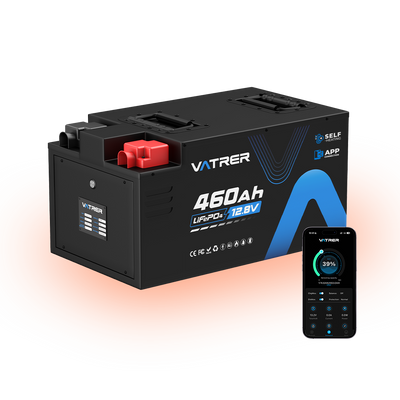
So, in real-world terms, a 12V lithium battery bank of around 500Ah would be a more realistic target for running a 1,000W AC for about 5 hours. Without inverter losses, the simple calculation would be 416.67Ah, but real systems always need extra margin.
Battery Runtime Estimates for AC Use
Actual runtime depends on AC size, outdoor temperature, thermostat setting, insulation, compressor cycling, battery voltage, inverter efficiency, and battery usable capacity. Still, the table below gives a practical starting point.
| Battery Bank | Approx. Stored Energy | Estimated Runtime with 1,000W AC |
|---|---|---|
| 12V 100Ah lithium | About 1.28kWh | About 1 hour or less after losses |
| 12V 300Ah lithium | About 3.84kWh | About 3 hours or less after losses |
| 12V 500Ah lithium | About 6.4kWh | About 5 hours, depending on cycling and losses |
| 48V 100Ah lithium | About 5.12kWh | About 4 to 5 hours, depending on system efficiency |
Choosing the Right Lithium Battery for Air Conditioning
When running AC on lithium battery power, do not choose only by amp-hours. You also need to look at discharge current, BMS rating, inverter compatibility, and charging setup.
- Capacity: Make sure the battery bank has enough watt-hours for your desired runtime.
- Discharge rate: The battery must safely deliver enough current for the inverter and AC load.
- BMS rating: A strong Battery Management System helps protect against over-discharge, overheating, overcurrent, and short circuits.
- Voltage: Large AC systems may work better on 24V or 48V battery banks because current is lower than on 12V.
- Charger compatibility: Use lithium-compatible solar controllers, converters, DC-DC chargers, and inverter chargers.
- Temperature protection: If you camp in cold weather, choose a battery with low-temperature charging protection or heating.
Inverter Size Matters
An air conditioner normally runs on AC power, while batteries store DC power. That means you need an inverter to convert battery power into household-style AC power.
For many RV rooftop AC units, a 2,000W inverter may not be enough unless the AC is small and has a soft start. A 3,000W inverter is a more common choice for many RV air-conditioning setups, but the right size depends on your specific AC unit and other loads running at the same time.
Also remember that inverter surge rating matters. If the inverter cannot handle the compressor startup surge, it may shut down even if the battery bank has enough capacity.
Advantages of Running AC on Lithium Battery Power
1. Better Efficiency
Lithium batteries waste less energy than lead-acid batteries and hold voltage better under heavy loads. That means more of the stored energy is available for cooling instead of being lost as heat or voltage drop.
2. Cleaner Off-Grid Comfort
When paired with solar panels, lithium batteries can reduce generator runtime and make off-grid camping quieter. This is a big benefit for RVers who camp in national parks, remote sites, or hot summer areas where AC is not a luxury.
3. Portability and Weight Savings
Lithium batteries are much lighter than lead-acid batteries. In an RV, travel trailer, van, or boat, that weight savings can make installation easier and help protect cargo capacity.
Challenges to Plan For
1. Higher Upfront Cost
Lithium battery systems cost more upfront than lead-acid systems. Once you add batteries, inverter, wiring, fuses, charger upgrades, and possible soft start equipment, the full setup can be a serious investment.
2. Compatibility
Not every air conditioner, converter, solar controller, or inverter is ready for lithium battery power. Before upgrading, check that your AC, inverter, battery, charger, and wiring can all work together safely.
3. Recharging the Battery Bank
Running AC drains batteries quickly. You need a plan to recharge them. Solar can help, but roof space may limit how much power you can collect. Many RVers use a mix of solar, alternator charging, shore power, and generator backup.
Conclusion
You can run an air conditioner on lithium battery power, and lithium is one of the best battery types for the job. It offers high usable capacity, strong efficiency, lighter weight, fast charging, and reliable performance under load.
The key is proper system sizing. Calculate your AC running watts, account for starting surge, choose an inverter with enough continuous and surge power, and build a lithium battery bank large enough for your target runtime. For occasional short cooling, a smaller setup may work. For several hours of RV AC, you will likely need a larger battery bank, a strong inverter, and a serious recharge plan.
Share