How Much Solar Do I Need for a 40 Ft Camper? Full-Time RV Guide
Reading time: 13 minutes

Share
For a 40 ft camper used for full-time RV living, most people need 800W–1200W of solar panels with a 400Ah–600Ah LiFePO4 lithium battery bank for moderate boondocking. If you mostly stay plugged into shore power at RV parks, you may only need 200W–400W of solar and 100Ah–200Ah of lithium battery capacity for basic 12V backup. If you want heavy off-grid living with an air conditioner, residential refrigerator, microwave, Starlink, and daily appliance use, plan closer to 1200W–2000W+ of solar and 800Ah–1200Ah+ of LiFePO4 lithium battery capacity.
A 40 ft camper is not sized like a small weekend trailer. It can feel more like a small mobile home, especially when you live in it every day. The right RV solar system depends on your daily power use, sun exposure, battery capacity, roof space, and whether you expect solar to support air conditioning.


How Much Solar Do You Need for a 40 Ft Camper?
The best starting point is your camping style. A full-time RVer staying at RV parks does not need the same camper solar setup as someone living in an off-grid camper for weeks at a time.
Solar and Lithium Battery Sizing Guide for a 40 Ft Camper
| Full-Time Camper Use Case | Estimated Daily Use | Suggested Solar Panels | Suggested LiFePO4 Lithium Battery Bank | Best For |
|---|---|---|---|---|
| Mostly plugged into shore power | 0.5–1.5 kWh/day | 200W–400W optional solar | 100Ah–200Ah | RV parks, lights, water pump, slide-outs, basic 12V loads |
| Light off-grid use | 1.5–3 kWh/day | 600W–800W | 300Ah–400Ah | Short boondocking trips and light appliance use |
| Moderate full-time boondocking | 3–6 kWh/day | 800W–1200W | 400Ah–600Ah | Fridge, lights, fans, laptops, Starlink, small appliances |
| Heavy off-grid living | 6–10 kWh/day | 1200W–1600W | 600Ah–800Ah | Longer stays, remote work, higher appliance use |
| High-load full-time living | 10 kWh/day or more | 1600W–2000W+ | 800Ah–1200Ah+ | Air conditioner use, microwave, residential fridge, high daily demand |
For many 40 ft camper owners, 1000W of solar is a practical starting point for regular boondocking. It can cover normal daily loads in good sun, but it should not be treated as enough for long air conditioner runtime. Once AC becomes part of your daily plan, the solar array, lithium battery bank, and inverter all need to be sized more carefully.
What Affects Solar Needs for Full-Time Camper Living?
A 40 ft camper gives you more living space, but it also brings more electrical loads. Before choosing panels, look at what runs every day and what pulls high wattage for short periods.
Daily Power Usage
Your daily power usage drives the entire system size. You are not really sizing solar for the camper length. You are sizing solar for your refrigerator, lights, fans, water pump, laptops, TV, Starlink, microwave, coffee maker, and air conditioner.
Some loads are easy to underestimate. A coffee maker may pull 800W–1200W, but it only runs for a few minutes. A refrigerator, internet device, or furnace fan may draw less power at one moment, yet run long enough to use more energy across the day.
For moderate off-grid use, many campers fall around 3–6 kWh per day. A large 40 ft camper with multiple AC units, a residential-style refrigerator, electric cooking, and long workdays can move into 10–20+ kWh per day. That does not mean every 40 ft camper uses that much power. It means your appliance list matters more than the trailer length.
Sunlight Hours and Roof Space
Solar panels do not produce their rated wattage all day. A 1000W solar array does not give you 1000W from sunrise to sunset. Most sizing estimates use 3–6 peak sun hours per day, depending on location, weather, season, and panel placement.
Roof space also matters. A 40 ft camper may look large, but air conditioners, vents, skylights, antennas, roof curves, and shade can reduce usable panel space. Some roofs can fit 800W–1200W without much trouble. Others may need higher-wattage panels or a more careful layout to reach the same output.
Air Conditioner and High-Load Appliances
Air conditioning is usually the biggest variable. A single RV air conditioner may use about 1200W–1800W while running, and startup surge can be much higher without a soft start device. If your camper has two AC units, the demand can rise fast.
Other high-load appliances also affect your setup:
- Microwave: Often uses 900W–1500W. Short runtime makes it manageable, but it still affects inverter sizing.
- Coffee maker: Often uses 800W–1200W. It is usually a short burst load, not a large all-day energy load.
- Electric cooking appliances: Many use 1000W–1800W. Daily electric cooking can push you into a larger battery bank.
- Hair dryer or space heater: Often uses 1200W–1500W. These loads can drain batteries quickly and should be used with care off-grid.
This is why two 40 ft campers with the same solar panels can perform very differently. One owner may run fans, lights, and a propane stove. Another may run AC, induction cooking, and Starlink all day. Those systems need different planning.
How to Calculate Solar Panel Size for a Camper
You just need to calculate your daily energy use, then size your solar panels and lithium battery bank around that number.
Step 1: Estimate Your Daily Watt-Hours
Use this formula:
Appliance watts × hours used per day = daily watt-hours
Sample Daily Power Use for a 40 Ft Camper
| Appliance | Power Draw | Daily Runtime | Daily Energy Use |
|---|---|---|---|
| Refrigerator | 120W | 10 hours | 1200Wh |
| Laptop | 60W | 6 hours | 360Wh |
| Starlink or internet device | 50W–75W | 8 hours | 400Wh–600Wh |
| LED lights | 40W | 5 hours | 200Wh |
| Water pump | 60W | 0.5 hour | 30Wh |
| Microwave | 1000W | 0.25 hour | 250Wh |
| Vent fans | 40W | 8 hours | 320Wh |
This sample comes out to about 2760Wh–2960Wh per day before system losses. Add 15%–25% for inverter loss, charging loss, cloudy periods, and real-world usage changes. That puts the same setup around 3200Wh–3700Wh per day.
This example does not include air conditioning. If you add AC, calculate it separately because it can use several kWh in only a few hours.
Step 2: Convert Daily Power Use Into Solar Wattage
Use this formula:
Daily watt-hours ÷ peak sun hours = minimum solar wattage
If you use 5000Wh per day and get 5 peak sun hours, the estimate is:
5000Wh ÷ 5 = 1000W of solar panels
That is the minimum number. Real camper roofs deal with heat, clouds, shade, dust, flat mounting angles, and shorter winter days. A more realistic version adds a buffer:
5000Wh ÷ 5 × 1.2 = 1200W of solar panels
That 20% margin helps reduce generator use and gives your system more room for imperfect weather.
Step 3: Match Solar Output With Battery Capacity
Solar panels refill your system during the day. Your LiFePO4 lithium battery bank carries you through the night, cloudy mornings, and high-load moments.
Solar panels work like the system’s charging source, while the battery bank stores the energy for later use. If the solar array is too small, the battery bank may not recover after heavy power use. If the solar array is large but the battery bank is too small, you may produce enough power during the day but still run short overnight.
For full-time RV living, size these parts together:
- Solar panels: Cover your average daily use and recharge the battery bank during available sun.
- Lithium battery bank: Stores enough energy for night use, cloudy weather, and appliance peaks.
- Inverter: Handles AC appliance wattage and startup surge.
- Backup charging: Covers poor weather, winter sun, shade, or high-load days.
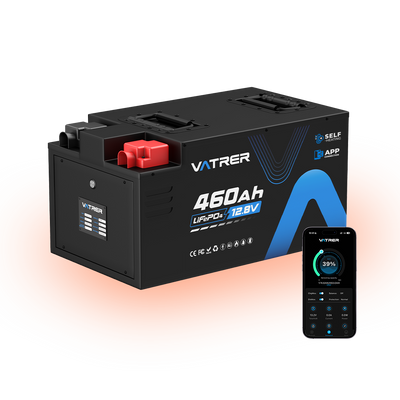
If you are comparing battery options for a 40 ft camper, Vatrer 12V lithium batteries are worth considering because built-in BMS protection, app monitoring, and low-temperature protection make it easier to track real usage and protect the system during daily off-grid use.
What Size LiFePO4 Lithium Battery Bank Do You Need?
For a 40 ft camper, battery capacity is just as important as solar panel wattage. Solar gets attention because it is visible on the roof, but the battery bank decides how long your fridge, fans, lights, electronics, and appliances keep running when the sun is gone.
LiFePO4 Lithium Battery Bank Sizing by Use Case
| Use Case | Suggested LiFePO4 Battery Capacity | Approx. 12V Energy Storage | Practical Use |
|---|---|---|---|
| Shore power backup | 100Ah–200Ah | 1.28–2.56 kWh | Basic 12V loads and short unplugged periods |
| Light off-grid use | 300Ah–400Ah | 3.84–5.12 kWh | Short boondocking, lights, fans, fridge, small electronics |
| Moderate full-time use | 400Ah–600Ah | 5.12–7.68 kWh | Daily off-grid living with controlled appliance use |
| Heavy off-grid use | 600Ah–800Ah | 7.68–10.24 kWh | Remote work, Starlink, longer stays, more appliance use |
| High-load living | 800Ah–1200Ah+ | 10.24–15.36 kWh+ | AC support, residential fridge, high daily energy demand |
These energy estimates assume a 12.8V LiFePO4 lithium battery system. If you move to 24V or 48V, the Ah number changes. Compare watt-hours, not Ah alone.
Use this formula:
Battery watt-hours = battery voltage × amp-hours
A 12.8V 400Ah lithium battery bank stores about 5120Wh, or 5.12 kWh. A 25.6V 200Ah lithium battery bank stores about the same amount of energy. The Ah number is lower, but the stored energy is similar because the voltage is higher.
For high-load systems, 24V or 48V can reduce current for the same wattage. That can help with larger inverters and heavier loads, though it also makes system design more involved. Many RV owners still prefer a well-planned 12V LiFePO4 setup because it is easier to match with common RV equipment.
Battery type also changes usable capacity. A LiFePO4 lithium battery usually supports 80%–100% depth of discharge. AGM or flooded lead-acid batteries are commonly limited to about 50% usable capacity if you want reasonable lifespan. A 400Ah AGM battery bank may only give you around 200Ah of practical use, while a 400Ah LiFePO4 lithium battery bank gives you much more usable energy.
Can Solar Run an Air Conditioner in a 40 Ft Camper?
Solar can run or help run an RV air conditioner, but long AC runtime requires a large system. You need enough solar input, enough LiFePO4 battery capacity, an inverter that can handle the load, and usually a backup charging option.
A typical RV air conditioner may draw about 1200W–1800W while running. If it runs for 4 hours, that can use roughly 4.8–7.2 kWh before inverter losses. That one appliance can use as much energy as an entire moderate off-grid camper setup uses in a day.
Startup surge is a separate issue. Some AC units can surge to 3000W–6000W for a short moment when the compressor starts. A soft start device can reduce that startup demand, but it does not reduce the total energy needed to cool the camper.
Air Conditioner Solar Planning for a 40 Ft Camper
| AC Use Pattern | Suggested Solar Panels | Suggested LiFePO4 Battery Bank | Inverter Target | Backup Power |
|---|---|---|---|---|
| Occasional short AC use | 1200W–1600W | 600Ah–800Ah | Around 3000W | Recommended |
| Frequent AC use | 1600W–2000W+ | 800Ah–1200Ah+ | 3000W or larger | Strongly recommended |
| Long hot-weather AC runtime | 2000W+ if roof space allows | 1000Ah+ or higher-voltage system | Sized to AC surge/load | Usually needed |
Solar can support AC, but it should not be sized casually. If you want to keep a 40 ft camper cool all day in summer, solar may become limited by roof space, cost, and battery capacity. In that case, solar is part of the power plan, not the only source.
What Other Components Do You Need for a Camper Solar System?
A good RV solar system is more than panels and batteries. The supporting components decide how smoothly and safely the system works.
- Inverter: The inverter turns DC battery power into AC power for household-style appliances. A 2000W inverter can handle basic AC loads, while a 3000W inverter is more practical for a microwave, coffee maker, and heavier daily use. For air conditioning or several high-watt appliances at once, you may need a larger inverter.
- MPPT charge controller: The MPPT charge controller manages power from the solar panels to the lithium battery bank. It needs to match solar array wattage, battery voltage, and charging current. A 1200W solar array on a 12V system creates much higher charging current than the same array on a 24V or 48V system.
- Battery monitoring: Full-time use is easier when you can check state of charge, voltage, current, charging status, and discharging status. Bluetooth monitoring, app monitoring, or an LCD screen helps you see which loads drain the system fastest.
- Backup charging: A full-time camper should have a backup charging path. Shore power, a generator, or a DC-DC charger from the tow vehicle can help during storms, shaded campsites, winter sun, or heavy appliance days.
- Correct wiring and protection: Larger systems need proper wire size, fuses, breakers, disconnects, and safe installation practices. Once you move into 1200W+ solar or a 3000W inverter, wiring choices matter more.
When planning a system around Vatrer lithium batteries, check the battery’s rated charge current, BMS limits, and monitoring features before matching the charge controller and inverter. That helps your camper solar setup work as one system instead of a group of mismatched parts.
Common Mistakes When Sizing Solar for a 40 Ft Camper
Small sizing mistakes can become daily frustrations when the camper is your home.
- Only counting solar panels: Solar wattage is only part of the setup. You also need enough lithium battery capacity for nights, cloudy weather, and high-load appliances.
- Treating shore power and boondocking the same: RV park living and off-grid camper living have different power needs. Shore power handles heavy loads at a campground, but your own system has to carry those loads when you boondock.
- Ignoring air conditioner power consumption: AC can use several kWh in a few hours. A system that works well for lights, fans, and laptops may still be too small for long AC runtime.
- Using perfect sunny-day math: Solar ratings come from ideal test conditions. Real camper roofs deal with heat, shade, dust, clouds, flat panel angles, and shorter winter days.
- Undersizing the inverter: Stored energy is not enough by itself. The inverter must also handle appliance wattage and startup surge, especially with AC units and microwaves.
- Comparing AGM and lithium battery capacity by rated Ah only: A 400Ah AGM battery bank and a 400Ah LiFePO4 lithium battery bank do not give you the same usable energy. Lithium gives you more practical capacity.
- Leaving no room for changes: Full-time RV living often changes your power habits. You may add Starlink, a larger fridge, extra devices, or more off-grid days. A 15%–25% capacity buffer makes the system easier to live with.
Is Solar Worth It for Full-Time Camper Living?
Solar is worth it for many full-time camper owners, but the system size should match how you camp.
If you stay mostly at RV parks, a large off-grid solar build may not make sense. A smaller solar setup and a 100Ah–200Ah LiFePO4 lithium battery can be enough for basic 12V backup, short unplugged periods, and battery maintenance.
If you boondock often, the value is much stronger. A larger RV solar system can reduce generator runtime, lower noise, support remote campsites, and keep your lithium battery bank charged more consistently. You also gain flexibility because you are not planning every stop around hookups.
For a 40 ft camper, solar works best when it matches your actual lifestyle. A light setup will disappoint you if you expect full off-grid performance. A heavy off-grid setup may be more than you need if you spend most nights connected to shore power.
Conclusion
A good solar plan for a 40 ft camper should start with how you actually live, not with the largest system that fits on the roof. If you spend most nights connected to shore power, a small solar setup and modest lithium battery bank may be enough. If you boondock often, your system needs enough solar to recover during the day and enough battery capacity to carry your loads overnight. Air conditioning, electric cooking, Starlink, and residential-style appliances are the loads that usually push a setup from moderate to heavy-duty.
Share