How Many Batteries for a 3000 Watt Inverter?
Reading time: 11 minutes

Share
A 3000 watt inverter usually needs 3 to 4 x 12V 100Ah LiFePO4 lithium batteries for a practical 12V high-load setup. A cleaner option is often 2 x 12V 200Ah lithium batteries, because you get similar usable capacity with fewer battery cases and fewer parallel connections. For a new high-power system, a 24V or 48V battery bank is often easier to manage than a 12V setup.
That number is not fixed. A 3000W inverter does not always use 3000W. It only pulls what your appliances demand, plus the energy lost during DC-to-AC conversion. Battery count depends on actual load, runtime, battery voltage, usable capacity, and discharge current.
A battery can also have enough Ah on paper and still fail to run a 3000W inverter if its BMS cannot supply enough continuous current. That is why battery sizing should include both energy capacity and discharge rating.
Quick Answer: Batteries for a 3000W Inverter
A 3000W inverter can work with 12V, 24V, or 48V battery systems. The total energy demand stays the same, but current changes a lot. Higher voltage means lower current, which usually makes the system easier on cables, fuses, busbars, and battery connections.
3000W Inverter Battery Setup at a Glance
| System Voltage | Approx. Current at 3000W | Common Starting Setup | Best Fit | Main Check |
|---|---|---|---|---|
| 12V system | About 250A before efficiency loss; about 260A at 12.8V with 90% efficiency | 3–4 x 12V 100Ah LiFePO4 lithium batteries in parallel | RVs, vans, boats, small backup systems | BMS current, cable size, fuse, and connection quality |
| 24V system | About 125A before efficiency loss; about 130A at 25.6V with 90% efficiency | 2 x 12V batteries in series, with more series pairs for runtime | RV solar, cabins, medium backup systems | Battery matching and inverter voltage compatibility |
| 48V system | About 63A before efficiency loss; about 65A at 51.2V with 90% efficiency | 4 x 12V batteries in series or one 48V lithium battery | Off-grid solar, home backup, larger systems | Charger, inverter, and system compatibility |
This table gives a starting layout, not a final runtime answer. A 12V system may need 4 batteries for about one hour of heavy use, while a longer backup system may need far more. Runtime is what turns a basic battery count into a real battery bank design.


Why Battery Count Is Not Fixed
The inverter rating tells you what the inverter can output. It does not tell you how fast your batteries will drain. That depends on the actual appliances you run.
Inverter Rating Is Not Actual Load
A 3000W inverter has a maximum continuous AC output of 3000W. It does not pull 3000W all the time.
A refrigerator, TV, laptop, and a few lights may use 600W to 1200W together. A microwave and coffee maker running at the same time may push the load closer to 2500W or 3000W. Those two situations need very different battery banks.
Use the inverter rating as the limit. Use your appliance wattage for the calculation.
Runtime Changes Battery Size
Battery count only makes sense when time is included.
A 3000W load running for 15 minutes is a short burst. The same load running for 4 hours is a large energy demand. The inverter is the same, but the battery bank is not.
Three common patterns show the difference:
- High load for a short time: A microwave, coffee maker, or power tool may run for a few minutes. Current demand is high, but total energy use stays limited.
- Medium load for several hours: A fridge, lights, router, and TV may use less power, but the hours add up.
- Full load for long periods: A 3000W load running for several hours needs a large battery bank, often better suited to 24V or 48V systems.
Inverter Efficiency Adds Loss
An inverter loses some energy as heat while converting DC battery power into AC power. For planning, use 85% to 90% inverter efficiency unless your inverter manual gives a tested value.
Examples:
- 3000W ÷ 90% efficiency = about 3333W from the battery bank
- 3000W ÷ 85% efficiency = about 3529W from the battery bank
- 1500W ÷ 90% efficiency = about 1667W from the battery bank
That extra demand affects runtime and current draw.
BMS Discharge Current Matters
Ah tells you how much energy a battery can store. Discharge current tells you how much power it can safely deliver at once.
A 12V 3000W inverter can pull around 260A from a 12.8V lithium battery bank when inverter efficiency is included. A single 12V 100Ah lithium battery with a 100A BMS cannot support that full load by itself.
Before pairing batteries with a 3000W inverter, check:
- Continuous discharge current: This is the current the battery can supply steadily.
- Peak discharge current: This helps with short surge loads, but it is not a long-running rating.
- Parallel support: The battery manual should allow the number of batteries you plan to connect.
- BMS protection behavior: Over-current protection may shut the battery off when the inverter pulls too much current.
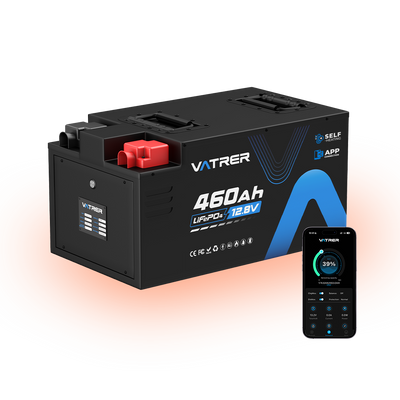
Vatrer lithium batteries include built-in BMS protection against overcharge, over-discharge, over-current, high temperature, and low-temperature cutoff. That protection is useful with inverter loads because current can rise quickly when large appliances start.
What Can a 3000W Inverter Run?
A 3000W inverter can run many RV, home backup, and off-grid appliances. It handles small loads easily and can support short high-power loads when the battery bank and wiring are sized correctly.
The catch is timing. You usually should not run every large appliance at once. A microwave, toaster, coffee maker, and small air conditioner can push a 3000W inverter close to its limit very quickly.
Common Appliance Wattage for a 3000W Inverter
| Appliance | Typical Running Watts | What to Check |
|---|---|---|
| Refrigerator | 350–800W | Startup surge can be 2–3 times running watts |
| Microwave | 800–1500W | High draw, usually for short use |
| Coffee maker | 600–1200W | Often runs for 5–15 minutes |
| TV | 100–300W | Easy load for most systems |
| Laptop | 50–150W | Low draw, long runtime possible |
| Lights | 50–300W total | LED lights use much less power |
| Fan | 30–100W | Good for long runtime |
| Small air conditioner | 1000–1500W+ | Surge power and runtime matter |
| Power tools | 500–2000W+ | Motor startup can be demanding |
A 3000W inverter running a 1000W load uses roughly one-third of the energy it would use at full load. The battery bank should be sized around what you actually run, not around the inverter label alone.
Check Surge Power Before Sizing Batteries
Some appliances pull more power at startup than they use while running. Motors and compressors are the usual troublemakers.
Watch these loads closely:
- Refrigerators and freezers: A fridge rated at 500W may briefly need 1000W to 1500W at startup.
- Water pumps and compressors: These can create sharp current spikes.
- Air conditioners: Even a small air conditioner can stress a weak battery bank during startup.
- Power tools: Drills, saws, and compressors may not run smoothly if the battery bank voltage sags.
A pure sine wave inverter is usually the safer choice for sensitive electronics, refrigerators, pumps, and motor-driven appliances. The battery bank still has to keep up.
How to Calculate Battery Size for a 3000W Inverter
The easiest way to calculate battery size is to work in watt-hours. Ah is useful, but Wh makes different voltage systems easier to compare.
Step 1: Estimate Your Total Load
Write down the appliances that will run at the same time. Add their running watts.
Example:
- Refrigerator: 500W
- TV: 150W
- Lights: 100W
- Laptop: 100W
- Fan: 80W
Total load: 930W
That is very different from a full 3000W load. You only need to calculate for the power you plan to use.
Step 2: Choose Your Runtime
Decide how long the load should run.
Common runtime targets include:
- 30 minutes: Short microwave, coffee maker, or tool use.
- 1 hour: High-power loads or a quick backup window.
- 2–4 hours: RV evenings, short outages, and campsite use.
- 8+ hours: Larger battery bank with tighter load control.
Without runtime, no battery-count answer is accurate.
Step 3: Include Inverter Efficiency
Use this formula:
Required battery energy = Load watts × Runtime ÷ Inverter efficiency
Required Battery Energy Examples
| Load | Runtime | Inverter Efficiency | Required Battery Energy |
|---|---|---|---|
| 3000W | 1 hour | 90% | About 3333Wh |
| 1500W | 2 hours | 90% | About 3333Wh |
| 1000W | 4 hours | 90% | About 4444Wh |
| 500W | 8 hours | 90% | About 4444Wh |
The pattern is easy to miss: a smaller load can need the same battery capacity as a larger load when it runs much longer.
Step 4: Find Usable Energy per Battery
Use this formula:
Usable energy per battery = Battery voltage × Battery Ah × Depth of Discharge
For LiFePO4 lithium batteries, nominal voltage is usually 12.8V for a 12V battery. For long-life sizing, 80% DOD is a practical planning number, even though many LiFePO4 batteries can support deeper discharge.
Usable Energy by Battery Size
| Battery Type | Nominal Energy | Usable Energy | Notes |
|---|---|---|---|
| 12V 100Ah LiFePO4 lithium battery | 12.8V × 100Ah = 1280Wh | About 1024Wh at 80% DOD | Modular size, current rating must be checked |
| 12V 200Ah LiFePO4 lithium battery | 12.8V × 200Ah = 2560Wh | About 2048Wh at 80% DOD | Often simpler for 3000W inverter systems |
| 12V 300Ah LiFePO4 lithium battery | 12.8V × 300Ah = 3840Wh | About 3072Wh at 80% DOD | More capacity in fewer batteries |
| 12V 100Ah lead-acid battery | 12V × 100Ah = 1200Wh | About 600Wh at 50% DOD | Larger bank needed for similar usable energy |
LiFePO4 lithium batteries give you more usable energy from the same Ah rating. Lead-acid batteries can run an inverter, but they usually need a larger and heavier battery bank for the same runtime.
Step 5: Calculate Battery Count
Use this formula:
Number of batteries = Required battery energy ÷ Usable energy per battery
Round up. A calculation of 2.2 batteries means 3 batteries. A calculation of 3.25 batteries means 4 batteries.
Then check discharge current. Capacity tells you how long the system may run. Discharge current tells you whether it can run the load safely.
Example Battery Counts for a 3000W Inverter
These examples use 90% inverter efficiency and 80% DOD for LiFePO4 lithium batteries. Real runtime can change with temperature, battery age, wiring loss, and load variation.
3000W Load for 1 Hour
This is close to the hardest common sizing case: full inverter output for a full hour.
Calculation with 12V 100Ah LiFePO4 batteries:
- Required battery energy: 3000W × 1h ÷ 0.90 = 3333Wh
- Usable energy per battery: 12.8V × 100Ah × 0.80 = 1024Wh
- Battery count: 3333Wh ÷ 1024Wh = 3.25 batteries
You would round up to 4 x 12V 100Ah LiFePO4 lithium batteries.
That gives you enough usable energy on paper and spreads the current across multiple batteries. Each battery still needs a suitable BMS discharge rating, and the parallel wiring must be matched correctly.
1500W Load for 2 Hours
A 1500W load for 2 hours uses about the same energy as a 3000W load for 1 hour.
Calculation with 12V 200Ah LiFePO4 batteries:
- Required battery energy: 1500W × 2h ÷ 0.90 = 3333Wh
- Usable energy per battery: 12.8V × 200Ah × 0.80 = 2048Wh
- Battery count: 3333Wh ÷ 2048Wh = 1.63 batteries
You would round up to 2 x 12V 200Ah LiFePO4 lithium batteries.
This setup gives about the same usable energy as 4 x 12V 100Ah batteries, but with fewer battery cases and fewer parallel connections. That can make the battery bank cleaner and easier to inspect.
3000W Load for 4 Hours
Full output for 4 hours is a large energy demand.
- Required battery energy: 3000W × 4h ÷ 0.90 = 13,333Wh
- Usable energy per 12V 100Ah LiFePO4 battery: 1024Wh
- Battery count: 13,333Wh ÷ 1024Wh = 13.02 batteries
You would round up to 14 x 12V 100Ah LiFePO4 lithium batteries.
That is a lot of batteries for a 12V system. At this point, a 24V or 48V battery bank usually makes more sense. Reducing the load also helps. Electric heat, ovens, toasters, and induction cooktops drain batteries fast because they turn stored energy directly into heat.
Common Battery Sizing Mistakes
A 3000W inverter is large enough that small sizing mistakes show up fast. The inverter may turn on, but the system may still fail once a real load starts.
Using One 100Ah Battery for Full Load
A single 12V 100Ah battery may power light loads through a 3000W inverter. It should not be expected to run a full 3000W load.
Turning on the inverter is not the same as running 3000W of appliances. The second task demands far more current and energy.
Ignoring Runtime
“How many batteries?” needs a time target.
One hour and four hours are not close. At full 3000W load, one hour needs about 3333Wh from the battery bank at 90% efficiency. Four hours needs about 13,333Wh.
Ignoring BMS Discharge Limits
A lithium battery with enough capacity can still shut down if the inverter pulls more current than the BMS allows.
Check continuous discharge current first. Then check peak discharge current for surge loads. Both matter, but continuous current decides whether the system can keep running.
Mixing Different Batteries
Do not mix battery brands, capacities, chemistries, ages, or charge states in the same series or parallel battery bank.
A mismatched battery bank can drift out of balance. That can reduce usable capacity and trigger protection cutoffs earlier than expected.
Choosing 12V for Every High-Power System
A 12V system can work with a 3000W inverter, but it has to handle high current. For a new system, 24V or 48V is often cleaner.
Existing 12V RV systems can still be upgraded with a well-sized LiFePO4 battery bank, matched BMS ratings, correct cables, and proper over-current protection. Just do not treat 12V as the default answer for every 3000W build.
Conclusion
Choose the battery bank by load and runtime first, then check discharge current and system voltage.
A practical 12V starting point is 3–4 x 12V 100Ah LiFePO4 lithium batteries for high-load use, or 2 x 12V 200Ah lithium batteries if you want fewer batteries and about 4096Wh usable energy at 80% DOD. A 24V or 48V battery bank is often a better path for a new system that will use a 3000W inverter often.
LiFePO4 lithium batteries make the most sense for many 3000W inverter systems because they deliver more usable capacity, steadier voltage, longer cycle life, and lower maintenance than lead-acid batteries. The best battery count is not the biggest number you can fit. It is the battery bank that matches your real load, runtime target, and inverter current demand.
Share