Can You Use Marine Batteries in a Golf Cart? Pros & Risks
Reading time: 11 minutes

Share
Some marine batteries can run a golf cart. A true deep-cycle model may handle light use, while a marine starting battery and most dual-purpose batteries are poor choices for powering the cart. The 12V label alone tells you very little about how the battery will perform under a motor load.
A golf cart motor draws power for the whole trip, with demand rising sharply during takeoff, hill climbing, and heavy loading. That duty is different from starting a boat engine or running moderate onboard electronics. If you are considering a marine battery for golf cart use, compare the complete battery set rather than one battery’s voltage. Here, we’re talking about the main drive battery, not a separate 12V battery that runs only the lights or audio system.


Which Marine Batteries Work in a Golf Cart?
The words “marine battery” do not tell you exactly how the battery is built. That label can appear on a starting battery, a dual-purpose model, a deep-cycle battery, or a LiFePO4 battery. Each one responds differently to the steady motor load of a golf cart.
Starting and Dual-Purpose Batteries
A marine starting battery is rated mainly by cold cranking amps (CCA) or marine cranking amps (MCA). It delivers a quick burst to crank an engine, and the boat’s charging system restores that energy afterward. Repeated deep discharge damages it quickly.
A dual-purpose marine battery combines cranking ability with limited cycling ability. It may move your cart, but it divides its design between two jobs and usually cannot cycle as deeply or as often as a true deep-cycle battery.
If the label focuses on CCA or MCA and provides little information about amp-hours, cycle life, or sustained discharge, do not use that battery as a golf cart battery replacement.
Deep-Cycle Marine Batteries
A true deep-cycle marine battery is built to provide power for longer stretches and handle repeated charging. That makes it the only conventional marine type worth considering as the cart’s main power source.
Some batteries fit both labels. A 6V 225Ah deep-cycle model may work in marine and golf cart applications, so its construction and ratings matter more than the word “marine.” A low-cost 12V marine/RV battery with a modest Ah rating is a different product, even if both labels say deep cycle.
Lithium Marine Batteries
You can wire 12.8V LiFePO4 marine batteries in series only if the manufacturer allows it. Three create a 38.4V nominal battery pack; four create 51.2V. Before connecting them, check four items:
- The maximum number of batteries allowed in series.
- Continuous and peak BMS discharge current.
- The required charge voltage and charger profile.
- Compatibility with regenerative braking, if your cart sends current back to the battery.
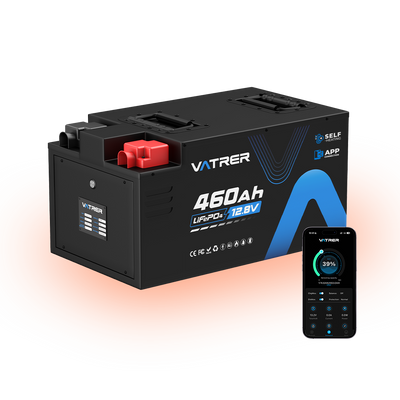
Each 12V lithium battery has its own BMS. If one BMS reaches a protection limit first, it can disconnect the entire series string. With one integrated battery, you do not have three separate BMS units that can trip independently. For example, the Vatrer 38.4V 105Ah golf cart battery places all its cells under one BMS instead of combining three separate 12V batteries. It delivers 200A continuously, reaches 400A for 35 seconds, and comes with a matching 43.8V charger.
Marine Battery vs Golf Cart Battery: What's the difference?
The biggest difference between a marine battery and a golf cart battery is the duty cycle, or how the battery delivers power during use. A boat may use one battery for cranking and another for accessories. A golf cart battery set supplies propulsion current every second the cart is moving. Two 12V models can share the same voltage yet differ by more than 50% in capacity.
12V Lead-Acid Battery Comparison
| Specification | Group 31 Deep-Cycle Battery | 12V Golf Cart Battery |
|---|---|---|
| Nominal voltage per battery | 12V | 12V |
| 20-hour capacity | 98Ah | 150Ah |
| Reserve capacity at 25A | 210 minutes | 280 minutes |
| Battery dimensions | 13 × 6.75 × 9.63 in | 12.96 × 7.13 × 11.13 in |
| Four batteries in series | 48V 98Ah | 48V 150Ah |
| Calculated nominal battery pack energy | 4.70 kWh | 7.20 kWh |
| Nominal energy at a 50% DoD reference | About 2.35 kWh | About 3.60 kWh |
Both four-battery sets produce 48V, but the golf cart battery example stores about 53% more nominal energy. Wiring batteries in series adds voltage; it does not add amp-hours. That extra energy can make a large difference in range, even before you account for terrain, tire size, temperature, and high-current losses.
Physical fit can also go the opposite way from what you expect. The marine example is slightly longer but about 1.5 inches shorter. A battery that sits in the tray may still leave the factory hold-down too high, place the terminals near metal, or force the cables to bend sharply.
Pros and Risks of Marine Batteries in a Golf Cart
Price is usually what puts marine batteries on the shortlist. The initial saving may be real, but compare it with the energy available under a motor load, the depth of discharge on each trip, and how soon the battery set may need replacement.
Lower Upfront Cost and Easier Availability
- Common 12V marine batteries are widely stocked by auto parts stores, warehouse clubs, and large retailers.
- A lower per-battery price can make a temporary repair look attractive, especially when three batteries replace six in a 36V cart.
- Batteries you already own can help test whether an older cart’s motor, controller, and drivetrain operate before you buy a complete battery pack.
Compare the cost of the full battery set and any charger, cable, or hold-down changes—not just the price of one battery on the shelf.
Shorter Range and Reduced Performance
A lead-acid battery’s Ah rating usually comes from a gentle 20-hour discharge test. A golf cart asks for far more current. At that higher current, the battery gives up some usable capacity, and a smaller marine battery reaches low voltage sooner.
You will notice the difference most under conditions that raise motor demand:
- Starting from a stop or climbing a grade
- Carrying passengers, golf bags, tools, or cargo
- Running oversized tires or a higher-speed motor
- Driving in cold weather, when lead-acid capacity falls
Voltage sag may make the cart feel slow even though a resting meter reading looks normal. A battery showing roughly 12.6–12.8V after charging can still collapse under load.
Shorter Lifespan and Higher Long-Term Cost
Flooded lead-acid batteries usually last longer when you avoid deep discharges. Using around 50% of the rated capacity per cycle is a common target; repeatedly using close to 80% puts much more stress on the battery. A smaller marine battery set has to use a greater share of its capacity to complete the same trip, so it can age faster even with correct charging.
You cannot give marine batteries one fixed lifespan in a golf cart. Battery type, discharge depth, temperature, maintenance, and driving load all change the result. A more useful comparison is cost per usable kWh over the battery’s service life, not the price printed on one battery.
When Can You Use Marine Batteries in a Golf Cart?
Whether that tradeoff works depends on how you use the cart. Short trips on flat ground place far less demand on the battery set than daily driving with passengers, hills, or cargo.
Where a Marine Battery Configuration Fits and Where It Does Not
| Use case | Recommendation | Main condition |
|---|---|---|
| Temporary testing of an older cart | Reasonable for a short test | Correct voltage, safe mounting, and sound wiring |
| Occasional trips on flat ground | May be acceptable | Matched true deep-cycle batteries with enough Ah |
| Short campground or neighborhood use | Conditional | You can accept reduced range and earlier replacement |
| Daily or long-distance driving | Poor choice | Repeated deep cycling raises lifetime cost |
| Steep hills, passengers, or towing | Not recommended | Current demand and voltage sag become more severe |
| Commercial or fleet service | Not recommended | Consistent range and cycle life matter more than initial price |
If your normal round trip would consume more than about half of the battery set’s rated capacity, or if voltage drops sharply on the steepest part of the route, the marine battery set is already too small for comfortable routine use.
How to Check Marine Battery Compatibility
Five things have to line up: battery-set voltage, stored energy, discharge current, charger settings, and physical installation. A 12V label on each battery does not make the complete setup compatible by itself.
Match the Battery Pack Voltage
Wiring golf cart batteries in series raises the voltage, so the full battery set has to match the cart’s 36V or 48V system.
Common 36V and 48V Series Configurations
| Golf cart system | Common golf cart battery configuration | Possible 12V configuration | Electrical result |
|---|---|---|---|
| 36V | Six 6V batteries | Three 12V batteries | Voltage matches; Ah may be much lower |
| 48V | Six 8V batteries | Four 12V batteries | Voltage matches; capacity and fit still need checking |
| 48V | Four 12V batteries | Four 12V marine batteries | Battery count matches; duty rating may not |
Six 6V 225Ah golf cart batteries create a 36V 225Ah battery set with 8.10 kWh of nominal energy. Three 12V 98Ah marine batteries also create 36V, but store only about 3.53 kWh roughly 56% less.
Check Capacity and Current
Matching the voltage is only the first step. Capacity and discharge ratings decide whether the cart can finish the route without a low-voltage shutdown:
- Battery pack energy: Multiply nominal voltage by Ah, then divide by 1,000. A 48V 98Ah battery pack stores about 4.70 kWh nominally.
- Continuous discharge current: This must cover normal driving without overheating the batteries or triggering a lithium BMS.
- Peak discharge current: The battery needs enough short-duration current for takeoff, hills, and heavy loads.
- Reserve capacity: RC tells you how many minutes a lead-acid battery can deliver 25A. It is useful for comparison, though a golf cart can pull much more than 25A.
CCA and MCA describe cranking performance. They do not tell you how far a golf cart will travel.
Confirm Charging and Installation
Use a charger profile that matches the battery chemistry. Check the charger, tray, cables, and batteries together, because a mismatch in any one of them can cause trouble:
- Charger: Its output voltage must match the completed battery set and the battery manufacturer’s charging limits.
- Tray and clearance: Measure length, width, height, terminal clearance, and the location of the factory hold-down.
- Cables: Cable gauge, lug size, and length must suit the motor current without pulling on the terminals.
- Battery matching: Use the same chemistry, brand, model, capacity, and age throughout the set.
Flooded batteries need ventilation and routine watering. Keep exposed terminals away from metal seat frames, and secure every battery so it cannot slide or tip during braking and turns.
If Marine Batteries Are Already Installed
Test the whole series string, since one weak battery can slow or stop the entire cart. Work through the battery set in this order:
- Fully charge the battery pack with the correct charger.
- Record each battery’s resting voltage after the surface charge settles.
- Test every battery under load; a good resting voltage does not prove usable capacity.
- Watch total battery pack voltage during acceleration or on a hill.
- Check for hot cables, loose lugs, corrosion, damaged cases, and poor hold-downs.
- Replace the full matched set if several batteries are aged or imbalanced. Mixing one new battery into an old series string often creates another imbalance.
If the cart loses charge while parked, something on the cart may be drawing power, or one battery may have high self-discharge. Disconnecting the accessories for a controlled test can tell you whether the problem is in the cart or the batteries.
Better Alternatives to Marine Batteries
If the marine battery set falls short on range or current, move to a golf cart lead-acid golf cart battery set or a complete LiFePO4 golf cart battery. Your choice comes down to initial cost, battery weight, maintenance, and how often you use the cart.
Golf Cart Lead-Acid Batteries
Flooded lead-acid batteries made for golf carts remain a practical golf cart battery replacement. Common capacities include 6V 225Ah, 8V 170Ah, and 12V 150Ah. They handle sustained motor loads better than starting or dual-purpose marine batteries, and many existing carts already have a compatible charger and tray.
A six-battery 6V 225Ah configuration may weigh about 372 lbs, six 8V 170Ah batteries about 378 lbs, and four 12V 150Ah golf cart batteries about 340 lbs before cables and hold-down hardware. Flooded cells also need water checks, terminal cleaning, and full recharging after use.
LiFePO4 Golf Cart Batteries
A complete lithium golf cart battery holds its voltage more steadily and does not need watering. Its built-in BMS still needs a current rating high enough for your controller, while the charger, tray dimensions, and cable routing remain part of the golf cart battery upgrade.
Six 8V batteries may weigh about 378 lbs, the Vatrer 48V 105Ah lithium golf cart battery weighs 102.5 lbs, cutting about 275 lbs from that example. It stores 5.376 kWh, delivers 200A continuously, and can reach 400A for 35 seconds. The battery is rated for at least 4,000 cycles and comes with a LiFePO4 charger.
Lithium battery range still changes with tire size, terrain, speed, passenger weight, controller settings, and temperature. Compare energy and current first, then treat the lower weight as another benefit.
Should You Use Marine Batteries in a Golf Cart?
Use a marine battery set only if it passes five checks: correct total voltage, true deep-cycle construction, enough usable energy to keep routine discharge near 50% DoD, adequate sustained current, and a compatible charger. Walk away if the cycle data is missing. Mixed batteries or a tray change that leaves the battery set unsecured should also rule it out.
Before buying, write down your cart’s system voltage, controller rating, charger model, tray measurements, and normal trip distance. Compare that worksheet with matched golf cart lead-acid batteries and complete LiFePO4 options. Pick the battery set that can finish your usual route with capacity in reserve; the cheapest shelf price loses its appeal if range falls short or the batteries need early replacement.
Share