What Battery Is Best For A Street-Legal Golf Cart?
Reading time: 14 minutes

Share
For most street-legal golf carts and low-speed vehicles, a 48V LiFePO4 lithium golf cart battery is the best overall choice. It gives you steadier power, more usable range, lower maintenance, lighter weight, and a longer service life than traditional lead-acid batteries.
A 100Ah–105Ah 48V lithium golf cart battery is a strong fit for many 2-seater and light 4-seater carts used around neighborhoods, campgrounds, beach towns, and gated communities. Heavier carts need more reserve. If your cart has rear seats, larger tires, a lift kit, frequent hills, or longer daily routes, a 150Ah lithium battery is usually the safer pick. Larger 6-seater carts, fleet carts, and long-range builds may need 200Ah or more.
Lead-acid batteries still work for low-budget carts that make short, occasional trips. But when you want the best battery for street-legal golf cart use, LiFePO4 lithium battery usually gives you the better long-term result.
What Makes a Battery Good for a Street-Legal Golf Cart?
A street-legal golf cart does more than cruise around a course. It may carry passengers on neighborhood roads, make repeated short trips, run lights after dark, and deal with hills or stop-and-go driving. That kind of use asks more from the battery.
A good street-legal golf cart battery should support:
- Stable voltage: The cart should not feel strong at full charge and sluggish halfway through the ride.
- Practical range: Daily errands, campground loops, and community driving can add up to 10–30 miles faster than expected.
- Passenger weight: A 4-seater or 6-seater pulls more current than a basic 2-seater.
- Street accessories: Headlights, brake lights, turn signals, horn, USB ports, and sound systems all need steady 12V support.
- Low upkeep: A cart used several days a week becomes frustrating if the battery bank needs frequent watering and corrosion cleanup.
- Safe matching: Voltage, BMS output, charger profile, cable routing, and battery fitment all need to match the cart.
A battery upgrade does not make a golf cart street legal by itself. Local rules may still require registration, insurance, VIN, mirrors, lights, seat belts, and speed limits. The battery’s job is to power the cart reliably once the vehicle is properly equipped.


Lithium vs Lead-Acid Golf Cart Batteries
Most golf cart battery replacement decisions come down to three options: flooded lead-acid, AGM, or LiFePO4 lithium. All three can power a cart, but they behave very differently once you add road speed, passengers, accessories, and daily use.
Battery Type for Street-Legal Carts
| Battery Type | Typical Upfront Cost | Maintenance | Weight | Usable Energy | Typical Service Life | Best Fit |
|---|---|---|---|---|---|---|
| Flooded lead-acid | About $800–$1,500 per full set | Watering, terminal cleaning, corrosion checks | Often 300–450 lbs for a 48V bank | Lower; commonly treated as about 50% usable for long life | About 3–5 years with good care | Budget carts and short trips |
| AGM lead-acid | About $1,200–$2,000 per full set | No watering, but still heavy and aging-sensitive | Often close to flooded lead-acid | Better convenience, not lithium-level usable energy | About 4–6 years | Low-maintenance lead-acid replacement |
| LiFePO4 lithium | About $1,500–$3,000+ for many complete kits | Very low | Often 100–250+ lbs lighter than lead-acid | Higher usable capacity with steadier voltage | Often 8–10 years with proper use | Daily street driving, hills, passengers, long-term value |
Lead-acid is the cheaper short-term fix. LiFePO4 is the better choice when the cart is used often, driven on streets, loaded with passengers, or expected to last for years without regular battery maintenance.
Lead-Acid Batteries
Flooded lead-acid batteries are the traditional golf cart option. They are easy to find and cost less upfront, often around $800–$1,500 for a full replacement set depending on voltage, brand, and local pricing.
The savings come with tradeoffs. A full 48V lead-acid bank often weighs about 300–450 lbs, and flooded batteries need regular water checks, terminal cleaning, and corrosion control. They also lose voltage more noticeably as they discharge, which is why an older cart may feel slower near the end of a ride or while climbing a hill.
Lead-acid still makes sense for light use. If the cart only runs a few short trips per week and price matters most, it can do the job.
AGM Batteries
AGM batteries are sealed lead-acid batteries. They do not need watering, and they are cleaner to maintain than flooded lead-acid batteries.
They are still heavy. Their usable energy, cycle life, and voltage stability are also closer to lead-acid than lithium. AGM can be a reasonable middle option when you want less maintenance but are not ready for a full golf cart lithium battery conversion.
For frequent street use, AGM usually feels like a compromise rather than the best battery for golf cart performance.
LiFePO4 Lithium Batteries
LiFePO4 lithium batteries cost more upfront, often around $1,500–$3,000+ for complete golf cart battery kits depending on voltage, capacity, charger, monitor, and accessories. The higher price buys you lower weight, more usable energy, steadier voltage, faster charging, and far less maintenance.
A lithium battery also fits how street-legal carts are used in real life. You may not drive far in one trip, but you may drive often. You may carry passengers. You may use lights, sound systems, USB ports, and a 12V reducer. Lithium handles that pattern better than a tired lead-acid bank.
Why LiFePO4 Lithium Batteries Are Usually the Best Choice
LiFePO4 does not win because it sounds newer. It wins because its strengths line up with the way street-legal carts are actually driven.
Steadier Power for Hills
Street driving exposes weak batteries quickly. A cart may need to hold 18–25 mph, climb a mild slope, start from a stop sign, and carry two or more passengers. Lead-acid voltage drops more as the pack discharges, so the cart can feel weaker long before the batteries are empty.
LiFePO4 lithium has a flatter voltage curve. The cart feels more consistent across the ride, especially on hills, campground roads, and neighborhood slopes.
BMS output matters here. A 100Ah battery with weak discharge current can struggle more than a 105Ah battery with stronger output. For demanding carts, look for continuous discharge around 150A–200A+ and short peak output around 300A–600A, depending on the controller and vehicle setup.
More Usable Range
Lithium golf cart batteries usually give you more usable range because you can draw more of the stored energy without the same voltage sag you get from lead-acid.
A 48V lithium battery in the 100Ah–105Ah range can handle many daily carts. Real-world range often lands somewhere around 30–50+ miles per charge, but the number changes with cart weight, passenger count, terrain, tire size, speed, wind, accessories, and driving habits.
A light 2-seater on flat pavement and a lifted 6-seater on hills will not use power at the same rate. Capacity gives you range; current output helps the cart handle load.
Lower Weight and Maintenance
Lithium can remove a lot of dead weight from the cart. Many lead-acid-to-lithium swaps cut battery weight by 100–250+ lbs, depending on the original battery bank and the replacement battery.
That weight drop changes the cart in practical ways:
- Less strain on the cart: Suspension, tires, and brakes carry less battery weight.
- Easier acceleration: The motor has less mass to move.
- Cleaner ownership: No acid spills, no watering schedule, and less terminal corrosion.
- More room for consistency: The cart is not spending as much energy hauling its own battery bank.
LiFePO4 still needs basic care. Keep connections tight, use the correct charger, and avoid storing the battery fully drained. That is a much easier routine than maintaining six or eight flooded lead-acid batteries.
Longer Service Life
A good lithium golf cart battery can support thousands of charge cycles. Many LiFePO4 golf cart batteries are rated around 3,000–5,000+ cycles, while traditional lead-acid batteries are often closer to 300–700 cycles, depending on depth of discharge, charging habits, and maintenance.
In normal use, lithium often lasts about 8–10 years. Lead-acid may last 3–5 years with good care, and less if it is deeply discharged, stored poorly, or left low on water.
That longer service life is the reason lithium can be the better value even with a higher upfront price. You are paying for fewer replacements, less maintenance time, and steadier performance over the life of the cart.
What Voltage and Ah Rating Do You Need?
Voltage must match the cart. Ah rating should match how the cart is used.
A 48V cart needs a 48V battery system. A 36V cart needs 36V unless you are doing a full system conversion. A 72V cart needs a 72V system. Do not change battery voltage casually. Controller, motor, charger, solenoid, wiring, and accessories all have to work with the system voltage.
36V Golf Cart Batteries
Many older EZGO, Club Car, and Yamaha carts use 36V systems. A 36V lithium battery can be a good upgrade if you want less weight and less maintenance without changing the entire electrical system.
The limitation is power headroom. A 36V cart can work for short, light trips, but it usually does not feel as strong as a 48V system when carrying passengers or climbing hills. For basic community driving on flat roads, it may be enough. For heavier street use, 48V is usually the better target.
48V Golf Cart Batteries
This is the sweet spot for many street-legal carts.
A 48V lithium golf cart battery gives a strong balance of power, range, cost, and compatibility. Many modern carts and conversion kits are already built around 48V or 51.2V LiFePO4 systems.
A 100Ah–105Ah battery fits many 2-seater and light 4-seater carts. A 150Ah battery gives more reserve for rear seats, larger tires, hills, longer routes, and heavier daily use. If you are choosing one setup for the widest range of street-legal golf cart use, start here.
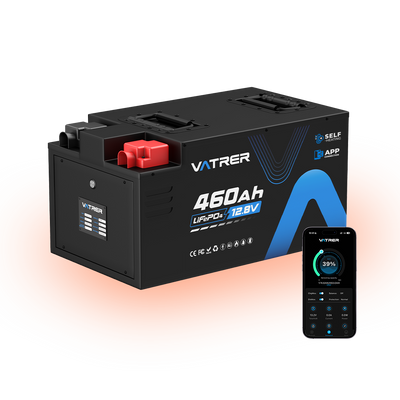
Vatrer offers 48V lithium golf cart battery options that pair the LiFePO4 battery with a matched charger, screen, cables, and installation accessories in many kits. That kind of package can make a golf cart lithium battery conversion easier than buying the battery, charger, display, and hardware separately.
72V Golf Cart Batteries
A 72V lithium golf cart battery can deliver strong power, but it is not automatically better for a street-legal golf cart. It belongs in a cart already built for 72V or a cart receiving a full system upgrade.
A regular 48V cart should not jump to 72V just for more speed. Street-legal carts are tied to local speed and road-use rules, and a higher-voltage system needs compatible electronics. If the controller, motor, charger, wiring, solenoid, and accessories are not matched, the upgrade can become expensive fast.
Choose 72V when the cart is designed for it. Choose 48V when you want the most practical, street-legal golf cart battery setup.
100Ah vs 150Ah vs 200Ah+
Ah rating tells you capacity, not the whole story. A larger battery usually gives more range, but it still needs enough BMS output to handle acceleration, hills, and heavy loads.
Capacity Guide by Cart Load and Route Length
| Battery Capacity | Best Match | Typical Use | Practical Takeaway |
|---|---|---|---|
| 100Ah–105Ah | 2-seater and light 4-seater carts | Neighborhood roads, short errands, campground loops, mostly flat routes | Best starting point for many daily 48V carts |
| 150Ah | 4-seater carts, rear seats, larger tires, moderate hills | Longer daily driving, heavier loads, more accessories | Better reserve and less range anxiety |
| 200Ah+ | 6-seater carts, commercial carts, fleet use | Long-range routes, frequent passenger loads, limited charging time | Best when range and duty cycle matter more than compact fitment |
Choose 100Ah–105Ah for normal daily street use, 150Ah for heavier or hillier carts, and 200Ah+ only when long range, frequent passenger loads, or commercial use justify the extra size and cost.
What to Check Before Choosing a Lithium Golf Cart Battery
A lithium battery can have the right voltage and still be the wrong battery. Check the parts that affect how it performs once installed.
BMS Output
The BMS protects the battery from overcharge, over-discharge, over-current, short circuit, and temperature issues. It also controls how much current the battery can safely deliver.
Look at two numbers:
- Continuous discharge current: The current the battery can supply steadily. For many street-legal carts, 150A–200A+ is a useful range to look for.
- Peak discharge current: Short bursts for takeoff, hills, and heavy loads. Many golf cart lithium batteries list peak output around 300A–600A.
Do not buy by Ah alone. A 150Ah battery with weak current output can feel worse under load than a smaller battery with a stronger BMS.
Lithium Charger
LiFePO4 batteries need a lithium charging profile. An old lead-acid charger may undercharge the battery, trigger protection, or shorten battery life.
A matched charger is worth having. It removes guesswork and helps the battery charge to the correct voltage. Many complete Vatrer golf cart lithium battery conversion kits include a lithium charger with the battery, which helps avoid one of the most common upgrade problems.
Battery Fitment
Measure the cart before buying a battery.
Check these points:
- Battery tray space: Measure length, width, and height.
- Seat clearance: Some high-capacity batteries are taller than expected.
- Cable routing: Main positive and negative cables should reach without strain.
- Mounting hardware: The battery needs to be fixed in place.
- Weight position: Lithium is lighter, but it still needs secure placement.
A bigger battery is not better if it barely fits or leaves wiring stretched across the tray.
12V Reducer
Most street-legal carts use 12V accessories. Headlights, brake lights, turn signals, horns, USB ports, soundbars, and dashboard devices usually need regulated 12V power.
A 48V or 51.2V lithium system should use a proper 48V-to-12V reducer for those accessories. Do not tap one section of the main battery pack to feed 12V loads. That can create uneven draw and unreliable accessory power.
SOC Display
Lithium voltage stays flatter than lead-acid voltage. That helps the cart drive better, but it also means old lead-acid battery meters may not read accurately.
A better lithium setup uses:
- LCD display: Quick battery status on the cart.
- Bluetooth app: More detail from your phone.
- Battery monitor: Better state-of-charge tracking during daily use.
This matters more than many owners expect. A lithium cart can feel strong even when the battery is lower than the old meter suggests.
Warranty and Support
A lithium battery is not just a box with a voltage label. Warranty, installation help, charger matching, and technical support matter, especially when the cart is used on public neighborhood roads.
A cheap battery with unclear specs can become expensive if the BMS trips under load, the charger does not match, or the battery does not fit cleanly. Strong support is part of what makes a battery a good choice, not an extra bonus.
Best Battery for Street-Legal Golf Cart Use
The best choice depends on how hard the cart works. Match the battery to the cart’s real routine instead of buying the largest battery on the page.
Neighborhood Driving
A 48V 100Ah–105Ah LiFePO4 battery is the best fit for most neighborhood driving.
It works well for short errands, gated communities, local roads, school pickup routes, and quick trips around town. The battery is large enough for useful range without making the setup oversized or unnecessarily expensive.
This is also the most practical starting point if you are replacing a tired lead-acid bank and want a cleaner, lighter, low-maintenance upgrade.
Campgrounds and Beach Communities
Campgrounds and beach towns usually mean short trips, frequent stops, slow cruising, lights at night, and passengers climbing in and out. A 48V 100Ah–150Ah lithium battery fits that rhythm well.
The low-maintenance side matters here. You are not checking water levels during a weekend trip, cleaning acid corrosion before a beach ride, or wondering why the cart feels weak halfway through the day.
4-Seater and 6-Seater Carts
A 4-seater cart should usually move toward 150Ah if it carries people often. Rear seats add weight, and passengers make the motor work harder every time the cart starts or climbs.
A 6-seater cart may need 200Ah+ when it runs longer routes or carries full passenger loads regularly. Range drops faster as cart weight goes up, even when the battery voltage stays the same.
The battery also needs enough current output. Capacity helps range. BMS output helps the cart move that weight without tripping protection.
Hills and Heavy Loads
Hills expose weak setups. So do lifted carts, large tires, trailers, heavy passengers, and high accessory loads.
A 150Ah LiFePO4 battery with strong continuous and peak discharge ratings is usually better than pushing a smaller battery to its limit. The cart will feel more consistent, and the battery has more reserve during high-current moments.
For demanding carts, look for three things together:
- Enough capacity: 150Ah or more is often better for heavier use.
- Strong BMS output: Around 200A continuous is a useful target for many loaded carts.
- Correct voltage match: 36V, 48V, or 72V must match the cart’s system.
Conclusion
For carts used on public roads, battery selection should be based on actual load, terrain, and usage frequency rather than a single fixed specification. Lighter carts on flat routes can use moderate-capacity lithium setups, while heavier passenger loads, frequent hills, or longer daily distances require higher capacity and stronger discharge capability to maintain consistent performance. Higher-voltage systems are only appropriate when the vehicle’s electrical components are designed to support them, and budget-oriented lead-acid options remain viable for infrequent use, though they involve more upkeep and less consistent output over time.
If you want a matched lithium upgrade instead of piecing together parts one by one, Vatrer offers 36V, 48V, and 72V lithium golf cart batteries, including conversion kits with LiFePO4 battery, charger, display, cables, brackets, and accessory support depending on the package. Match the voltage to your cart first, then choose the Ah rating based on passenger load, hills, route length, and how often you want to charge.
Share