Best Yamaha Golf Cart Batteries for Drive, G29, and Drive2 Models
Reading time: 16 minutes

Share
Choosing the right Yamaha golf cart battery directly affects range, power, charging time, and maintenance.
For Yamaha Drive, G29, and Drive2 models, first confirm your cart’s voltage, battery layout, charger type, and available space. Many use a 48V system, but you should verify before buying.
Common options include flooded lead-acid, AGM, and LiFePO4 lithium batteries. Lead-acid is cheaper upfront, AGM reduces maintenance, and lithium offers lighter weight, faster charging, and longer lifespan.
For most 48V Yamaha carts, a 48V 100Ah or 105Ah LiFePO4 battery provides a good balance of performance and range. Heavier loads or hilly terrain may require higher capacity or stronger BMS output.


Check Your Yamaha Drive, G29, or Drive2 Battery System First
Before you compare brands, check what your cart already uses. This step prevents most Yamaha golf cart battery replacement mistakes.
Confirm 36V or 48V System Voltage
The number printed on one battery is not always the voltage of the whole cart. A single lead-acid battery may be 6V, 8V, or 12V. The cart system voltage is the total after those batteries are wired in series.
Common Yamaha Golf Cart Battery Layouts
| Cart System Voltage | Common Battery Layout | Total Battery Count | Replacement Note |
|---|---|---|---|
| 36V | 6 × 6V batteries | 6 | Common on some older carts; do not install a 48V battery without a full system conversion |
| 48V | 6 × 8V batteries | 6 | Common lead-acid setup for many Yamaha electric carts |
| 48V | 4 × 12V deep cycle batteries | 4 | Possible, but battery tray fit and load rating matter |
| 48V | 1 × 48V LiFePO4 battery | 1 | Cleaner wiring, but charger, BMS, mounting, and accessories must match |
A 48V cart can use six 8V batteries, four 12V deep cycle batteries, or one 48V lithium battery. The cart sees the total system voltage, not the label on one battery.
Do not use regular car starting batteries in a Yamaha golf cart. Golf carts need deep cycle batteries built for repeated discharge and recharge. A car battery is made for a short starting burst, not for driving across 18 holes, through a neighborhood, or up a long hill.
Match Battery Choice to the Model
Yamaha Drive, G29, and Drive2 carts are often discussed together, but installation details can still vary. A Yamaha G29 battery replacement may not be identical to a Yamaha Drive2 battery replacement because the tray, controller, charger plug, and wiring layout may differ.
Check these items before buying:
- Model and year: Look for the model plate, serial number, or owner’s manual. This helps confirm whether you are working with a Drive, G29, Drive2, or another Yamaha platform.
- Existing battery layout: Count the batteries and read the voltage label on each one. Six 8V batteries usually indicate a 48V system.
- Charger type: A charger made for lead-acid batteries may not match a LiFePO4 charging profile.
- Battery tray space: Measure length, width, and height. Also check hold-down brackets and cable reach.
- Accessory wiring: Lights, horns, USB ports, fans, and stereos often run on 12V power, so a lithium upgrade may need a voltage reducer.
A Yamaha Drive lithium battery upgrade can be very clean when the battery, charger, display, and mounting hardware are planned together. Problems usually show up when the battery is electrically correct but awkward to secure, charge, or wire.
Single 48V Lithium Battery vs Multiple Lead-Acid Batteries
A single Yamaha golf cart lithium battery can replace a multi-battery lead-acid setup in many 48V carts, as long as voltage, output, charger, and mounting all match.
A single 48V lithium golf cart battery gives you a cleaner system:
- Fewer connection points: Six lead-acid batteries require more cables and terminals. Fewer connections mean fewer places for corrosion, loose hardware, or voltage drop.
- Lower total weight: A six-pack of 8V flooded batteries can weigh about 300–400+ lbs. A lithium system can remove a large amount of that weight from the cart.
- Easier monitoring: Many lithium batteries include Bluetooth, an LCD, or a state-of-charge display. That is more useful than guessing range from an old lead-acid gauge.
- Better pack consistency: One lithium battery with one BMS avoids the imbalance issues that can happen when multiple batteries age at different rates.
The tradeoff is that lithium is not just a “same voltage, done” purchase. You still need to check BMS output, charger compatibility, mounting fit, and accessory power.
Lithium vs Lead-Acid Batteries for Yamaha Golf Carts
The best Yamaha golf cart batteries depend on how you use the cart and how much maintenance you want to deal with. Flooded lead-acid, AGM, and lithium can all work, but they do not deliver the same ownership experience.
Flooded Lead-Acid Batteries
Flooded lead-acid batteries are the traditional Yamaha golf cart replacement batteries. They are still widely used because they are easy to find and cost less upfront.
Main advantages:
- Lower upfront cost: A lead-acid replacement set usually costs less than a complete lithium conversion. That makes it attractive when the cart is used lightly.
- Easy local availability: Many battery shops, golf cart dealers, and auto parts stores carry 6V, 8V, and 12V deep cycle options.
- Familiar setup: If your Yamaha already uses six 8V batteries, replacing them with the same format keeps the system close to stock.
Main drawbacks:
- Heavy pack weight: A full lead-acid set can add 300–400+ lbs to the cart. That weight affects acceleration, braking feel, tire wear, and energy use.
- Regular watering: Flooded batteries need electrolyte checks and distilled water. Skipping maintenance shortens battery life.
- More corrosion risk: Acid mist and terminal corrosion are common around older flooded packs, especially in humid areas.
- Voltage sag: As charge drops, the cart can feel weaker. Hill-climbing often feels worse near the lower half of the charge.
- Shorter service life: Many golf cart lead-acid batteries last about 3–5 years, depending on charging habits, water maintenance, heat, and storage.
Flooded lead-acid still makes sense when your budget is tight and your driving is light. It makes less sense if you use the cart every day and dislike maintenance.
AGM Batteries
AGM batteries are sealed lead-acid batteries. They reduce some of the mess of flooded batteries, but they still carry much of the weight and lifespan limitation of lead-acid chemistry.
Good points:
- No regular watering: AGM batteries are sealed, so you do not open cells and add distilled water.
- Spill-resistant build: The electrolyte is held in glass mat separators, which helps with vibration and rougher paths.
- Lower self-discharge: AGM batteries generally sit better than flooded lead-acid batteries during storage.
Limitations:
- Still heavy: AGM is easier to maintain than flooded lead-acid, but it does not give the weight savings of lithium.
- Higher cost than flooded: You pay more upfront for sealed convenience.
- Charging sensitivity: AGM batteries can be damaged by poor charging habits or incorrect charger settings.
- Shorter life than lithium: AGM golf cart batteries often fall around 4–6 years in typical use, while LiFePO4 batteries often last longer when properly matched and charged.
AGM is a middle path. It is cleaner than flooded lead-acid, but it is usually not the strongest long-term value if your budget is already close to a lithium kit.
LiFePO4 Lithium Batteries
LiFePO4 lithium batteries have become the main upgrade path for Yamaha golf carts because they cut weight, reduce maintenance, and keep voltage more stable during discharge.
Strong points:
- Much lighter system: Removing 200+ lbs from a cart changes how it feels. You may notice better acceleration and less strain on hills.
- No watering: There is no electrolyte level to check and no monthly watering routine.
- Stable output: A lithium battery holds voltage better through most of its discharge curve, so the cart does not feel as weak near the end of the charge.
- Fast charging: A matched lithium charger can recharge a 100Ah or 105Ah battery in several hours, depending on charger amperage.
- Long cycle life: Many LiFePO4 golf cart batteries are rated for 3,000–4,000+ cycles, depending on depth of discharge and operating conditions.
- Better monitoring: Bluetooth apps, LCD screens, and BMS data make it easier to see state of charge and battery health.
Watch-outs:
- Higher initial price: Lithium usually costs more upfront than flooded lead-acid.
- Charger must match: A lead-acid charger may not fully charge lithium correctly.
- BMS output matters: Ah tells you runtime. BMS current tells you whether the battery can handle hills, passengers, and controller demand.
- Installation fit still matters: A battery can be electrically correct and still be a poor fit if the tray, cables, or brackets do not line up.
A Yamaha lithium golf cart battery is usually the better choice when you want lower maintenance, stronger usable range, and less weight. It is not the right purchase if you do not want to check charger, BMS, and mounting details.
Which Battery Type Should You Choose?
Yamaha Golf Cart Battery Type Comparison
| Battery Type | Typical Lifespan | Maintenance Level | Weight | Best Fit |
|---|---|---|---|---|
| Flooded lead-acid | 3–5 years | High: watering, cleaning, inspections | Highest | Lowest upfront cost |
| AGM lead-acid | 4–6 years | Medium-low: sealed, no watering | High | Less maintenance without lithium |
| LiFePO4 lithium | 8–12 years with proper use | Low: no watering | Lowest | Long-term value, range, and performance |
Lead-acid wins on upfront cost. Lithium wins on weight, maintenance, cycle life, and driving feel. AGM sits between the two but does not remove the weight penalty.
Best Battery Options for Yamaha Drive, G29, and Drive2
Once you know your system voltage and battery type preference, the next decision is capacity. Ah rating affects range, but bigger is not always better. The right capacity depends on passenger load, terrain, tire size, accessories, and how often you drive.
Best Overall for Most Yamaha Models
A 48V 100Ah or 105Ah LiFePO4 battery is the best all-around choice for many Yamaha Drive, G29, and Drive2 carts running a 48V system.
This size works well for:
- Daily driving: A 100Ah or 105Ah lithium battery gives enough stored energy for regular neighborhood driving without jumping into oversized capacity.
- 18 holes: Most standard golf course use fits comfortably in this range, assuming the cart is in normal condition and not overloaded.
- Moderate hills: Stable lithium voltage helps the cart feel more consistent uphill than aging lead-acid batteries.
- Light four-passenger use: A 105Ah lithium battery can handle typical family or neighborhood use better than a low-capacity lithium option.
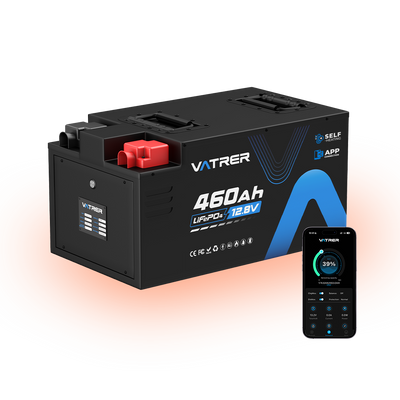
If I were comparing a 48V Yamaha golf cart battery kit for a typical Drive, G29, or Drive2, would look beyond the battery box. The charger, display, mounting parts, Bluetooth monitoring, and BMS should all match the same upgrade path. Like the Vatrer 48V 105Ah Yamaha golf cart battery, it includes a 58.4V 20A charger, a 2.8-inch LCD, mounting accessories, Bluetooth monitoring, and a 200A BMS with 600A peak output, so you are not piecing the system together part by part.


Best Budget Option
Flooded lead-acid batteries are still the budget choice. A typical 48V Yamaha lead-acid replacement uses six 8V deep cycle batteries.
This option makes sense when:
- The cart is used lightly: Short rides, flat paths, and occasional use do not always justify a full lithium upgrade.
- Upfront price matters most: Lead-acid can cost less at purchase, even though maintenance and future replacement costs add up.
- You want to keep the cart close to stock: Replacing like-for-like is easier when the old wiring and charger are still in good condition.
Do not judge lead-acid only by the Ah printed on the case. A battery may list a high 20-hour Ah rating, but flooded lead-acid should not be treated as if 100% of that capacity is usable every day. Frequent deep discharge shortens lifespan.
Best Low-Maintenance Lead-Acid Option
AGM batteries are worth a look when you want to avoid watering but are not ready to move to lithium. They are cleaner than flooded lead-acid and more resistant to vibration.
AGM fits best when:
- You store the cart seasonally: Lower self-discharge helps during storage, though the batteries still need proper charging.
- You dislike watering: No removable caps or electrolyte checks are needed.
- You prefer a sealed battery: AGM is less messy around the battery compartment.
The downside is value. AGM costs more than flooded lead-acid, but it does not deliver the same weight savings or long cycle life as lithium. If your budget is close to a lithium kit, compare the total cost over 8–10 years before choosing AGM.
Best Long-Range or Heavy-Load Option
Higher-capacity lithium batteries make sense when your cart works harder than a standard two-passenger golf cart. Think hills, long properties, utility work, big tires, cargo boxes, or four-passenger seating.
Capacity Guide for Yamaha Drive, G29, and Drive2 Batteries
| Battery Capacity | Best Use | Watch-Out |
|---|---|---|
| 60Ah | Short neighborhood rides, occasional flat-ground use | May feel limiting for hills, long rides, or frequent use |
| 100Ah / 105Ah | Daily driving, 18 holes, community use, moderate loads | Best balance for many 48V Yamaha carts |
| 150Ah+ | Hills, 4+ passengers, heavy accessories, long-range use | Check BMS output, tray fit, and charger size |
Capacity should match the work your cart actually does. A 105Ah lithium battery is a strong middle ground, while 150Ah+ is better when load and range matter more than keeping cost down.
BMS output becomes more important as load increases. A 150Ah battery with weak discharge specs may not feel as strong as a 105Ah battery with a better BMS. Read both numbers.
What to Check Before a Yamaha Lithium Battery Upgrade
A lithium upgrade can be very clean, but only when the supporting parts match. Do not stop at “48V” and “fits Yamaha.” Check the system around the battery.
Lithium Battery Charger
LiFePO4 batteries need a charging profile that matches lithium chemistry. A lead-acid charger may stop too early, charge incorrectly, or cause the battery’s BMS to protect itself.
Check these charger specs:
- Output voltage: Many 48V LiFePO4 chargers charge around 58.4V.
- Output current: A 20A charger can refill a 105Ah battery in roughly 5–7 hours, depending on starting state of charge and charging conditions.
- Connector style: Yamaha plugs and charge ports vary, so check plug compatibility.
- Kit inclusion: A complete kit with a matched charger removes guesswork.
I would avoid mixing an old lead-acid charger with a new lithium battery unless the charger is confirmed compatible. The Vatrer Yamaha battery conversion kit includes a 58.4V 20A charger, so the battery and charger are already paired for the same LiFePO4 charging range.
BMS Output
The BMS protects the lithium battery and controls how much current it can safely deliver. It matters as much as capacity.
Look for:
- Continuous discharge amps: Standard carts often work well with 150A–200A continuous output. Heavy carts and hills benefit from the higher end of that range.
- Peak discharge current: Short bursts help with takeoff and steep grades. For a strong 48V lithium setup, peak output in the 400A–600A range is useful.
- Over-current protection: This protects the battery when load spikes.
- Temperature protection: Good lithium batteries monitor heat and cold.
- Low-temperature charging cutoff: Charging LiFePO4 below 32°F can damage cells, so low-temperature protection matters in cold climates.
- Cell balancing: This helps keep cells working evenly over time.
Do not buy only by Ah. A 48V 105Ah battery tells you storage capacity. The BMS tells you how well that battery handles real cart loads.
Voltage Reducer for Accessories
Many Yamaha carts run 12V accessories. Lights, horn, radio, USB charger, turn signals, fans, and small audio systems all need the right power source.
A voltage reducer steps the main pack voltage down to 12V. That is better than tapping one battery or one section of a pack.
Check accessory needs:
- Basic lights and horn: A small 12V reducer may be enough.
- Street-legal accessories: Turn signals, brake lights, and horn should be wired through a proper reducer.
- Audio or extra lighting: Higher accessory loads need a reducer with enough amp rating.
Tapping a single battery in a multi-battery pack creates imbalance. On lithium, careless accessory wiring can cause BMS issues or unstable accessory power.
SOC Meter or Battery Display
A traditional lead-acid battery meter reads voltage drop. That works because lead-acid voltage falls more noticeably as the pack drains.
Lithium is different. Voltage stays flatter through much of the discharge. A basic old meter may show “full” longer than expected, then drop quickly near the end.
Better options include:
- Lithium-compatible SOC meter: Shows a more useful state of charge.
- LCD display: Helpful when mounted where you can see it before driving.
- Bluetooth app: Good for checking voltage, current, temperature, and battery status from your phone.
The Vatrer Yamaha lithium batteries includes a 2.8-inch LCD and Bluetooth app monitoring, so you can check battery information without guessing from an old lead-acid gauge.
Battery Tray and Mounting Fit
“Drop-in” should mean more than matching voltage. A good kit should sit securely in the battery compartment and work with the cart’s wiring path.
Check these measurements before buying:
- Tray length, width, and height: Leave room for cables, brackets, and safe routing around components.
- Terminal position: Terminals should line up with safe cable routing.
- Cable length: Avoid tight cables that pull on terminals.
- Hold-down hardware: The battery should not bounce on rough paths.
- Charger port: Make sure the charger connection is practical for daily use.
A clean battery installation looks boring, and that is a good thing. No stretched cables. No loose brackets. No accessory wires hanging across sharp edges.
Common Mistakes When Buying Yamaha Golf Cart Batteries
Most battery problems start before installation. The wrong battery may still power the cart, but it can create weak performance, short range, charger issues, or accessory problems.
Buying the Wrong Voltage
36V and 48V systems are not interchangeable. A 48V lithium battery does not belong in a 36V cart unless the full system is converted correctly. Count your batteries and verify the total voltage before you order.
Choosing Too Little Capacity
A low-capacity lithium battery may look attractive because it costs less. That can be fine for short flat rides. It becomes a poor fit when the cart carries four people, climbs hills, runs large tires, or drives long distances.
Use 100Ah or 105Ah as the normal middle ground for many 48V Yamaha carts. Move higher when load and range demand it.
Ignoring Charger Compatibility
A charger mismatch can turn a good battery into a bad experience. Lithium batteries need a LiFePO4 charging profile. If your Yamaha still has the original lead-acid charger, verify it before using it with lithium.
Overlooking Accessory Power
Accessories are easy to forget because they are not part of the drive system. Then the lights flicker, the horn fails, or the battery system becomes unbalanced. Check whether your cart needs a 12V voltage reducer before you install the new battery.
Only Comparing Upfront Cost
A cheaper flooded lead-acid pack may win on day-one price. That does not always make it cheaper over 8–10 years. Add water maintenance, cleaning, charging time, replacement frequency, and weight into the decision.
Lithium costs more upfront, but it can reduce maintenance and replacement cycles. That is why a Yamaha golf cart battery replacement should be judged by total ownership, not only checkout price.
Conclusion
Choosing the right Yamaha golf cart battery comes down to matching voltage, usage needs, and long-term value. While flooded lead-acid batteries offer a lower upfront cost, they require regular maintenance and add significant weight. LiFePO4 lithium batteries stand out for their lighter weight, more stable performance, faster charging, and longer service life.
If you're considering upgrading or replacing your battery, Vatrer batteries are not only lighter than lead-acid batteries, but also offer longer range, faster charging, and true plug-and-play installation. This simplifies the upgrade process and avoids the uncertainty of using different brands of parts, ensuring reliable system performance.
Share