What Are the Best Batteries for 5th Wheel Campers?
Reading time: 12 minutes

Share
A fifth-wheel camper can put real pressure on its battery system. Lights and a water pump are only part of it. The battery also supports slide-outs, leveling controls, furnace blower, vent fans, appliance control boards, and sometimes a residential refrigerator or inverter.
For most setups, the best battery for 5th-wheel camper use is a 12V LiFePO4 lithium deep cycle battery. It gives you more usable power from the same rated capacity, charges faster, weighs less, and does not need watering. AGM batteries still make sense for simple campground use. Flooded lead-acid batteries cost less up front, but they bring more maintenance and less usable capacity.
Best Battery Choice Depends on How You Camp
Battery choice starts with your camping pattern. A fifth wheel that stays plugged into shore power needs a different battery setup than one that spends three nights off-grid with the furnace running.


Mostly RV Parks and Shore Power
A fifth wheel that stays at RV parks with 30A or 50A hookups does not need a huge battery bank. Shore power carries the heavy loads, while the battery covers basic 12V functions and backup use.
In this setup, the battery usually supports:
- Interior lights and vent fans
- Water pump and appliance control boards
- Slide-outs and leveling controls
- Short power interruptions
- Propane appliance controls
A 100Ah to 200Ah battery is usually enough. AGM works here because the off-grid demand is light, and the lower upfront cost may be more attractive than lithium. A small LiFePO4 RV battery is better if you want less weight, longer service life, and more usable capacity from the same Ah rating. A 400Ah battery bank would be overkill for most campground-only use.
Weekend Dry Camping
Weekend dry camping needs more cushion. You may still use propane for heat or refrigeration, but your RV house battery keeps the 12V side alive through the night.
A 200Ah to 300Ah LiFePO4 battery bank is a practical range for this style of camping. It gives you enough energy for lights, water pump, fans, furnace blower, a TV, and limited inverter use.
The loads that usually surprise people are:
- Furnace blower: Propane creates the heat, but the blower still drains the battery.
- Small inverter appliances: A short coffee maker or microwave run can pull high current.
- Residential refrigerator: This can turn a casual weekend battery setup into a serious energy system.
A 300Ah lithium battery stores about 3,840Wh at 12.8V. In real use, inverter losses and safety margin reduce what you should plan around, but the jump from 100Ah to 300Ah is easy to feel during a dry camping weekend.
Boondocking or Full-Time RV Living
Boondocking changes the battery from a backup item into the center of your power system. Your fifth wheel may need to support a refrigerator, Starlink, laptops, furnace blower, lights, water pump, and a larger inverter without shore power nearby.
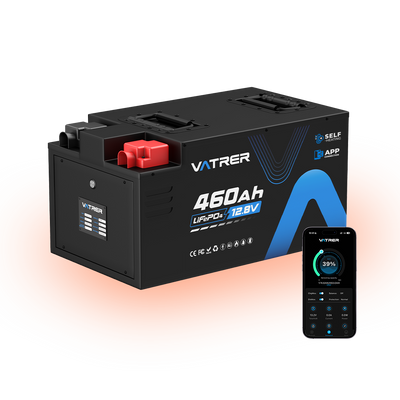
A 300Ah to 400Ah LiFePO4 battery bank is a better starting point for regular off-grid camping. A 460Ah lithium battery gives more reserve for longer stays or cloudy solar days. A 600Ah lithium battery bank fits heavy power use, especially with a residential fridge and a 2,000W or 3,000W inverter.
Solar helps most during the day. The battery still carries you overnight, in shade, and during bad weather. That is why boondocking setups need both charging input and enough stored energy.
Best Battery Types for 5th Wheel Campers
A fifth-wheel camper needs a deep cycle RV battery, not a car starting battery. A starting battery gives a short burst of power. A deep cycle battery supplies steady energy over hours.


LiFePO4 Lithium Batteries
LiFePO4 lithium is the best RV battery chemistry for most modern fifth wheel campers. The upfront price is higher than lead-acid, but the useful energy, lifespan, and weight savings are much better.
Key advantages include:
- More usable capacity: LiFePO4 batteries can often use 80% to nearly 100% of rated capacity. Lead-acid batteries are usually kept around 50% depth of discharge to protect lifespan.
- Longer lifespan: Many LiFePO4 batteries are rated for 3,000 to 5,000+ cycles, depending on depth of discharge and operating conditions.
- Lower weight: A 12V 100Ah LiFePO4 battery often weighs about 24 to 30 lbs. A similar lead-acid battery may weigh around 60 lbs or more.
- Faster charging: Lithium accepts charge more efficiently, which helps with solar, generator charging, and inverter chargers.
- No watering: You do not need to check electrolyte levels or deal with acid maintenance.
A quality lithium RV battery should have a built-in BMS for overcharge, over-discharge, over-current, short-circuit, and temperature protection. Bluetooth monitoring is also helpful because lithium voltage stays fairly flat while discharging. A Vatrer LiFePO4 RV battery with app monitoring makes state-of-charge checks much easier than guessing from voltage alone.
AGM Deep Cycle Batteries
AGM batteries are sealed lead-acid batteries. They are cleaner than flooded lead-acid and require less maintenance. They can be a good RV battery replacement if your fifth wheel mostly stays plugged in.
AGM makes sense when the priorities are:
- Lower upfront cost than lithium
- No watering
- Light dry camping only
- Compatibility with many existing lead-acid charging systems
The tradeoff is usable capacity. A 100Ah AGM battery is often treated like a 50Ah usable battery if you want better lifespan. It is also heavy, and frequent deep discharges shorten its life. AGM is a practical middle option, not the strongest long-term choice for frequent boondocking.
Flooded Lead-Acid Batteries
Flooded lead-acid batteries are the traditional low-cost RV option. They can still run basic 12V loads, but they ask for more attention.
You need to check water levels, use distilled water, clean terminals, avoid deep discharging, and keep the battery area properly vented. Skipping those tasks can shorten battery life quickly.
Flooded lead-acid works best in a simple setup with low power demand and a tight budget. It becomes less attractive if you dry camp often, run an inverter, or want a low-maintenance fifth-wheel camper battery.
Lithium vs AGM vs Lead-Acid Comparison
5th Wheel Camper Battery Type Comparison
| Feature | LiFePO4 Lithium | AGM | Flooded Lead-Acid |
|---|---|---|---|
| Typical usable capacity | 80%–100% | About 50% | About 50% |
| Typical cycle life | 3,000–5,000+ cycles | 300–700 cycles | 300–500 cycles |
| Weight for 12V 100Ah class | About 24–30 lbs | About 60–70 lbs | About 60–70 lbs |
| Maintenance | None in normal use | Low | Regular watering |
| Charging speed | Fast | Medium | Slower |
| Cold charging concern | Needs protection below 32°F | Less sensitive | Less sensitive |
| Best fit | Boondocking, solar, inverter use | Shore power and light dry camping | Lowest upfront cost |
LiFePO4 is the best battery for RV camping if you care about usable capacity, weight, and cycle life. AGM is the better low-maintenance lead-acid choice for light use. Flooded lead-acid only wins on initial price, and that advantage fades if you replace batteries often or spend time maintaining them.
How Much Battery Capacity Does a 5th-Wheel Camper Need?
Amp-hours tell you battery size, but watt-hours make the power easier to picture.
Use this simple estimate:
12.8V × Ah = watt-hours
A 100Ah LiFePO4 battery stores about 1,280Wh. A 300Ah lithium battery stores about 3,840Wh. AC appliances running through an inverter will use some extra energy because no inverter is 100% efficient.
100Ah for Basic Backup
A 100Ah battery fits light campground use. It can run basic 12V loads and give you backup power between hookups.
This size works for:
- Shore power camping
- Lights and water pump use
- Short travel days
- Basic replacement of an aging lead-acid battery
It is too small for regular inverter use, long furnace runtime, or a residential refrigerator. A single 100Ah battery is a backup source, not a full off-grid power system.
200Ah to 300Ah for Weekend Trips
A 200Ah to 300Ah lithium setup is the best fit for many weekend dry camping trips. It gives enough power to feel comfortable without turning the battery compartment into a large custom project.
A 300Ah lithium battery also keeps the setup cleaner than several smaller batteries. Fewer cases, fewer cables, and fewer connection points reduce installation clutter. In this capacity range, Vatrer 300Ah lithium batteries are worth purchasing if you want longer runtime from one main battery rather than building a bank from multiple 100Ah units.
Common Fifth Wheel Battery Capacity Ranges
| Battery Capacity | Approx. Stored Energy at 12.8V | Best Use | Main Limitation |
|---|---|---|---|
| 100Ah | 1,280Wh | Basic backup, shore power camping | Not enough for regular inverter use |
| 200Ah | 2,560Wh | Light weekend dry camping | Furnace and fridge loads need watching |
| 300Ah | 3,840Wh | Weekend trips and moderate off-grid use | Heavy inverter use still needs planning |
| 460Ah | 5,888Wh | Longer dry camping with more comfort loads | Requires proper wiring and charging |
| 600Ah | 7,680Wh | Full-time RV living or heavy boondocking | Higher cost and larger system planning |
A 300Ah battery is the balanced pick for many fifth-wheel campers. A 460Ah lithium battery gives more breathing room for longer trips. A 600Ah lithium battery bank belongs in a larger off-grid system with matching charging, wiring, and inverter capacity.
400Ah+ for Boondocking and Heavy Loads
Large inverter loads need both capacity and current support. A 1,500W microwave can pull around 125A or more from a 12V battery bank after inverter losses. A coffee maker may draw similar current for a short time.
A 400Ah+ LiFePO4 battery bank makes sense if your fifth wheel has:
- A residential refrigerator
- A 2,000W or 3,000W inverter
- Starlink or several daily electronics
- Heavy furnace use in cold weather
- Multi-day stays without shore power
At this level, the battery is only one part of the system. Cable gauge, fuse ratings, inverter size, solar input, and charger output need to match the current draw.
What to Check Before Upgrading 5th Wheel Batteries
An RV lithium battery upgrade can be simple, but the surrounding system still matters. Older fifth wheel campers often have converters made for lead-acid batteries, and those chargers may not fully charge LiFePO4.
Charger and Converter Compatibility
LiFePO4 batteries usually need a charging profile around 14.2V to 14.6V, depending on the battery maker. Some older converters charge at lower lead-acid voltages. The battery may still charge, but not to full capacity.
Check these items before replacing your batteries:
- Converter output voltage
- Charger mode or battery type setting
- Solar charge controller profile
- Inverter charger settings
- Battery maker charging requirements
A lithium-ready charger gives better performance. It also helps the battery reach full capacity more reliably.
Solar and Inverter Setup
Solar pairs well with LiFePO4 because lithium handles daily cycling better than lead-acid. A 400W solar array may support light camping in good sun, while heavier use may need 600W, 800W, or more. Shade, roof angle, cloudy weather, and winter sun can change output a lot.
Inverters need closer sizing. A 2,000W inverter on a 12V system can draw more than 160A under heavy load. A 3,000W inverter can pull more than 250A. The battery BMS, cables, fuses, and bus bars must handle that current. A strong battery cannot fix undersized wiring.
Battery Space, Wiring, and Safety
Measure before buying. Battery compartments vary by fifth wheel model, and lithium batteries do not all share the same case size.
Check:
- Battery length, width, and height
- Terminal position
- Cable reach
- Wire gauge
- Main fuse or breaker rating
- Battery hold-downs for travel
Lead-acid batteries also need ventilation. Lithium batteries remove that acid-gas concern, but they still need solid mounting and clean connections. A high-capacity battery can deliver serious current, so loose terminals or thin cables become real risks.
Cold Weather Protection
LiFePO4 batteries should not be charged below 32°F / 0°C unless they have low-temperature charging protection or a heating function. Discharging in cold weather is usually less restricted, but each battery has its own limits.
Look for cold-weather features such as:
- Low-temperature charge cut-off
- Self-heating function
- Battery temperature data
- Protected battery placement
- App or monitor visibility
A winter RV setup should not be judged only by Ah rating. When choosing a lithium battery for cold-weather camping, it makes sense to focus first on low-temperature protection features, and then consider capacity.
Best 5th-Wheel Camper Battery Recommendations
The right recommendation depends on how much time you spend away from hookups and how many loads you expect the battery to carry.
Best Overall
A 12V LiFePO4 lithium deep cycle battery is the best overall choice for most fifth-wheel campers. A 200Ah to 300Ah bank is a strong starting range if you dry camp occasionally or want a major upgrade from lead-acid.
This setup gives you lower weight, more usable power, faster charging, and no regular battery maintenance. It also leaves room to add solar or an inverter later without feeling underbuilt from the start.
Best Value Lithium
A 300Ah lithium battery is often the best value point. It gives real dry camping capacity without the cost and installation work of a much larger battery bank.
This size is useful for:
- Weekend dry camping
- Moderate inverter use
- Longer runtime than a single 100Ah battery
- Cleaner installation with fewer battery cases
- Easier monitoring if Bluetooth is built in
Move to 460Ah if you want more reserve for longer trips, heavier fridge use, or cloudy solar days.
Best Budget Choice
AGM is the best budget choice for low-maintenance campground use. It costs less than lithium, works with many existing lead-acid charging systems, and avoids the watering needs of flooded batteries.
Flooded lead-acid is cheaper at purchase, but it gives up convenience. The lower usable capacity, added weight, and regular maintenance make it harder to recommend for frequent dry camping.
Best for Boondocking
A 300Ah to 400Ah+ LiFePO4 battery bank is the better range for regular boondocking. Add solar, a battery monitor, and a lithium-compatible charger so the system can recover after daily use.
A 600Ah lithium battery bank belongs in a heavier setup with larger inverter loads and full-time off-grid habits. In that range, using fewer high-capacity batteries can simplify the layout. Vatrer high-capacity LiFePO4 models fit that approach because they help reduce the number of separate batteries while keeping the system easier to monitor.
Best for Cold Weather
The best cold-weather battery is a LiFePO4 model with low-temperature charging protection. A self-heating version is better if the battery sits in an exposed compartment.
Do not pick winter capacity first. Pick the protection features first, then choose the Ah rating that matches your normal power use.
Conclusion
Write down three things before buying: how many nights you camp without hookups, which loads you run from the battery, and how your battery will recharge. That simple list will point you toward the right size faster than guessing from battery labels.
A 100Ah to 200Ah battery works for basic shore power camping. A 200Ah to 300Ah LiFePO4 setup fits many weekend dry camping trips. A 460Ah lithium battery or 600Ah lithium battery bank makes more sense for longer off-grid stays, residential refrigerators, larger inverters, or full-time RV living. Once the charger, wiring, fuses, and battery space match the battery, LiFePO4 gives a fifth-wheel camper the strongest long-term mix of runtime, weight savings, and low maintenance.
Share