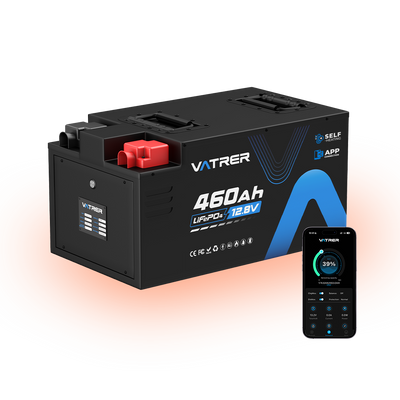
Pros and Cons of LiFePo4 Batteries: Complete Guide
Reading time: 5 minutes

Share
For many people, battery problems don't start on day one, they build up over time. RV owners notice their lights dimming sooner than expected. Golf cart owners deal with sluggish acceleration and frequent battery replacements. In most cases, the issue isn't the equipment itself, but the limitations of traditional lead-acid batteries.
As these frustrations add up, more users begin looking for alternatives that last longer, require less maintenance, and perform more consistently. This is where LiFePO4 batteries enter the conversation.


What Are LiFePO4 Batteries?
LiFePO4 batteries (lithium iron phosphate batteries) are a specific type of lithium battery designed around stability rather than maximum energy density. Instead of using cobalt-based chemistry like many lithium-ion batteries, they rely on iron phosphate, which is far more resistant to overheating and chemical breakdown.
LiFePO4 batteries behave predictably. They deliver steady voltage, typically around 3.2V per cell, across most of their discharge cycle. That's why equipment powered by LiFePO4 batteries tends to run at full strength until the battery is nearly empty, rather than slowly fading like lead-acid systems.
Another defining element is the battery management system (BMS). A quality BMS actively manages overcharge, over-discharge, overcurrent, and temperature limits. Without it, LiFePO4 battery wouldn't be viable for real-world use, which is why BMS design plays such a critical role in overall performance and safety.
Pros of LiFePO4 Batteries
Long Cycle Life and Extended Service Time
One of the most practical LiFePO4 battery advantages is how long they last. A typical lead-acid battery delivers around 300-500 cycles at 50% depth of discharge. In contrast, LiFePO4 batteries commonly reach 3,000-6,000 cycles at 80-100% depth of discharge.
At one cycle per day, that translates to roughly 8-12 years of usable life, depending on operating conditions. This difference dramatically reduces replacement frequency and long-term hassle.
High Safety Compared With Other Lithium Batteries
LiFePO4 chemistry is inherently stable, with thermal runaway temperatures typically above 500°F, far higher than cobalt-based lithium batteries.
Combined with a well-designed BMS, this makes LiFePO4 batteries suitable for enclosed environments such as RV compartments, cabins, garages, and indoor energy storage rooms, where safety margins matter more than compact size.
Consistent Power Output and High Efficiency
LiFePO4 batteries maintain a flat voltage curve, usually holding between 3.2-3.3V per cell for most of the discharge cycle. This consistency improves inverter efficiency and prevents early voltage cutoffs.
Usable capacity is another advantage. While lead-acid batteries should only be discharged to about 50% to avoid damage, LiFePO4 batteries comfortably deliver 90-95% usable capacity, effectively providing more energy from the same rated amp-hour size.
Low Maintenance and User-Friendly Operation
There's no watering, equalization charging, or corrosion cleanup. Self-discharge rates are typically below 3% per month, making LiFePO4 batteries well suited for seasonal or standby applications where equipment may sit unused for weeks or months.
Environmental and Sustainability Benefits
LiFePO4 batteries contain no lead, acid, or cobalt. Their long lifespan reduces waste over time, and higher efficiency means less energy lost as heat during charging and discharging, an important factor for renewable energy systems.
Cons of LiFePO4 Batteries
Higher Upfront Cost
The most noticeable LiFePO4 battery disadvantage is price. Lead-acid batteries often cost around $120-$200 per kWh, while LiFePO4 batteries typically range from $350-$700 per kWh, depending on features and brand.
Although long-term cost per cycle is usually lower, the upfront investment can be difficult for users with limited budgets or short-term use plans.
Performance Limitations in Cold Temperatures
LiFePO4 batteries generally discharge safely down to around –4°F, but charging below 32°F can cause internal damage if not properly managed. This is why cold-temperature protection or self-heating features are critical for winter use.
Without these protections, cold climates can reduce practicality unless additional insulation or heating solutions are installed.
Dependence on Battery Management Systems
A LiFePO4 battery is only as reliable as its BMS. Poor-quality systems may cause unexpected shutdowns or restrict usable capacity. This makes manufacturer quality and specification transparency especially important.
Lower Energy Density Than Other Lithium Chemistries
Compared with NMC or NCA lithium batteries, LiFePO4 batteries are heavier for the same energy capacity. In weight-sensitive applications, this trade-off may matter, though many stationary or vehicle-based systems can accommodate the difference without issue.
LiFePO4 Batteries vs Lead-Acid vs Other Lithium Batteries
| Feature | Lead-Acid Battery | LiFePO4 Battery | Other Lithium-Ion (NMC/NCA) |
|---|---|---|---|
| Cycle Life | 300–500 cycles | 3,000–6,000 cycles | 1,000–2,000 cycles |
| Usable Capacity | 50–60% | 90–95% | 80–90% |
| Cost per kWh | $120–$200 | $350–$700 | $500–$900 |
| Maintenance | High | Very low | Low |
| Thermal Stability | Moderate | Very high | Moderate |
While LiFePO4 batteries are not the cheapest option upfront, they offer a much longer service life and higher usable capacity. Compared with other lithium-ion chemistries, they trade energy density for improved safety and longevity, which is often a better match for long-term energy storage rather than compact consumer electronics.
Continue reading: Lead-acid Battery vs Lithium-ion Battery
Are LiFePO4 Batteries Worth It for Different Applications?
RV and Camper Vans
- Pros: Long cycle life, stable voltage for appliances, reduced maintenance
- Cons: Higher upfront cost, cold-weather charging considerations
- Worth it? Yes, especially for full-time or frequent travelers
Solar and Off-Grid Systems
- Pros: Handles daily cycling, high usable capacity, long lifespan
- Cons: Initial investment higher than lead-acid
- Worth it? Strong yes for systems designed for long-term use
Golf Carts and Electric Utility Vehicles
- Pros: Consistent torque, lighter weight than lead-acid, fast charging
- Cons: Requires compatible charger and BMS quality matters
- Worth it? Yes for performance-focused users
How to Decide If LiFePO4 Batteries Are Right for You
Choosing LiFePO4 batteries makes the most sense when long-term reliability, frequent cycling, and reduced maintenance matter more than upfront savings. Users living in cold climates should prioritize models with built-in low-temperature protection or heating functions.
Practical Checklist
| Factor | What to Consider |
|---|---|
| Daily Cycle Frequency | Frequent cycling favors LiFePO4 |
| Operating Temperature | Below-freezing charging needs protection |
| Budget Horizon | Long-term savings vs upfront cost |
| Safety Requirements | Enclosed spaces favor LiFePO4 |
| Monitoring Needs | Bluetooth monitoring improves usability |
If your system runs daily, operates indoors or in enclosed spaces, and you value predictable performance over years rather than months, LiFePO4 batteries are usually the more practical choice.
Conclusion
LiFePO4 batteries offer clear strengths: long cycle life, high usable capacity, stable output, and a much higher safety margin than traditional lead-acid batteries. Their main trade-offs are higher upfront cost and the need for proper low-temperature protection.
Choosing a well-designed LiFePO4 battery can reduce replacements and maintenance over time. Vatrer Power's LiFePO4 batteries, with 4,000+ cycles, built-in BMS, low-temperature protection, and optional Bluetooth monitoring and self-heating, are designed to solve common real-world issues rather than just meet basic specifications.
Share
2 comments
I learned much from this. It was well-articulated and has helped me with my decision to purchase 72v 60ah Lifepo4 setup for my bike. Thanks for sharing
Ich habe LI Fe PO4 als Speicher für Photovoltaik Anlage im Einsatz, ich betreibe 4 Batterien in Serie mit Sicherung und Trennrelais. Es ist wiederholt vorgekommen das eine Batterie ausfällt und nur noch eine Spannung von 1,2 bis 2,4 V liefert. Meine Frage ist was kann das für eine Urache haben?
Es ist auch schon vorgekommen das eine vermeintlich defekte Batterie auch wieder eine Spannung von 11,3V liefert und nach separaten Laden wieder Einsetzbar war.