What Types of Batteries Do Electric Forklifts Use?
Reading time: 12 minutes

Share
The main electric forklift battery types are flooded lead-acid, lithium-ion, and Thin Plate Pure Lead (TPPL). A flooded lead-acid battery usually costs less at purchase and works well with a predictable overnight charge. A lithium-ion battery suits longer operating hours because it can accept short charges during breaks and does not need watering. TPPL keeps lead-acid chemistry but uses a sealed design that supports faster, more flexible charging than many conventional flooded batteries.
Battery chemistry is only the first decision. Your forklift still needs the correct voltage, amp-hour range, compartment size, connector layout, charger, and battery weight.
Quick Comparison of Forklift Battery Types
| Battery type | Daily charging pattern | Routine work | Best starting point |
|---|---|---|---|
| Flooded lead-acid | Full charge after a shift; multi-shift fleets may rotate batteries | Watering, electrolyte checks, equalization, and terminal care | One-shift fleets with an established battery room |
| Lithium-ion | Full charging plus short opportunity charges | Connector checks, BMS review, and temperature monitoring | Multi-shift or high-use fleets |
| TPPL | Frequent partial charges with scheduled full recharge | Charger-profile checks and periodic condition review | Light- to medium-duty fleets with regular plug-in time |
A forklift that can recharge overnight and already has trained battery-maintenance staff may gain little from an immediate lithium conversion. Lost runtime changes the calculation. If battery changes interrupt production every day, lithium-ion deserves a closer cost comparison. TPPL fits between these cases when you want sealed lead-acid technology without routine watering.
Main Types of Electric Forklift Batteries
These three systems affect how you charge the truck, maintain the battery, and organize the fleet. Their operating routines differ more than their basic purpose.
Flooded Lead-Acid Batteries
A flooded lead acid forklift battery contains a series of two-volt cells. A 48V battery commonly uses 24 cells, while an 80V battery commonly uses 40. Each cell contains positive and negative plates immersed in liquid electrolyte. The steel battery tray holds the cells together and protects them inside the truck.
Lead-acid remains practical because service support is widely available, the purchase price is usually lower than lithium, and the heavy battery can contribute to the forklift’s required counterweight. The trade-off is regular hands-on care.
Typical work includes:
- checking electrolyte levels and adding distilled or de-ionized water after charging when required;
- cleaning corrosion from terminals and the battery top;
- running equalization charges according to the battery and charger instructions;
- inspecting cables, vent caps, connectors, and insulation;
- moving batteries with approved handling equipment if the fleet uses battery rotation.
OSHA identifies sulfuric acid, battery weight, electrical short circuits, and hydrogen gas during charging as major hazards. It also calls for designated charging areas and trained personnel where batteries are charged or changed.
Flooded traction batteries may use flat-plate or tubular-plate construction. Tubular construction holds active material around vertical spines, while flat-plate construction uses flatter grid-style plates. This difference can affect cycling and charge acceptance.
Lithium-Ion Forklift Batteries
A lithium forklift battery combines lithium-ion cells with a battery management system, contactors, sensors, wiring, industrial connectors, and a protective enclosure. LiFePO4 is widely used in material handling because it offers stable discharge behavior and good thermal stability.
The battery management system (BMS), monitors individual cell voltage, current, temperature, state of charge, and fault conditions. It can limit or stop current when the battery moves outside its programmed operating range. The system still needs inspection, but it removes the watering and electrolyte work associated with a flooded battery.
Lithium changes the workday in several visible ways:
- The battery usually stays in the truck during charging.
- Operators can add energy during breaks or shift changes.
- Voltage remains relatively consistent through much of the discharge.
- Multi-shift fleets may need fewer spare batteries.
- BMS data makes charge status and faults easier to track.
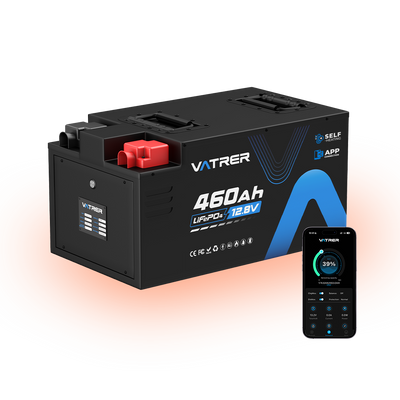
The Vatrer 48V 600Ah lithium battery delivers 30.72 kWh of energy, featuring a maximum continuous discharge current of 350A and a 30-second peak discharge current of 700A. Additionally, it is equipped with CAN and RS485 communication interfaces and an LCD display for real-time battery status monitoring. Before installing this battery in a forklift, please verify that specifications, such as voltage, peak current, installation space, connector type, and weight meet your requirements. Vatrer also offers OEM services if you need a lithium battery tailored to your specific needs.


TPPL Forklift Batteries
TPPL stands for Thin Plate Pure Lead. It is a sealed lead-acid design rather than a separate battery chemistry. Thin high-purity lead plates and absorbed glass mat separators allow more plate surface area inside the case and support faster charge acceptance than many conventional flooded batteries.
You do not add water to a TPPL battery. You can also return it to service before every charge reaches 100%, which makes the technology useful for opportunity charging. The charging schedule still needs discipline because repeated deep discharge or missed full-recharge periods can shorten battery life.
What Are The Differences Between The Types of Forklift Batteries?
Forklift battery types differ most in how they handle charging, shift changes, maintenance, and facility requirements.
Charging and Shift Workflow
A conventional lead-acid fleet often rotates batteries. At the end of a shift, staff remove the discharged battery, install a charged replacement, and send the first battery through its charging and cooling period.
Lithium usually stays in the forklift. Operators plug in during planned pauses, adding enough energy to continue working even when the battery does not reach a full charge. This practice can reduce battery-change labor, but the charger must return energy fast enough to cover the truck’s actual use.
Use a simple estimate:
Energy used (kWh) = average power demand (kW) × operating time (hours)
A truck that averages 6kW for six operating hours uses about 36kWh. A 6kW charger connected for one hour can return no more than about 6kWh before charging losses and current tapering.
TPPL also accepts partial charging, though its allowable daily throughput and full-recharge schedule differ from lithium. The battery specifications and charger settings define how far you can rely on short charging periods.
Maintenance, Space, and Safety
The battery type changes the work required around the charging area.
Flooded lead-acid may involve:
- a designated charging area;
- watering equipment and a maintenance log;
- ventilation for charging gas;
- spill-neutralization materials and flushing facilities;
- lifting equipment for battery changes;
- storage space for charged and discharged batteries.
Lithium work shifts toward electrical and electronic checks:
- Use the charger approved for the battery system.
- Review BMS alerts before they become performance problems.
- Inspect connectors, cable insulation, restraint points, and the enclosure.
- Keep charging within the documented temperature range.
- Confirm that the facility can supply the charger’s input power.
TPPL removes watering but keeps the need for a controlled charging routine. Staff still need to follow the correct profile, complete scheduled full charges, and avoid excessive discharge.
Service Life and Total Cost
Battery life depends on how deeply you discharge it, how often you charge it, the operating temperature, and how well you follow the required maintenance routine. Two batteries with the same cycle rating can reach very different replacement dates when one runs a light single shift and the other powers a forklift around the clock.
Typical Forklift Battery Cycle-Life Ranges
| Battery type | Typical planning range | Main factors that shorten its life |
|---|---|---|
| Flooded lead-acid | About 1,200–1,800 cycles | Low electrolyte levels, missed equalization, heat, over-discharge, and incomplete charging |
| TPPL | About 1,000–1,500 cycles | Frequent deep discharge, missed full charges, heat, and an incorrect charger profile |
| Lithium-ion | About 2,000–4,000 cycles or more | High temperatures, excessive charge or discharge current, deep cycling, and long periods at very high or low state of charge |
These ranges help with early budgeting, purchase price also gives an incomplete cost comparison. A lead-acid battery may be cheaper to buy, yet a multi-shift fleet may need extra batteries, changing equipment, maintenance labor, and dedicated charging space. Lithium-ion usually costs more upfront, but opportunity charging can reduce battery swaps and keep each forklift available for more of the workday.
Calculate total ownership cost with these items:
- Battery purchase and expected replacement frequency
- Charger purchase and electrical installation
- Spare batteries
- Battery-changing or lifting equipment
- Watering, cleaning, equalization, and inspection labor
- Energy consumed during charging
- Charging and cooling downtime
- Battery-room and storage space
- Repairs, service support, freight, and end-of-life handling
The lithium forklift battery cost should include the complete installed system. A low battery-only price may not include the charger, communication display, cables, ballast, freight, or conversion work.
Forklift Battery Voltage, Capacity, and Weight
A battery must fit the truck electrically, physically, and mechanically. Choosing a newer chemistry does not correct the wrong voltage or missing counterweight.
Common Forklift Battery Voltages
Electric material handling equipment commonly uses 24V, 36V, 48V, 72V, or 80V systems. Smaller pallet equipment often sits at the lower end, while larger counterbalance or specialized trucks may use 48V, 72V, or 80V.
Typical Voltage Ranges by Equipment
| Nominal voltage | Common equipment pattern | Check before purchase |
|---|---|---|
| 24V | Pallet trucks, compact stackers, and smaller order pickers | Peak current and available capacity |
| 36V | Reach trucks and warehouse trucks | Lift demand, compartment width, and maximum Ah |
| 48V | Many counterbalance forklifts | Current draw, battery weight, and connector rating |
| 72V | Selected narrow-aisle and specialized trucks | Charger availability and compartment size |
| 80V | Larger or heavier-duty electric forklifts | High-power charger and battery-handling requirements |
Ah, kWh, and Runtime
Amp-hours describe charge capacity. Kilowatt-hours describe stored energy.
Use this calculation:
Nominal energy (kWh) = nominal voltage × amp-hours ÷ 1,000
A 51.2V 600Ah battery stores:
51.2 × 600 ÷ 1,000 = 30.72kWh
A 36V 600Ah battery stores:
36 × 600 ÷ 1,000 = 21.6kWh
Both batteries carry a 600Ah label, but the first stores about 42% more nominal energy. Ah alone cannot compare batteries at different voltages.
Runtime depends on how quickly the truck uses that energy. A 30kWh battery supplying an average 5kW load gives a theoretical six hours. At an 8kW average load, the same battery falls below four hours before reserve capacity and conversion losses are considered.
Real work changes the result through:
- load weight and lift frequency;
- travel distance and ramp use;
- hydraulic attachments;
- ambient and battery temperature;
- controller and motor efficiency;
- usable depth of discharge;
- time available for opportunity charging.
Size, Weight, and Counterbalance
Forklift batteries may weigh hundreds or thousands of lbs. In many electric forklifts, that weight contributes to truck stability and rated capacity.
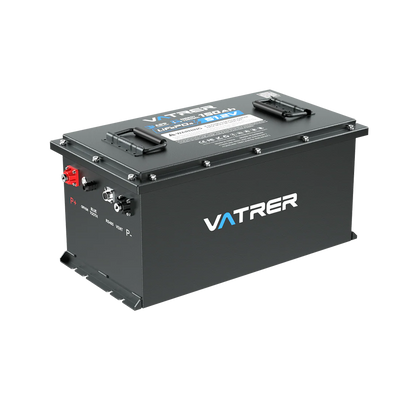
Lithium batteries often result in a difference in weight. The Vatrer 51.2V 600Ah lithium battery weighs 640 pounds and measures 31.50*26.30*14.96 inches. Since lithium batteries weigh less than the original lead-acid battery systems, additional ballast is required.
Check all of these before installation:
- Compartment length, width, height, and lid clearance
- Minimum and maximum battery weight
- Cable exit and connector position
- Restraint points and lifting method
- Room for cable bends, cooling airflow, and service access
- The effect of ballast on truck capacity and documentation
How to Choose the Right Forklift Battery
Start with measured operating data. A scheduled eight-hour shift may contain only four hours of motor-on time, while another truck may lift, travel, and climb ramps almost continuously.
Match the Duty Cycle
Record at least one representative workweek:
- motor-on hours per shift;
- starting and ending state of charge;
- average and maximum load;
- lift height and lift frequency;
- travel distance and ramp use;
- number and length of breaks;
- battery changes or charging interruptions;
- seasonal temperature conditions.
A one-shift fleet with overnight charging and an established maintenance area may get the best value from flooded lead-acid. Multi-shift work usually gives lithium a stronger case because short charging periods can reduce battery swaps. TPPL can fit moderate workloads where regular plug-in time is available and deep discharge is controlled.
A 24/7 operation needs an energy study rather than a chemistry guess. Compare the energy consumed during each working block with the energy returned during every scheduled charge. If consumption remains higher, increase charger power, battery capacity, or charging time, or plan a battery rotation.
Plan Charging and Facility Needs
Select the battery and charger as one system. Charger output sets the best-case energy you can return during a break.
Assume the truck uses 24kWh between full charging windows and has three 30-minute breaks.
| Charger output | Ideal energy returned in 1.5 hours | Result before losses and tapering |
|---|---|---|
| 6kW | 9kWh | Extends runtime but leaves a 15kWh gap |
| 12kW | 18kWh | Replaces most, but not all, of the 24kWh |
| 20kW | 30kWh | Has enough theoretical output to cover the use |
For this 24kWh duty cycle, the 6kW option cannot sustain the workload through opportunity charging alone. The 20kW charger has enough theoretical output, but the battery’s maximum charge current, BMS limits, AC service, and tapering behavior still control the real result.
Facility planning also needs:
- input voltage, phase, breaker size, and simultaneous charger load;
- parking positions and cable routing;
- protection from forklift traffic;
- battery-storage or handling space;
- ventilation and emergency equipment where the work requires them;
- utility demand charges during peak charging periods.
Consider the Work Environment
Cold storage can separate discharge performance from charging performance. A battery may power the truck below freezing yet block charging at the same temperature.
Review:
- time spent inside and outside the cold room;
- condensation after temperature changes;
- battery heating and charge lockout;
- charger location;
- cable flexibility and seal materials;
- dust, moisture, chemicals, or washdown exposure.
High heat can speed battery aging. Use the documented temperature range for the complete battery and charger system instead of relying only on the chemistry name.
Can You Replace Lead-Acid with Lithium Forklift Batteries?
Some lead-acid forklifts can use lithium after a proper conversion review. A matching nominal voltage and a connector that plugs in do not make the conversion complete.
Electrical and Charger Compatibility
Check the full current path:
- nominal, maximum, and minimum battery voltage;
- continuous current during travel and lifting;
- peak current during acceleration or heavy lifts;
- regenerative current if the truck returns energy to the battery;
- charger voltage, output current, and charge profile;
- connector and cable current ratings;
- CAN or other communication requirements;
- emergency disconnects and fault behavior.
Lithium systems may exchange data between the BMS, charger, and forklift. Do not reuse a lead-acid charger unless the battery supplier has approved that exact model and configuration. The plug shape cannot confirm the charge profile or communication logic.
Fit, Weight, and System Integration
Mechanical checks carry the same weight as electrical checks:
- compartment dimensions and lid clearance;
- minimum and maximum battery weight;
- restraints, lifting points, and cable locations;
- ballast design;
- state-of-charge display;
- BMS and charger communication;
- data-plate or capacity-documentation changes.
Final Recommendation
Start with the forklift data plate, then look at how the truck works during a normal week. Note its daily operating hours, remaining charge at the end of each shift, break schedule, load demands, and any time lost to charging or battery changes. This gives you a much better basis for choosing a battery.
Flooded lead-acid is often the practical choice for a lightly used forklift that can charge overnight. Lithium-ion becomes more attractive as operating hours increase and battery changes begin to interrupt the workday. TPPL may suit a moderate-duty fleet that has regular charging breaks but does not need a full lithium conversion.
Before placing the order, confirm the battery voltage, usable energy, continuous and peak current, dimensions, installed weight, connector, charger requirements, communication method, and warranty. The battery should fit the truck, support the shift, and meet the required counterweight, not simply match the space inside the battery compartment.