Are Cheap Lithium Trolling Motor Batteries Safe? What to Know Before Buying
Reading time: 16 minutes

Share
A cheap lithium trolling motor battery can be safe, but you cannot judge it by price or star ratings alone. You need to look at the LiFePO4 cells, BMS current rating, motor compatibility, enclosure, charger requirements, and warranty terms.
Fire is not the only concern. An undersized BMS may cut power while you are moving against wind or current, and poor wiring can overheat even when the battery itself works correctly. The goal is to find a battery that stays electrically stable, delivers the current your motor needs, and holds up in a wet, vibrating boat environment.


What Makes a Cheap Lithium Trolling Motor Battery Safe?
Some low-cost batteries remove convenience features without weakening the main electrical protections. Others reach a lower price by using an undersized BMS, inconsistent cells, limited testing, or a poorly sealed case. The specifications usually show which type you are looking at.
Low Price vs Safety Risk
Reasonable cost reductions often affect convenience rather than basic battery operation. A budget model may have:
- A simple molded case
- No Bluetooth app or external display
- No self-heating system
- A shorter warranty
- Fewer included cables or accessories
- Direct online sales instead of a dealer network
Bluetooth is useful for checking voltage and state of charge, but it does not control current or protect the cells by itself. A simple battery with a properly rated BMS may be a better choice than a feature-heavy model with vague electrical data.
The following signs point to a riskier product:
- The listing mentions a “built-in BMS” without giving its current rating.
- Only peak discharge current appears in the specifications.
- Voltage, amp-hours, watt-hours, and power ratings conflict.
- The case appears unusually small or light for the claimed capacity.
- The seller provides no manual or technical documentation.
- Different parts of the listing show different operating limits.
- Warranty coverage appears only in a promotional image.
You can test basic capacity claims with a quick calculation. A 12.8V 100Ah battery should contain about 1,280Wh:
12.8V × 100Ah = 1,280Wh
If the same listing shows 640Wh, it describes roughly 50Ah of energy at 12.8V, not 100Ah. That gap is a reason to stop, not a reason to guess.
LiFePO4 Cells and Build Quality
Choose a battery that clearly identifies its chemistry as LiFePO4, or lithium iron phosphate. This chemistry is common in deep-cycle marine systems because it has a stable voltage curve, long cycle life, and lower thermal sensitivity than several higher-energy lithium-ion chemistries.
The chemistry label does not tell you how well the battery was assembled. Cell matching, internal busbars, sensors, terminals, and case construction still affect performance.
A credible LiFePO4 trolling motor battery should publish most of the following:
- Nominal voltage and rated capacity
- Total energy in watt-hours
- Recommended charge voltage
- Maximum charge current
- Continuous and peak discharge current
- Charge and discharge temperature limits
- Dimensions and weight
- Safety or test documentation
- A complete product manual
Poorly matched cells can drift apart as the battery ages. One cell may reach its upper or lower voltage limit early, causing the BMS to disconnect the entire battery while usable energy remains in the other cells. The result may look like a faulty motor or inaccurate battery monitor, even though the shutdown starts inside the battery.
Claims about “Grade A,” “Grade B,” or recycled cells are difficult to verify from a marketplace page. Consistent specifications, traceable manufacturing information, capacity-test results, and dependable support tell you more than an unsupported cell-grade claim.
BMS Protection and Ratings
The Battery Management System watches cell voltage, current, and temperature. It disconnects the battery when an operating limit is exceeded.
A safe lithium trolling motor battery should list protection for:
- Overcharging
- Excessive discharge
- Overcurrent
- Short circuits
- High temperature
- Low-temperature charging
- Cell imbalance
The BMS current rating matters as much as the protection list. A battery may include every common cutoff feature and still be unsuitable for a high-current motor.
BMS Specifications That Affect Trolling Motor Use
| BMS specification | What it controls | Practical check |
|---|---|---|
| Continuous discharge current | Sustained current supplied to the motor | Must meet or exceed the motor’s maximum amp draw |
| Peak discharge current | Short current surge | Check the amperage and permitted duration |
| Overcurrent cutoff | Current level that disconnects output | Should sit above normal full-load demand |
| Maximum charge current | Highest charger output the battery accepts | Charger current must remain below this value |
| High-temperature cutoff | Shutdown point during charging or discharge | Check both temperature limits |
| Low-temperature charge cutoff | Blocks charging when cells are too cold | Often activates near 32°F, depending on the model |
| Recovery method | How output returns after a cutoff | May require load removal, charger connection, or a reset button |
A 200A peak rating does not compensate for a 50A continuous limit. If your motor can draw 55A, that 50A battery may shut down during sustained high-speed operation.
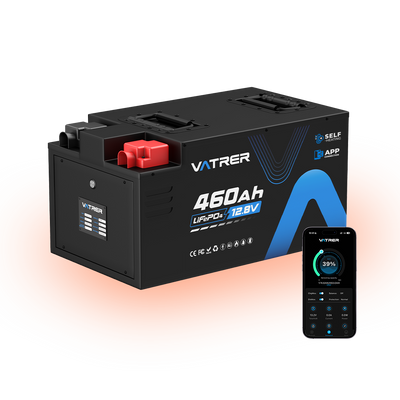
For a clear reference point, Vatrer 12V 100Ah lithium battery provide 1,280Wh of rated energy, while available BMS configurations may support 100A or 150A of continuous discharge. You can compare those two numbers with runtime needs and motor current without treating Ah as an output rating.
Will the Cheap Battery Safely Power Your Trolling Motor?
A well-built battery can still be the wrong battery for your motor. Voltage must match first. After that, compare the motor’s maximum amp draw with the battery’s continuous current rating.
Match the Battery Voltage
Trolling motors are designed around a specific system voltage. The lithium battery bank must supply that same system voltage.
Common Trolling Motor Voltage Configurations
| Trolling motor system | Typical battery arrangement | LiFePO4 nominal voltage |
|---|---|---|
| 12V motor | One 12V battery | 12.8V |
| 24V motor | One compatible 24V battery or two approved 12V batteries in series | 25.6V |
| 36V motor | One compatible 36V battery or three approved 12V batteries in series | 38.4V |
| 48V motor | One compatible 48V battery or four approved 12V batteries in series | 51.2V |
The nominal LiFePO4 voltage is slightly higher than the name used for the motor system. A 12V lithium battery usually reads 12.8V nominal because it contains four 3.2V cells connected in series.
Do not connect several 12V batteries in series unless the battery manufacturer allows it. Some internal BMS designs cannot tolerate higher series voltage, even though each battery works normally by itself.
A 24V motor needs a 24V-class battery system. Moving from 50Ah to 100Ah increases stored energy, but it cannot correct the wrong voltage.
Match BMS Amps to Motor Draw
Amp-hours describe energy capacity. Continuous discharge current describes how much electrical load the battery can carry without shutting down.
Ah is the tank size. Continuous current is the outlet size. A large tank with a narrow outlet still cannot feed equipment that demands a high flow rate.
Assume your motor draws up to 55A:
- 100Ah battery with a 50A BMS: The BMS may trip at maximum load.
- 100Ah battery with a 60A BMS: It covers the published draw but leaves little margin.
- 100Ah battery with a 100A BMS: It provides 45A of unused current capacity above the motor rating.
The motor will not draw 100A simply because the battery can supply it. Current is set by the load.
Use four numbers to check compatibility:
- Motor system voltage
- Motor maximum amp draw
- Battery continuous discharge current
- Battery overcurrent cutoff point
The continuous rating should meet or exceed the motor’s maximum draw, with some extra room for manufacturing tolerance, propeller resistance, and difficult operating conditions. Peak current does not count unless the manufacturer also gives a continuous rating.
A universal 100A minimum would be misleading. A small motor with a 30A maximum draw may work well with a 50A BMS, while a larger setup could need 80A, 100A, or more.
If the BMS trips, the motor stops immediately. Some batteries restart after you remove the load. Others remain inactive until you connect a charger or complete a manual reset. That failure mode matters more on moving water than an optimistic runtime claim.
Check Series and Motor Guidance
A multi-battery bank works best when every battery behaves the same. Series-connected units should match in:
- Brand and model
- Capacity
- Age
- State of charge
- BMS rating
- Operating temperature
An older battery may reach its voltage limit before the newer units. Its BMS then disconnects the whole 24V or 36V bank, even when the other batteries still hold energy.
The charging setup must also match the bank design. You may use separate 12V charging banks for series-connected batteries, or a charger made for the full bank voltage. A charger built for several individual 12V outputs may not work with a single-case 24V or 36V lithium battery.
Lithium batteries also hold their voltage higher through most of the discharge cycle. Certain brushed trolling motors were designed around the falling voltage of lead-acid batteries and may have limits on sustained full-speed operation.
Is the Lithium Battery Suitable for Marine Use?
LiFePO4 chemistry does not protect a battery from spray, salt, vibration, or standing water. The case, seals, terminals, mounting system, and cable connections handle those conditions.
Water and Vibration Protection
Look for a published ingress-protection rating. IP65, for example, covers dust ingress and water jets under test conditions. It does not cover submersion.
A marine lithium battery for trolling motor use should include practical features such as:
- Protected or recessed terminals
- Secure terminal covers
- Corrosion-resistant hardware
- A rigid case around the terminal area
- Handles or mounting points that do not flex
- Internal support against vibration
- Clear marine installation instructions
Mount the battery above the lowest point of the bilge. A strapped battery tray or box should prevent sliding, tipping, and impact against nearby gear. Support the cables separately so their movement does not pull on the terminals.
Saltwater residue can create conductive paths and accelerate corrosion. Disconnect the battery before cleaning exterior deposits, use fresh water sparingly, and dry the case and terminals before reconnecting the system.
Vatrer battery housing meets IP65 protection standards, which can withstand splashes and sprays, but we still recommend installing it above the water level. An ingress rating defines tested resistance; it does not turn the battery into a submersible power source.
Remove the battery from service if you find:
- Case swelling or distortion
- Cracks around the terminals
- Melted cable insulation
- Unusual heat while the battery is idle
- A burning or chemical smell
- Water inside the enclosure
- Loose terminals that rotate in the case
Do not open a sealed battery to inspect the cells. A damaged unit belongs with the manufacturer or a qualified battery recycler, not on your workbench.
Warranty and Product Support
A warranty matters only when you can use it. Read the full terms before buying rather than relying on a large “five-year warranty” graphic.
Check these details:
- Covered failures
- Marine-use exclusions
- Capacity-retention requirements
- Proof-of-purchase rules
- Return shipping costs
- Replacement process
- Service location
- Actions that void coverage
One poor review does not prove that a battery line is unreliable. A pattern does. Repeated complaints about early capacity loss, BMS shutdown, swelling, conflicting specifications, or unanswered support requests deserve attention.
You should also be able to download a manual that explains charging limits, storage, wiring, series connections, and BMS recovery. That documentation becomes part of the product you are buying.
Choose the Right Battery Capacity and Runtime
Capacity affects operating time, but it cannot fix the wrong voltage, an undersized BMS, or overheated wiring. Base your decision on average current draw, trip length, boat load, and the reserve you want for the return journey.
50Ah vs 100Ah Lithium Batteries
At the same voltage, a 100Ah battery stores about twice the energy of a 50Ah model.
12V 50Ah vs 12V 100Ah Trolling Motor Batteries
| Comparison point | 12V 50Ah LiFePO4 battery | 12V 100Ah LiFePO4 battery |
|---|---|---|
| Nominal voltage | 12.8V | 12.8V |
| Rated energy | About 640Wh | About 1,280Wh |
| Runtime at the same average load | Baseline | About 2× longer |
| Typical use | Short trips and lighter boats | Longer trips and heavier loads |
| Physical size | Usually smaller | Usually larger |
| Weight | Lower | Higher |
| Charging time with the same charger | Baseline | About 2× longer |
A 50Ah model may suit a kayak, canoe, compact inflatable, or small jon boat used for short trips at low to medium speed.
A 12V 100Ah lithium trolling motor battery gives you more reserve for wind, current, extra gear, and longer travel. It also takes more space and usually needs twice as long to charge with the same charger.
At a shared average load, moving from 50Ah to 100Ah roughly doubles runtime. Choose 100Ah for longer range, not because a larger capacity rating makes the battery electrically safer.
The best lithium battery for trolling motor use is the model that covers the required current and trip length without adding unnecessary weight or charging time.
Estimate Runtime and Keep Reserve
Use this planning formula:
Estimated runtime = usable capacity ÷ average current draw
Planning with 80% to 90% of rated capacity leaves room for temperature, battery age, changing weather, and the trip back to shore.
Approximate Runtime Using an 85% Planning Factor
| Average motor draw | 50Ah battery | 100Ah battery |
|---|---|---|
| 10A | 4.25 hours | 8.5 hours |
| 20A | 2.1 hours | 4.25 hours |
| 30A | 1.4 hours | 2.8 hours |
| 40A | 1.1 hours | 2.1 hours |
| 50A | 0.85 hour | 1.7 hours |
At a 20A average draw, a 50Ah battery gives about 2.1 hours under this planning method. A 100Ah battery extends that figure to about 4.25 hours.
The calculation for the larger battery is:
100Ah × 0.85 ÷ 20A = 4.25 hours
Real-world current draw changes constantly. The following conditions can shorten runtime:
- Strong headwinds
- River current
- Extra passengers or fishing gear
- Weeds around the propeller
- Damaged propeller blades
- High motor speed
- Low battery temperature
- Fish finders or other shared loads
Try to reach the dock with 15% to 25% capacity left. A planned reserve gives you time for worsening weather, a blocked route, or a longer return run.
Charge and Install the Lithium Battery Safely
The wrong charger can shorten battery life, while undersized cables can create heat far from the battery cells. Both parts of the system need specifications that match the load.
Use the Right Charger
Many 12.8V LiFePO4 batteries charge near 14.4V to 14.6V, but you should follow the voltage range printed in the battery manual.
Before connecting a charger, confirm that:
- It has a compatible LiFePO4 profile.
- Its maximum voltage stays within the battery limit.
- Its output current does not exceed the allowed charge current.
- Equalization and desulfation modes can be disabled.
Some lead-acid chargers use a voltage profile that also works with LiFePO4 batteries. Others apply long float stages, recovery pulses, or equalization cycles that do not suit lithium cells. The charger label alone cannot settle the question; compare its full voltage profile with the battery manual.
Approximate charging times look like this:
- A 100Ah battery on a 10A charger: about 10 to 12 hours
- A 100Ah battery on a 20A charger: about 5 to 6 hours
- A 50Ah battery on a 10A charger: about 5 to 6 hours
Charging below 32°F can damage LiFePO4 cells. A low-temperature cutoff blocks charge current, while a heating system raises cell temperature before charging begins. Those are separate functions.
If cold docks or winter storage are part of your routine, Vatrer self-heating lithium battery models stop charging near 32°F, warming the cells, and automatically resume charging once the internal temperature rises to 41°F. Warm-climate installations may not require the extra cost or complexity.
Bluetooth can display temperature and state of charge. It cannot stop damaging current unless the BMS includes the required cutoff.
Wire and Mount It Safely
Place a correctly sized fuse or circuit breaker near the positive battery terminal. The BMS protects the cells, the external breaker protects the cables and connected equipment.
Use the trolling motor manufacturer’s data for:
- Maximum amp draw
- Fuse or breaker size
- Wire gauge
- Maximum cable length
- Plug and receptacle rating
A longer cable creates more resistance. You may need thicker wire to limit voltage drop and heat, especially on high-current 12V systems.
The physical installation should include:
- A rigid battery tray or battery box
- Straps that block movement in every direction
- Covered positive and negative terminals
- Cable support near the battery
- Protection from sharp edges
- No loose tools or metal tackle near the terminals
- Clearance above standing bilge water
- Clean, firmly tightened connections
Keep the battery away from fuel vapors, engine heat, and repeated deck impact. Follow the terminal torque in the manual, overtightening can damage the insert, while loose terminals create resistance and heat.
Cheap vs Premium Trolling Motor Batteries
Higher price does not automatically mean safer construction. It may buy useful features, better documentation, or stronger support, but only if the product clearly states what you are paying for.
When a Budget Battery Is Enough
A lower-cost LiFePO4 trolling motor battery may make sense when:
- The motor runs on 12V and has moderate current demand.
- Trips are short and stay close to shore.
- The boat is a kayak, canoe, inflatable, or small jon boat.
- Most use takes place in freshwater.
- The continuous discharge rating is clearly published.
- Charger and wiring compatibility are easy to verify.
- You have another practical way to return if the motor system fails.
Do not trade away electrical compatibility to reach a lower price. A 100Ah battery with a 50A BMS remains a poor choice for a motor that can sustain a 55A load.
When Paying More Makes Sense
Extra cost can be worthwhile when it solves a specific operating problem.
Where a Higher Battery Price May Add Value
| Use condition | Feature worth paying for | Direct benefit |
|---|---|---|
| 24V or 36V motor | Approved series support or a single high-voltage battery | Fewer balancing and compatibility issues |
| High-current motor | Higher continuous BMS rating | More current headroom before shutdown |
| Cold-weather charging | Low-temperature cutoff and self-heating | Safer charging near or below 32°F |
| Remote fishing | More reserve capacity and battery monitoring | Earlier warning before power runs low |
| Saltwater use | Better sealing and corrosion-resistant hardware | Lower risk of moisture-related connection problems |
| Frequent use | Documented cycle life and practical warranty support | Better long-term replacement value |
| Tight battery compartment | Accurate dimensions and higher energy density | Easier fit without sacrificing capacity |
Spend more for a feature that addresses your actual motor, climate, range, or installation. A premium label with missing BMS data is still a poor purchase.
Final Buying Trolling Motor Battery Checklist
Review these points before ordering a cheap lithium trolling motor battery:
- The chemistry is clearly identified as LiFePO4.
- Nominal voltage matches the trolling motor system.
- Amp-hours and watt-hours agree mathematically.
- Continuous BMS current is published.
- Continuous current meets the motor’s maximum amp draw.
- Peak-current duration is stated.
- Overcurrent and temperature protections are listed.
- Low-temperature charging limits are explained.
- Series connection is approved if your system needs it.
- Marine enclosure or ingress-protection information is available.
- Charger voltage and current requirements are published.
- Warranty and return terms are readable before purchase.
- The manufacturer provides a manual and technical support.
- Reviews show no repeated pattern of shutdown, swelling, or failed warranty claims.
Reject a battery if the manufacturer hides its chemistry, continuous current, charger limits, or BMS recovery method. A discount cannot compensate for missing electrical information.
Conclusions
Set a minimum standard before comparing prices. The battery must match your motor voltage, carry the full-load current without reaching its continuous BMS limit, provide enough usable capacity for the trip, and support the charger and wiring already planned for the boat.
A budget model is a reasonable choice for moderate 12V use, short trips, and easy access to shore. Remote routes, strong current, saltwater, winter charging, and high-current 24V or 36V systems justify more current headroom, more reserve capacity, and stronger product support. If the required specifications are missing, remove that battery from your list.
Share