Whole-Home vs Partial Home Battery Backup: Which Do You Need?
Reading time: 19 minutes

Share
A whole-home battery backup keeps most or all circuits in your house available during a power outage. A partial home backup supplies only the circuits you select in advance, such as the refrigerator, internet equipment, medical devices, and several lights.
The right choice depends on what you need to keep running, not the size of your house alone. Whole-home coverage gives you more flexibility, but major appliances can consume stored energy quickly. A partial system limits what you can use, yet the same battery capacity may last much longer because fewer loads are connected.
Whole-Home vs Partial Home Battery Backup
The main difference in whole home backup vs partial home backup is circuit coverage. Both systems may use similar lithium battery, inverter, transfer, and monitoring technology. They are wired and sized around different outage goals.
Whole-Home Backup
A whole home battery backup usually connects near the main electrical panel. When the grid goes down, the battery system disconnects the home from utility power and supplies electricity to most or all household circuits.
You can keep using more of the home without moving between a few dedicated backup outlets. Lighting, refrigeration, kitchen circuits, HVAC equipment, well pumps, and standard receptacles may remain available if the inverter and battery bank are sized for them.
That does not mean every appliance can run at once.
Your electrical service may be rated at 200A, but a residential battery inverter often delivers far less power than the utility connection. If the air conditioner, electric dryer, oven, and EV charger start together, their combined demand may exceed the inverter output even though every circuit is technically connected to backup power.
Whole-home systems therefore work best with three layers of planning:
- Enough inverter power for the largest expected combination of loads
- Enough battery capacity for the desired outage duration
- A load-control plan that delays or disconnects high-demand equipment
Tesla and Enphase both support whole-home and partial configurations, but their system design documents show that circuit layout, transfer equipment, utility approval, and load control affect how each installation is built.
Partial Home Backup
A partial home backup supplies a selected group of essential circuits. This configuration is also called essential-load backup or critical loads backup.
The backed-up circuits are commonly moved into a dedicated backup load panel. Some newer systems use smart panels, load controllers, or controllable breakers instead, so a separate subpanel is not the only possible design.
During an outage, non-backed-up circuits remain off. That prevents large or low-priority loads from draining the battery by accident.
A partial system is usually easier to size because the installer already knows which equipment may operate. The load could include a refrigerator, several lights, Wi-Fi, a furnace blower, a sump pump, and selected outlets. Electric cooking, central air conditioning, pool equipment, and Level 2 EV charging may remain outside the backup panel.
Partial coverage does have one practical drawback: changing your priorities later may require electrical work. If you install a heat pump, add a well pump, or decide that another room needs backup power, the panel and battery design may need to be revised.
Whole-Home and Partial Backup at a Glance
| Comparison area | Whole-home backup | Partial home backup |
|---|---|---|
| Circuit coverage | Most or all household circuits | Selected essential circuits |
| Typical battery demand | Higher because more loads remain available | Lower because large loads are often excluded |
| Inverter requirement | Must handle larger simultaneous loads | Sized around a known group of circuits |
| Outage runtime | Can fall quickly if major appliances stay active | Often longer with the same stored energy |
| Electrical layout | Commonly connected near the main panel | Often uses a backup loads panel or circuit controls |
| Load management | Frequently needed | Usually simpler |
| Upfront cost | Generally higher | Generally lower |
| Daily convenience during an outage | More circuits remain usable | Power is concentrated on essential needs |
| Future changes | Flexible if power and capacity are available | Adding circuits may require redesign |
| Best fit | Comfort, HVAC, water systems, and broader circuit access | Essential services, predictable use, and tighter budgets |
The better system is not automatically the one with more connected circuits. A well-sized partial system may provide two days of useful backup, while an undersized whole-house system may reach its reserve level in a few hours.


What Can a Home Battery Backup Power?
A home battery backup system has two separate limits.
The first is power, measured in kilowatts. It determines what the system can run at one moment. The second is energy, measured in kilowatt-hours. It determines how long those loads can keep running.
A battery may have enough stored energy to run a pump for several hours but lack the surge output needed to start its motor. The opposite can also happen: the inverter starts a large air conditioner without trouble, but the air conditioner consumes the available energy much faster than expected.
Critical Loads
Critical loads are the appliances and circuits that protect health, food, water, communication, and basic comfort during an outage.
A backup list may include:
- Food protection: Refrigerator, freezer, and a small kitchen outlet
- Communication: Modem, router, phones, laptops, and a television or radio
- Safety: Medical devices, security equipment, smoke alarms, and exterior lighting
- Water: Well pump or sump pump where needed
- Temperature control: Gas furnace blower, boiler controls, or a limited cooling circuit
- Basic access: Garage door opener and selected receptacles
Your list may look different. A well pump can be essential in a rural home and irrelevant in a home connected to municipal water. A furnace blower may be critical during a winter outage, while cooling may take priority during prolonged summer heat.
Sort each circuit into one of three groups before requesting an installation quote:
- Must run throughout the outage
- Useful but easy to limit
- Safe to leave off
This step often reveals that you do not need every circuit connected. It can also show the opposite. If water, medical equipment, electric heating, and cooling are all essential, a small critical-load panel may not meet your needs.
HVAC and Large Appliances
Large appliances affect both inverter sizing and battery runtime. Some draw high power continuously. Others create a brief startup surge that can trip an undersized inverter.
Typical High-Power Household Loads
| Appliance or load | Typical operating power | Energy used in one hour at full output | Backup concern |
|---|---|---|---|
| Microwave | 1.0–1.5 kW | 1.0–1.5 kWh | High draw, usually used briefly |
| Portable electric heater | About 1.5 kW | About 1.5 kWh | Continuous resistance load |
| Central air conditioner | 3–6 kW | 3–6 kWh | Compressor startup and long cycling periods |
| Electric water heater | 3–4.5 kW | 3–4.5 kWh | Can reheat for extended periods |
| Electric dryer | 3–5 kW | 3–5 kWh | Large heating load |
| Level 2 EV charger | 7–11 kW | 7–11 kWh | Can consume a small battery bank very quickly |
These are planning ranges rather than nameplate values for every appliance. The exact figure should come from the equipment label, manufacturer documentation, or a circuit-level energy monitor.
HVAC deserves special attention. A system capable of starting a 4 kW air conditioner could still use 12 kWh during three hours of compressor operation. That is most of the available energy in many single-battery systems.
Heat pumps can be more efficient than resistance heating, but performance changes with outdoor temperature and equipment design. Backup heat strips are especially demanding. Ask the installer whether the calculation includes auxiliary resistance heat, not only the heat pump compressor.
Electric water heaters, dryers, and ovens are easier to control because you can delay their use. Water pumps may be less flexible. If your home depends on a well, the inverter must handle the pump’s startup demand every time the pressure tank calls for water.
Coverage and Simultaneous Use
Think of circuit coverage as a road map. Inverter power is the width of the bridge.
Whole-home coverage may place every appliance on the map, but only a certain amount of power can cross the bridge at one time. A 10 kW inverter cannot supply 16 kW of combined demand simply because all circuits are connected.
This distinction changes how you should read a whole house battery backup proposal. Ask the installer for both figures:
- The circuits included in backup coverage
- The maximum continuous and surge output available during an outage
A proposal that says “whole home” without showing expected simultaneous loads leaves out a major part of the design.
You may still need to pause EV charging, avoid using the dryer while cooking, or raise the air-conditioning set point. Automatic load controls can make these decisions before the inverter becomes overloaded.
What Size Home Battery Backup Do You Need?
Start with the loads, then choose the battery. Buying a large battery first and deciding what to power later often leads to mismatched equipment or an inflated project cost.
System sizing requires thinking about four practical questions:
- What must operate?
- How much power can those devices demand at once?
- How many hours should they run?
- How much energy can solar produce during the outage?
kW vs kWh
Kilowatts and kilowatt-hours sound similar, but they describe different parts of performance.
- Kilowatts, or kW: The rate of power the inverter can deliver
- Kilowatt-hours, or kWh: The amount of energy stored
- Surge or peak power: Short-duration output used to start motors and compressors
A 5 kWh battery paired with a 10 kW inverter could support a high load for a short time. A 20 kWh battery paired with a 3 kW inverter might last much longer but fail to run several large appliances together.
Battery capacity can be calculated from nominal voltage and amp-hour capacity:
Battery energy in kWh = voltage × amp-hours ÷ 1,000
A 51.2V 100Ah lithium battery therefore stores:
51.2 × 100 ÷ 1,000 = 5.12 kWh
That makes a 5.12 kWh module a useful building block for modular backup. Two matching units provide 10.24 kWh of rated energy, while four provide 20.48 kWh before reserve settings and conversion losses.
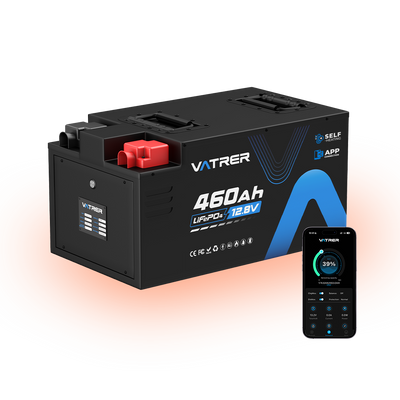
For solar backup power projects based on compatible inverters, if you plan to gradually add matching battery modules as energy demand increases, the Vatrer 51.2V 100Ah rack-mount lithium battery with WiFi is a good starting point, integrating 5.12 kWh capacity with a built-in BMS. Inverter compatibility, communication settings, breakers, cable size, and local electrical requirements still need to be checked before installation.
Estimate Backup Runtime
The basic runtime calculation is simple:
Estimated runtime = usable battery energy ÷ average active load
Rated battery capacity is not always the amount delivered to household appliances. The system may retain a reserve, and energy is lost while converting DC battery power into AC electricity.
The table below assumes that 85% of rated capacity reaches the loads after reserve and conversion losses. It is a planning example, not a guaranteed result.
Estimated Runtime at Different Battery Sizes
| Rated battery capacity | Assumed delivered energy | At a 0.5 kW average load | At a 1 kW average load | At a 2 kW average load |
|---|---|---|---|---|
| 5.12 kWh | 4.35 kWh | 8.7 hours | 4.4 hours | 2.2 hours |
| 10.24 kWh | 8.70 kWh | 17.4 hours | 8.7 hours | 4.4 hours |
| 20.48 kWh | 17.40 kWh | 34.8 hours | 17.4 hours | 8.7 hours |
The load matters as much as the battery. A 20.48 kWh system could support a carefully managed 500W essential-load average for more than a day. The same battery may last less than three hours at an average demand near 7 kW.
Real household loads also cycle. Refrigerators and air conditioners turn on and off, pumps run in short bursts, and lighting use changes through the evening. A circuit monitor or smart meter history gives you a better estimate than adding every appliance nameplate as though all equipment runs continuously.
Leave a reserve for uncertainty. Weather may reduce solar output, a pump may run more frequently than usual, or the outage may last longer than forecast.
Solar Recharge
Solar changes the calculation because backup runtime no longer depends only on the energy stored when the outage begins.
During daylight, solar production may:
- Supply active household loads
- Send excess energy into the battery
- Reduce the depth of overnight discharge
- Support repeated daily backup cycles during a longer outage
A 10 kWh battery that uses 7 kWh overnight could begin the next evening near full charge if the solar array produces enough surplus energy during the day. If clouds reduce solar production to 4 kWh while daytime loads consume 3 kWh, only about 1 kWh remains for charging.
Standard grid-tied solar usually shuts down during an outage unless the system includes compatible isolation and backup controls. Some systems can form a local microgrid, while certain configurations can provide limited daytime solar power to selected circuits even without a battery.
Solar array size alone does not predict outage performance. Roof orientation, season, shading, weather, inverter limits, and daytime consumption all affect how much energy reaches the battery.
A generator may support long outages when solar production is poor, but it should be treated as a separate fuel-based backup source. It does not replace correct battery and inverter sizing.
Whole-Home vs Partial Backup Cost and Installation
Battery capacity is only one part of the quote. Electrical work can change the price substantially, especially in homes with older panels, combined meter-main equipment, limited breaker space, or more than one service panel.
A smaller partial system often costs less. It uses less battery capacity and may need a lower inverter output. Yet moving many circuits into a new backup panel can add labor and equipment.
A whole-home installation may use more batteries and stronger power electronics, while the circuit layout itself could be more direct. The lower-cost design depends on the house.
Panel Configuration
A partial backup installation may involve a dedicated backup panel containing the selected circuits. The electrician disconnects those circuits from the main panel, routes them through the backup equipment, and labels the new arrangement.
Other designs can use:
- Smart electrical panels
- Automatic load controllers
- Remotely controlled breakers
- Meter-based sensing equipment
- Manufacturer-specific system controllers
Whole-home configurations often connect the backup equipment upstream of the main panel or at the service entrance. The transfer device detects a grid failure, isolates the house from the utility, and allows the inverter to form the home’s local electrical supply.
That placement can reduce circuit relocation, but it creates other design checks. Service ratings, busbar limits, utility approval, neutral configuration, grounding, and available fault current may all affect the installation.
Whole-home and partial configurations can both use transfer equipment, system controllers, smart metering, and load-control hardware. The final wiring method depends on the existing service layout, the selected equipment, the circuits being backed up, and local utility requirements. Partial backup does not always mean one fixed panel arrangement.
Load Management
Smart load management allows a whole-home system to keep broad circuit access without sizing the battery inverter for every appliance operating at once.
The controller may disconnect a lower-priority circuit when:
- Total power approaches the inverter limit
- Battery state of charge reaches a selected threshold
- Solar production falls below the active load
- A high-surge device needs to start
- The system enters an extended-outage mode
A common priority order might keep the refrigerator, well pump, medical equipment, and furnace controls active while pausing the EV charger, pool pump, electric water heater, or secondary HVAC zone.
Some systems restore the disconnected load automatically after demand falls. Others let you change priorities through an app.
This managed approach sits between traditional partial backup and a very large whole-home battery bank. Every circuit may remain connected, while software decides which high-demand equipment can operate at a given moment.
Cost and Future Expansion
As a broad planning range, one installed residential battery may add roughly $5,000 to $10,000 to a project, depending on its capacity, power rating, installation requirements, and regional labor costs. A multi-battery whole-home installation may reach $20,000 or more before unusual panel work, service upgrades, or other project-specific expenses are included.
Actual quotes can vary widely. Review each cost driver instead of relying only on the total price.
| Cost driver | Why it changes the quote |
|---|---|
| Battery capacity | More kWh usually means more modules and mounting hardware |
| Inverter output | Higher kW ratings may require larger or multiple inverters |
| Transfer equipment | Whole-home isolation and service equipment can add hardware |
| Critical loads panel | Circuit relocation adds breakers, wiring, and labor |
| Main panel work | Older or undersized panels may need modification or replacement |
| Load controllers | Smart switches and controlled breakers add equipment and setup |
| Solar integration | Existing inverter type and array design affect compatibility |
| Permits and utility work | Fees and approval steps vary by location |
The least expensive quote may leave no practical path for expansion. Ask how the design would change if you later add an EV, heat pump, electric water heater, more solar panels, or another battery module.
Modular LiFePO4 batteries can make staged expansion more practical. Vatrer 48V home storage batteries provide two types of lithium batteries: rack-mounted and wall-mounted, supporting up to 10-30 batteries in parallel. Start with the capacity your critical loads require, then confirm that the inverter, busbars, protection devices, communication protocol, and installation space can support the planned final size.
Mixing battery models, capacities, ages, or battery management settings can create current-sharing problems. Expansion plans should be documented before the first unit is purchased.
Which Home Battery Backup Is Right for You?
Your decision becomes clearer after you separate essential needs from normal household habits.
Choose Partial Home Backup
Partial backup makes sense if your outage plan centers on refrigeration, communication, lighting, medical equipment, and a few carefully selected circuits.
It is usually the stronger choice when:
- Your backup budget is limited
- Outages are commonly short
- You can postpone laundry, electric cooking, and EV charging
- HVAC is not required or can be limited to a small zone
- Longer runtime matters more than access to every circuit
- Your essential loads fit cleanly into a dedicated panel
A partial design can also work well during a long outage if daytime solar production regularly replaces the energy used overnight. Success depends on keeping the average load low enough for the solar array and battery to recover each day.
The main tradeoff is flexibility. A circuit left outside the backup panel stays unavailable until grid power returns, even if the battery still has energy.
Choose Whole-Home Battery Backup
Whole-home backup is a better match if several large or widely distributed loads must remain available.
Common reasons include:
- A well pump supplies all household water
- Medical needs require broader temperature control
- A heat pump or central air conditioner is part of the outage plan
- Essential equipment is spread across many circuits
- Family members cannot easily manage a limited set of backup outlets
- Future electrification will add more critical electrical loads
Plan around realistic use rather than normal utility habits. You may have every circuit available and still decide not to run the dryer, charge the EV, and heat water during the same evening.
Whole-home coverage becomes more useful as inverter output and battery capacity increase. It also becomes more expensive. Ask the installer to model peak demand, one night without solar production, and a period of two cloudy days.
Choose Managed Whole-Home Backup
A managed whole-home configuration can be the better middle ground.
Most circuits stay connected, while controls temporarily pause selected equipment. You retain the ability to use different rooms and outlets without building a battery bank large enough to support the theoretical maximum demand of the entire service.
This approach fits homes where:
- HVAC needs priority but can cycle around other loads
- EV charging should stop automatically during an outage
- Electric water heating can be delayed
- Battery capacity will be expanded later
- A fixed critical-load panel would be too restrictive
Managed backup still needs careful commissioning. Load priorities should match your actual outage plan, and you should know how to override them if household needs change.
Home Battery Backup Installation Checklist
Use this checklist to compare proposals and confirm what the system will actually do. A completed checklist gives you measurable design details.
Backup Coverage
- Obtain a complete circuit schedule showing which circuits will receive power during an outage.
- Mark any circuits that will remain unavailable until utility power returns.
- Confirm whether “whole-home” refers to circuit access, simultaneous power capacity, or both.
- Check whether future circuits can be added without replacing the backup panel or controller.
Power and Battery Capacity
- Record the system’s continuous inverter output in kW.
- Record its peak or surge output and the allowed surge duration.
- Confirm that the inverter can start the HVAC system, well pump, sump pump, or other motor loads.
- Verify the rated battery capacity and the usable capacity after reserve settings.
- Check whether adding battery modules also increases inverter output or only adds runtime.
Runtime Planning
- Request a runtime estimate based on your selected loads rather than home size.
- Review the average load used in the calculation.
- Include inverter losses, battery reserve, appliance cycling, and seasonal HVAC demand.
- Compare runtime at normal use and reduced outage use.
- Ask for a second estimate covering one night without solar production.
Solar and Extended Outages
- Confirm that the solar system can continue operating after the grid disconnects.
- Verify the maximum solar charging power available to the battery.
- Check whether household loads receive solar power before excess energy charges the battery.
- Review expected winter, summer, and cloudy-day solar production.
- Confirm how the system restarts after the battery reaches its minimum state of charge.
- Identify whether a generator can be integrated later if multi-day outages are a concern.
Electrical Installation
- Confirm whether the design requires a critical loads panel, smart panel, load controller, or service-side transfer equipment.
- Count how many breakers must be relocated.
- Check whether the main panel has enough physical and electrical capacity.
- Identify any required service upgrade, panel replacement, or meter work.
- Verify that permits, inspections, utility applications, and commissioning are included in the quote.
Load Management
- List every circuit that can be disconnected automatically.
- Set a clear priority order for refrigeration, medical equipment, water pumps, HVAC, EV charging, and water heating.
- Confirm the battery state-of-charge thresholds used to shed and restore loads.
- Check whether you can change priorities through an app or local control.
- Learn how to override automatic controls during an emergency.
Compatibility and Expansion
- Confirm inverter and battery communication compatibility.
- Check breaker ratings, cable size, busbar capacity, and battery disconnect requirements.
- Verify the maximum number of matching battery modules supported.
- Reserve enough wall, floor, or rack space for future batteries.
- Document whether batteries added later must match the original model, capacity, firmware, and age range.
- Review warranty terms for both the initial system and later expansion.
Quote Review
- Separate battery, inverter, panel, transfer equipment, load-control, permit, and labor costs.
- Compare usable kWh rather than battery quantity alone.
- Compare continuous and surge output across proposals.
- Check whether monitoring, remote support, commissioning, and software access require added fees.
- Request the final wiring diagram and equipment list before approving the project.
Final Recommendation
Build your decision from a written load plan. List what must run, record its operating power, estimate daily energy use, and choose a target outage duration. Then compare that demand with the proposed inverter output, usable battery capacity, and realistic solar recharge.
Choose partial backup when a small group of essential circuits can protect your household. Move toward whole-home or managed whole-home coverage when water, HVAC, medical needs, or distributed electrical loads make a fixed critical-load panel too limiting. Before signing the contract, request a circuit schedule and a runtime calculation based on your equipment, not a generic house-size estimate.
Share