How Long Does a 12V Battery Last? Runtime & Lifespan Guide
Reading time: 15 minutes

Share
A 12V battery can “last” in two very different ways. You may be asking how many years the battery will serve before it needs replacement. That is its lifespan. Or you may be asking how many hours it can run a fridge, fan, inverter, trolling motor, light, or RV load before it needs recharging. That is 12V battery runtime.
For lifespan, a typical 12V lead-acid car battery often lasts about 3–5 years. A deep cycle lead-acid battery may last several years if you avoid heavy deep discharges and keep it properly charged. A quality LiFePO4 battery can often last 10 years or more in deep cycle use, with many models rated for 2,000–5,000+ cycles depending on the depth of discharge and operating conditions.
For runtime, the answer depends on battery capacity, usable capacity, load size, inverter efficiency, battery age, and temperature. A 100Ah 12V battery can theoretically store about 1,200 watt-hours, but you usually cannot use every bit of that energy without affecting battery life, especially with lead-acid batteries.


How Long Different Types of 12V Batteries Last
Different 12V batteries are built for different jobs. A car starting battery and a 12V lithium deep cycle battery may both say “12V” on the label, but they behave very differently in real use.
Common 12V Battery Lifespan by Type
| Battery Type | Common Use | Typical Lifespan | Usable Capacity in Daily Use | Maintenance Level |
|---|---|---|---|---|
| Car starting battery | Vehicle starting | 3–5 years | Not designed for deep cycling | Low |
| Flooded lead-acid deep cycle battery | RV, marine, backup power | 2–5 years | Often around 50% for longer life | High |
| AGM battery | RV, marine, vehicles, powersports | 3–7 years | Often around 50%–60% for longer life | Low |
| Gel battery | Low/moderate deep cycle loads | 4–8 years | Often around 50%–60% | Low |
| LiFePO4 battery | RV, marine, solar, trolling motor | 10+ years possible | Often 80%–90% usable | Very low |
Voltage does not tell the whole story. Battery chemistry, discharge depth, charging habits, and load size matter more than the “12V” label once you start asking about real 12V battery life.
Car Batteries
A 12V car battery is usually a starting battery. Its job is to deliver a short burst of high current for a few seconds, then let the alternator recharge it while you drive.
That is why car batteries often fail early when they are used like deep cycle batteries. Running lights, a fridge, a fan, or an inverter from a starting battery for hours can pull it down too far. Do that repeatedly, and the battery may lose capacity much faster than expected.
For most drivers, 12V lead acid battery lifespan in a car is about 3–5 years. In hot climates, it may be closer to 2–4 years. Heat speeds up internal corrosion and water loss. Short trips also hurt because the battery may not fully recharge after starting the engine.
Watch for these signs:
- Slow cranking: The engine turns over more slowly than usual, especially in cold weather.
- Frequent jump starts: One dead battery can happen. Repeated jump starts usually point to a battery, charging, or parasitic draw issue.
- Fast voltage drop: The battery charges up but drops quickly after sitting or under a small load.
- Dim lights under load: Headlights or cabin lights dim more than normal when accessories are running.
A car battery can still show around 12.4V–12.6V at rest and be weak under load. Voltage is useful, but it is not a full health test.
Lead-Acid Deep Cycle Batteries
Lead-acid deep cycle batteries are common in RVs, boats, small solar systems, and backup power setups. They are built to provide power for longer periods than a car starting battery, but they still have limits.
A flooded lead-acid deep cycle battery usually lasts about 2–5 years, depending on how deeply you discharge it and how well you maintain it. If you regularly drain it close to empty, lifespan can drop fast. If you keep discharge shallow and recharge promptly, it can last much longer.
Flooded lead-acid batteries need more attention:
- Water level checks: The electrolyte level should stay above the plates. Use distilled water when topping up.
- Full recharging: Leaving the battery partially charged for long periods encourages sulfation.
- Ventilation: Flooded batteries can release gas during charging, so they need proper installation and airflow.
- Upright placement: They are not spill-proof and should normally stay upright.
For daily use, many people estimate only about 50% usable capacity from lead-acid batteries if they want decent lifespan. So a 100Ah lead-acid battery may only provide about 50Ah of practical capacity before you should recharge.
AGM and Gel Batteries
AGM and Gel batteries are sealed lead-acid batteries. They require less maintenance than flooded batteries and are popular in RV, marine, powersports, and vehicle applications.
AGM batteries are usually the more common of the two. They handle vibration well, can deliver strong current, and do not require water maintenance. A good AGM battery often lasts around 3–7 years, depending on use. It still does not like being deeply discharged over and over.
Gel batteries are better for low to moderate current deep cycle loads. They can be reliable in the right setup, but they are sensitive to charging voltage. A charger that works fine for flooded lead-acid may not be ideal for Gel. Too much voltage can damage the gel electrolyte and reduce lifespan.
The main caution with both types is charging. AGM and Gel batteries are cleaner and easier to live with than flooded lead-acid, but they are not “charge with anything” batteries. Match the charger profile to the battery type.
LiFePO4 Batteries
LiFePO4 is the lithium chemistry most often used in 12V lithium deep cycle battery applications. It is common in RVs, boats, solar storage, trolling motors, and off-grid systems because it handles repeated deep cycling much better than lead-acid.
A quality 12V LiFePO4 battery can often last 10 years or more when used correctly. Many are rated for 2,000–5,000+ cycles, and some premium cells can go higher under shallower cycling and controlled temperatures.
The real advantage is not only the number of years. It is the usable capacity. A 100Ah LiFePO4 battery often lets you use around 80%–90% of its capacity in normal deep cycle use. A 100Ah lead-acid battery is often treated more like a 50Ah usable battery if you want to preserve lifespan.
Key points that affect 12V lithium battery lifespan include:
- Depth of discharge: LiFePO4 handles deeper discharge better than lead-acid, but shallower cycles still help extend long-term life.
- BMS protection: A built-in BMS helps protect against overcharge, over-discharge, overcurrent, overheating, and low-temperature charging risks.
- Charger compatibility: Use a LiFePO4-compatible charger with the correct voltage profile.
- Temperature: LiFePO4 batteries should generally not be charged below 32°F / 0°C unless they have low-temperature charging protection or built-in heating.
- Storage state of charge: For long-term storage, about 40%–60% state of charge is usually healthier than storing fully charged or completely depleted.
How to Estimate 12V Battery Runtime
Runtime depends on how much usable energy the battery has and how fast your loads consume it. The key detail is this: battery energy should be calculated with the battery’s nominal voltage, not always a flat 12V number.
For most 12V lead-acid, AGM, and Gel batteries, the nominal voltage is about 12.0V. For a 12V LiFePO4 battery, the nominal voltage is usually 12.8V. That difference matters when you convert amp-hours into watt-hours.
For a 12V DC load rated in amps, use:
Runtime hours = Battery capacity Ah ÷ Load amps
For devices rated in watts, use:
Runtime hours = Battery Ah × nominal voltage × usable capacity ÷ Load watts
For AC appliances running through an inverter, include inverter efficiency:
Runtime hours = Battery Ah × nominal voltage × usable capacity × inverter efficiency ÷ Load watts
Most inverters are about 85%–95% efficient. If you do not know the exact number, 90% efficiency is a reasonable estimate.
A 100Ah battery example makes the difference easier to see. A 100Ah lead-acid battery and a 100Ah LiFePO4 battery do not store exactly the same watt-hours because their nominal voltages are different.
100Ah Battery Runtime Estimate with a 100W Load
| Battery Type | Nominal Voltage | Theoretical Energy | Practical Usable Capacity | Usable Energy | Estimated Runtime at 100W |
|---|---|---|---|---|---|
| Lead-acid deep cycle battery | 12.0V | 1,200Wh | 50% | 600Wh | About 6 hours |
| AGM battery | 12.0V | 1,200Wh | 50%–60% | 600–720Wh | About 6–7.2 hours |
| Gel battery | 12.0V | 1,200Wh | 50%–60% | 600–720Wh | About 6–7.2 hours |
| LiFePO4 battery | 12.8V | 1,280Wh | 80%–90% | 1,024–1,152Wh | About 10.2–11.5 hours |
This is why two batteries with the same 100Ah label can perform very differently. The LiFePO4 battery has a slightly higher nominal voltage and usually allows a higher usable capacity, so its real 12V battery runtime can be much longer in deep cycle use.
The formula still gives an estimate, not a guaranteed runtime. Real systems are less tidy.
12V battery runtime can be shorter because of:
- Battery age: A worn 100Ah battery may behave more like a 60Ah–80Ah battery.
- Starting charge level: If the battery starts at 80% instead of 100%, runtime drops by about 20%.
- Variable loads: Fridges, water pumps, and furnace blowers cycle on and off.
- Temperature: Cold reduces available capacity. Heat can make cooling appliances run more often.
- Inverter loss: A 500W AC load may pull about 550W from the battery after inverter loss.
- High discharge current: Lead-acid batteries lose effective capacity under heavy loads.
- Charging while discharging: Solar or alternator charging can change the result while loads are running.
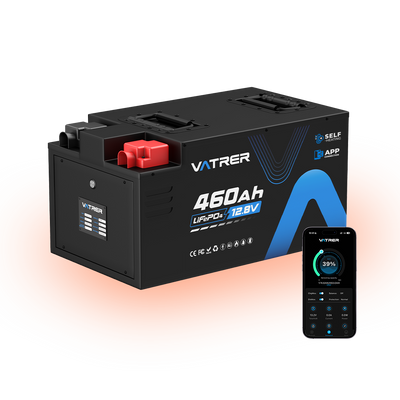
A shunt-based battery monitor gives a better picture than voltage alone. Many Vatrer batteries also include Bluetooth BMS monitoring, so you can check state of charge, current flow, and battery status from your phone.
Common 12V Battery Runtime Scenarios
Loads do not drain a battery at the same rate. A fan, fridge, and microwave all behave differently, even if they are powered from the same 12V system.
Running a Fridge
A 12V fridge is easy to misjudge because it does not run at full power all day.
A compact 12V fridge may draw 40W–70W while the compressor is running. Daily use often lands around 300Wh–800Wh per day, depending on size, insulation, outdoor temperature, door openings, and temperature setting.
A fridge using 500Wh per day may nearly drain the usable energy from a 100Ah lead-acid battery in one day. A 100Ah LiFePO4 battery with about 960–1,080Wh usable energy gives more room for the fridge plus small loads like lights or phone charging.


Using an Inverter
An inverter lets you run AC appliances, but high-wattage appliances drain a 12V battery fast.
A 1,000W appliance running through an inverter can pull about 90A–100A from a 12V battery after efficiency loss. That is a heavy draw, especially for a small lead-acid battery bank.
Common high-drain appliances include:
- Microwave: 700W–1,500W.
- Coffee maker: 600W–1,200W.
- Hair dryer: 1,200W–1,800W.
- Space heater: About 1,500W.
- Induction cooktop: 1,000W–1,800W.
An inverter may start the appliance, but that does not mean the battery can run it for long. Battery capacity and discharge current limits matter as much as inverter size.
Powering Lights, Fans, and Small DC Loads
Small DC loads are much easier on a 12V battery. LED lights, small fans, phone charging, and water pumps usually consume far less energy than AC appliances.
Typical Small 12V Load Runtime from a 100Ah Battery
| Device Type | Typical Power Draw | Lead-Acid Runtime at 50% Usable Capacity | LiFePO4 Runtime at 90% Usable Capacity |
|---|---|---|---|
| LED light strip | 10W | About 60 hours | About 108 hours |
| Small 12V fan | 20W | About 30 hours | About 54 hours |
| Phone charging hub | 30W | About 20 hours | About 36 hours |
| Water pump | 60W | About 10 hours continuous | About 18 hours continuous |
These are continuous-use estimates. A water pump may only run a few minutes at a time, so its real daily energy use can be much lower.
What Affects 12V Battery Life?
Battery lifespan depends on discharge depth, charging habits, temperature, storage, maintenance, and build quality. Most early failures come from repeated stress, not one single bad day.
Depth of Discharge
Depth of discharge, or DoD, means how much capacity you use before recharging.
A 50% DoD means you used half the battery. An 80% DoD means you used most of it.
Lead-acid batteries age faster with frequent deep discharge. Draining them to 80% or 100% DoD repeatedly can shorten lifespan. That is why many people plan around 50% usable capacity for lead-acid batteries.
LiFePO4 batteries tolerate deeper discharge better. In normal deep cycle use, you can often use 80%–90% of capacity. Shallow cycles still help extend long-term cycle life, but lithium does not punish deep cycling as harshly as lead-acid.
Charging Habits
Charging habits can add or remove years from battery life.
An undercharged lead-acid battery can sulfate. An overcharged battery can heat up, dry out, vent, or degrade. A lithium battery charged with the wrong profile may not charge correctly, and the BMS may stop charging to protect the cells.
Good charging habits include:
- Use the right charger: Match the charger to flooded lead-acid, AGM, Gel, or LiFePO4 chemistry.
- Recharge after use: Do not leave a discharged lead-acid battery sitting for days or weeks.
- Check charging voltage: Wrong voltage can shorten battery life.
- Use multi-stage charging: A smart charger helps reduce overcharging and undercharging.
- Read the manual: Battery makers list charge voltage, charge current, and temperature limits.
If you switch to lithium, check your RV converter, solar charge controller, onboard charger, or DC-DC charger. It should support LiFePO4 settings if you want the battery to charge properly and reach its expected lifespan.
Temperature and Storage
Heat speeds up battery aging. Cold reduces usable capacity.
A lead-acid car battery may last 5 years in a mild climate but only 3 years in a hot one. Under-hood heat is hard on plates, electrolyte, and internal connections.
Storage also depends on chemistry:
- Lead-acid batteries: Store fully charged. Recharge every 1–3 months during storage.
- Flooded lead-acid batteries: Check electrolyte level before and during storage.
- LiFePO4 batteries: Store around 40%–60% state of charge for long-term storage.
- All batteries: Store in a clean, dry place, ideally around 50°F–86°F.
LiFePO4 batteries should generally not be charged below 32°F unless they have low-temperature charging protection or built-in heating. Discharging below freezing is usually less risky than charging below freezing, but you should still follow the battery’s specifications.
Maintenance and Battery Quality
Flooded lead-acid batteries need the most maintenance, but every battery benefits from clean connections and good installation.
Useful habits include:
- Keep terminals clean: Corrosion increases resistance and causes voltage drop.
- Tighten connections: Loose terminals can heat up or cause intermittent power loss.
- Reduce parasitic loads: Small standby loads can drain a battery over days or weeks.
- Inspect the case: Swelling, leaking, cracks, or unusual smell are warning signs.
- Check specifications: Cycle life rating, recommended DoD, charge current, BMS limits, and warranty terms matter.
Two batteries can share the same voltage and Ah rating but use very different cells, plates, separators, or BMS designs. That difference usually shows up after months of real use.
How to Tell If a 12V Battery Is Near the End of Its Life
A weak battery usually gives warning signs before it fails completely.
Common signs include:
- Slow engine cranking: The starter sounds weaker than usual.
- Frequent jump starts: The battery repeatedly needs help.
- Quick voltage drop: It appears charged but falls fast under load.
- Shorter runtime: Your fridge, trolling motor, or RV loads do not run as long as before.
- Inverter low-voltage alarms: Alarms happen under loads the system used to handle.
- Visible damage: Swelling, leaks, cracks, heavy corrosion, or a sulfur smell need attention.
- Lithium BMS cutoffs: The battery shuts down under normal loads, even when it should have enough charge.
Voltage alone is not enough. A battery can show decent resting voltage and still fail a load test. For cars, a load test gives a better answer. For RV, marine, and off-grid batteries, a capacity test or battery monitor tells you more about real condition.
How to Make a 12V Battery Last Longer
You do not need perfect habits. Avoid the mistakes that shorten battery life fastest.
- Avoid repeated deep discharges: This matters most for lead-acid batteries. Recharge before the battery gets very low.
- Recharge soon after use: A discharged lead-acid battery can sulfate if left sitting.
- Use the correct charger: Match the charger profile to the battery chemistry.
- Keep connections clean and tight: Poor connections waste energy and make a healthy battery act weak.
- Maintain flooded batteries: Check electrolyte levels and add distilled water when needed. Do not use tap water.
- Store batteries correctly: Store lead-acid fully charged. Store lithium around 40%–60% for long-term storage.
- Avoid freezing lithium charging: Do not charge LiFePO4 below 32°F / 0°C unless the battery is built for it.
- Disconnect idle loads: RV stereos, alarms, propane detectors, and control boards can drain a battery slowly.
- Use monitoring: A battery monitor or Bluetooth BMS helps you avoid guessing.
Planning an RV or marine setup is easier when you can see usable capacity instead of relying on rough voltage readings. Vatrer lithium RV batteries with BMS monitoring can help you track battery status more clearly during off-grid use.
Should You Choose a 12V Lithium Battery for Longer Life?
A lithium battery is not automatically the right choice for every 12V system. It depends on how often you cycle the battery and how much usable power you need.
A 12V lithium deep cycle battery makes sense when you need repeated deep cycling, longer runtime, and low maintenance. That is why LiFePO4 is common in RV camping, marine electronics, trolling motors, solar backup, and off-grid power.
Choose LiFePO4 when these points matter:
- Longer cycle life: Many LiFePO4 batteries are rated for thousands of cycles.
- More usable capacity: You can often use 80%–90% of rated capacity.
- Lower weight: LiFePO4 batteries are often about 40%–60% lighter than comparable lead-acid batteries.
- Less maintenance: No watering, no acid checks, and much lower self-discharge.
- Better monitoring: Many models include Bluetooth app access or BMS data.
- Stable deep cycle use: LiFePO4 is built for repeated discharge and recharge.
Lead-acid may still be enough when:
- Starting power is the main job: A standard starting battery is usually practical for regular vehicle use.
- Deep cycling is rare: Light-use systems may not justify the higher upfront cost.
- The charger is not lithium-ready: A lithium upgrade may require charger or controller changes.
- Upfront budget is tight: Lead-acid costs less at purchase, even if it may need replacement sooner.


Conclusion
A 12V battery can last a few hours, a few days, or more than 10 years. It depends on whether you mean runtime or lifespan.
For lifespan, look at battery type, depth of discharge, charging habits, temperature, and maintenance. A car starting battery often lasts about 3–5 years, while a well-managed LiFePO4 deep cycle battery can often serve 10 years or longer.
For runtime, focus on Ah, usable capacity, load watts, and inverter efficiency. The “12V” label tells you voltage. It does not tell you how much energy you can safely use, how fast your devices will drain it, or how many years the battery will stay healthy.