How Long Will a 12V 300Ah Lithium Battery Last?
Reading time: 10 minutes

Share
A 12V 300Ah lithium battery is usually calculated at the LiFePO4 nominal voltage of 12.8V, so it stores about 3,840 watt-hours, or 3.84kWh, of energy. In real use, that means it can run a 100W load for about 34–38 hours, a 500W load for about 7 hours, or a 1000W load for about 3.5–3.8 hours when inverter loss is included.
The exact runtime depends on how much power your devices draw. A 12V fridge, LED lights, and a roof vent fan can run for days. A microwave, electric heater, or air conditioner can drain the same battery much faster. That is why the best way to estimate 300Ah lithium battery runtime is to convert amp-hours into watt-hours, then compare that number with your actual load.


How Much Energy Is in a 12V 300Ah Lithium Battery?
A 300Ah rating tells you how much current the battery can deliver over time, but watt-hours tell you how much usable energy you have for appliances.
The basic formula is:
Watt-hours = Voltage × Amp-hours
For a 12V LiFePO4 battery, the nominal voltage is typically 12.8V, so the calculation is:
12.8V × 300Ah = 3,840Wh
This number matters because most appliances are rated in watts, not amp-hours. Once you know the watt-hour capacity, you can estimate how long the battery will run a fridge, fan, laptop, inverter, pump, or trolling motor.
There is also a major difference between lithium and lead-acid batteries. A quality 300Ah LiFePO4 battery can usually use about 80%–100% of its rated capacity, depending on the battery design and BMS settings. That gives you about 3,072Wh–3,840Wh of usable energy. A lead-acid battery is usually limited to about 50% usable capacity if you want to avoid shortening its life. So while both batteries may say “300Ah” on the label, the lithium battery can often provide nearly twice the practical usable energy.
How to Calculate 300Ah Lithium Battery Runtime
The basic runtime formula is simple:
Runtime = Usable watt-hours ÷ Device watts
For DC devices, such as many 12V fridges, lights, fans, and pumps, you can use the formula directly. For AC appliances running through an inverter, you need to include inverter loss. Most inverters are about 85%–90% efficient, meaning 10%–15% of the stored energy is lost during conversion.
For AC loads, use this version:
Runtime = Battery watt-hours × Inverter efficiency ÷ Device watts
Example:
A 12V 300Ah lithium battery has about 3,840Wh. If you run a 100W DC device:
3,840Wh ÷ 100W = 38.4 hours
If that same 100W device runs through a 90% efficient inverter:
3,840Wh × 0.90 ÷ 100W = 34.6 hours
This is the same logic behind any 300Ah battery runtime calculator. The calculator is not doing anything mysterious. It is simply dividing usable stored energy by the power your device consumes.
How Long Will a 12V 300Ah Lithium Battery Last?
The easiest way to get a quick estimate is to compare the battery against common load sizes. This works well when you already know the total wattage of the devices you plan to run.
Runtime by Load Size
| Load Size | Estimated Runtime Without Inverter | Estimated Runtime With 90% Inverter Efficiency |
|---|---|---|
| 50W | About 76.8 hours | About 69.1 hours |
| 100W | About 38.4 hours | About 34.6 hours |
| 200W | About 19.2 hours | About 17.3 hours |
| 500W | About 7.7 hours | About 6.9 hours |
| 1000W | About 3.8 hours | About 3.5 hours |
| 1500W | About 2.6 hours | About 2.3 hours |
| 2000W | About 1.9 hours | About 1.7 hours |
Use this table as a planning estimate. A 1000W appliance does not always draw exactly 1000W, and some devices have a startup surge that is much higher than their running wattage. Wiring loss, inverter size, BMS limits, and temperature can also change the final runtime.
RV Appliances and Camping Loads
RV power use is usually a mix of small continuous loads and short high-power bursts. A fridge may run throughout the day, while a water pump or microwave only runs for a few minutes.
| RV Appliance | Typical Power Draw | Estimated Runtime |
|---|---|---|
| LED lights | 10W–30W | 128–384 hours |
| Roof vent fan | 20W–50W | 77–192 hours |
| 12V compressor fridge | 40W–80W average | 48–96 hours |
| Water pump | 60W–100W intermittent | Several days with normal use |
| Laptop | 50W–100W | 38–77 hours |
| CPAP machine | 30W–60W | 64–128 hours |
| TV | 80W–150W | 26–48 hours |
| Microwave | 1000W–1500W | About 2.3–3.5 hours through an inverter |
A 12V 300Ah lithium battery is a strong size for light to moderate RV use. It can comfortably support a compressor fridge, lights, fan, water pump, phone charging, and a laptop for a weekend-style setup. The runtime changes fast when you add heat-producing appliances. A microwave used for 10 minutes is manageable. An electric heater running for hours is not.
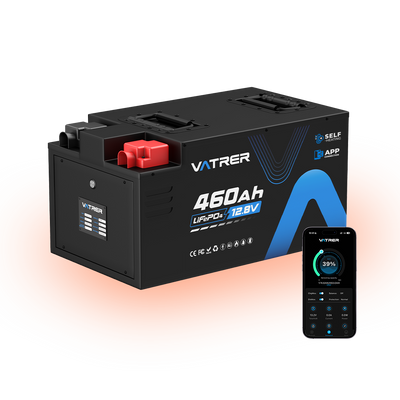
For RV owners who want a cleaner upgrade from lead-acid batteries, a LiFePO4 setup, Vatrer 12V lithium batteries with built-in BMS protection, low-temperature charging protection, and app monitoring is easier to manage than a traditional flooded battery bank, which helps when you want to track battery status without opening the battery compartment.
Marine and Trolling Motor Use
For trolling motors, runtime is usually easier to estimate by amps rather than watts.
Runtime = Battery Ah ÷ Motor amp draw
| Amp Draw | Estimated Runtime |
|---|---|
| 10A | About 30 hours |
| 20A | About 15 hours |
| 30A | About 10 hours |
| 40A | About 7.5 hours |
| 50A | About 6 hours |
| 60A | About 5 hours |
A trolling motor rarely runs at full draw the entire time. Lower speed settings, calm water, and lighter boat weight can stretch runtime well beyond a full-throttle estimate. Wind, current, heavy gear, and higher speed settings cut runtime down quickly.
A single 12V battery is only suitable for a 12V trolling motor. If your motor is 24V or 36V, you need the correct voltage battery setup. Do not connect one 12V battery to a higher-voltage motor and expect normal performance.
Off-Grid and Backup Power Loads
Off-grid and backup use often involves AC appliances, so inverter efficiency matters. A 3.84kWh battery becomes roughly 3.26–3.46kWh of usable AC energy after a typical 85%–90% inverter conversion.
| Device or Load | Typical Power Draw | Estimated Runtime With 90% Inverter Efficiency |
|---|---|---|
| WiFi router | 10W–20W | 173–346 hours |
| LED lighting setup | 30W–60W | 58–115 hours |
| Mini fridge | 60W–120W average | 29–58 hours |
| Small freezer | 80W–150W average | 23–43 hours |
| Desktop computer | 150W–300W | 11.5–23 hours |
| 500W load | 500W | About 6.9 hours |
| 1000W load | 1000W | About 3.5 hours |
A 12V 300Ah battery works well for lighting, routers, small refrigeration, electronics, and short-term emergency backup. It is not a full-home battery system by itself. Electric heaters, large air conditioners, electric ovens, and water heaters can draw 1500W–5000W, which is too much for long runtime from a single 3.84kWh battery.
How Many Days Can It Last for Camping or RV Boondocking?
For camping, daily energy use is more useful than single-device runtime. A battery may run a fan for many days, but your real setup probably includes lights, refrigeration, charging, water pump use, and maybe an inverter.
| Daily Power Use | Estimated Days From 3,840Wh |
|---|---|
| 500Wh/day | About 7.7 days |
| 800Wh/day | About 4.8 days |
| 1000Wh/day | About 3.8 days |
| 1500Wh/day | About 2.6 days |
| 2000Wh/day | About 1.9 days |
For a light camping setup, 500Wh–800Wh per day is realistic if you use LED lights, charge phones, run a small fan, and use a water pump occasionally. Add a 12V fridge and laptop charging, and daily use often moves closer to 1000Wh–1500Wh. Once you bring in microwave use, coffee makers, induction cooking, or air conditioning, the battery starts behaving less like a multi-day power source and more like a short backup reserve.
Solar charging changes the picture. A 400W solar array may produce roughly 1200Wh–2000Wh per day in good sun after real-world losses. That can cover much of a moderate daily load, but shaded campsites, cloudy weather, short winter days, and poor panel angle reduce output.
What Can Reduce the Actual Lithium Battery Runtime?
The above data is based on precise calculations. However, in actual system use, uncontrollable factors often exist, causing the runtime to fall short of expectations.
- Higher load wattage: A 1000W appliance drains the battery about ten times faster than a 100W device. Runtime is tied directly to power draw.
- Inverter loss: AC appliances usually lose about 10%–15% of stored energy through the inverter. A 3,840Wh battery may deliver only about 3,264Wh–3,456Wh as usable AC power.
- Depth of discharge: LiFePO4 batteries can handle deeper discharge than lead-acid, but many users still avoid draining them to 0% every cycle. Using 80% of the battery gives you about 3,072Wh instead of the full 3,840Wh.
- Temperature: Cold conditions can reduce performance and may limit charging. A battery with low-temperature charging protection stops charging below unsafe limits, while self-heating models help restore charging capability in cold environments.
- Battery age: Capacity gradually declines after years of cycling. A high-quality LiFePO4 battery with 4000+ cycles will hold up far better than a lead-acid battery that may show noticeable capacity loss after a few hundred deep cycles.
- Wiring and system setup: Undersized cables, loose terminals, poor fuse selection, and mismatched inverters can waste power or trigger protection. High-current 12V systems are especially sensitive to cable size because current rises quickly as wattage increases.
Can a 300Ah Lithium Battery Run High-Power Appliances?
A 12V 300Ah lithium battery can run some high-power appliances for a short time, but it is not the right battery size for long high-wattage operation.
High-power appliances usually include:
- RV air conditioner: Often draws about 1200W–1800W while running, with a higher startup surge unless a soft starter is installed.
- Electric heater: Common portable heaters draw about 1500W, which can drain the battery in about 2.3 hours through a 90% efficient inverter.
- Induction cooktop: Many units use 1000W–1800W, depending on the heat setting.
- Microwave: A microwave rated at 1000W cooking power may pull 1200W–1500W from the inverter.
- Electric kettle or hair dryer: These often draw 1200W–1800W, making them short-use appliances only.
Before running these loads, check more than the battery capacity. You need to confirm the battery’s maximum continuous discharge current, BMS output limit, inverter rating, surge rating, cable gauge, fuse size, and terminal connections. A battery may have enough stored energy on paper but still be limited by how much power it can safely deliver at once.
Is a 12V 300Ah Lithium Battery Enough for Your Setup?
A 12V 300Ah lithium battery is enough when your daily power use stays within the battery’s practical energy range. It is not enough when the system depends on long-running heat, cooling, or high-wattage appliances.
- RV and camper use: It is a good fit for a 12V fridge, LED lights, roof vent fan, water pump, phone charging, laptop use, and occasional inverter loads. Frequent air conditioner or electric heater use requires more battery capacity and a larger power system.
- Boat and fishing use: It works well for 12V trolling motors, fish finders, boat lights, and small pumps. For 24V or 36V motors, match the battery system voltage instead of relying on one 12V battery.
- Off-grid cabin use: It can handle lights, router, small fridge, small freezer, laptop, and emergency electronics. It should not be treated as a whole-cabin power source unless paired with more batteries, solar charging, and a properly sized inverter.
- Solar setup: A 300Ah battery is a practical storage size for small solar systems. The right solar panel size depends on daily usage, sunlight hours, charge controller capacity, and how quickly you need the battery to recover after a heavy-use day.
Conclusion
A 12V 300Ah lithium battery is a practical size when your setup is built around steady, moderate loads rather than long-running heat or cooling appliances. It fits RV camping, marine electronics, 12V trolling motors, small off-grid cabins, and backup power for essentials because those uses usually stay within the battery’s usable energy range.
The key is to estimate your daily watt-hour use before buying. If your main loads are a fridge, lights, fan, pump, laptop, router, or fish finder, one battery may be enough for short trips or emergency backup. If your plan includes air conditioning, electric heating, induction cooking, or several AC appliances at once, you should plan for more battery capacity, solar charging, or a higher-voltage power system.
For the best real-world result, choose a LiFePO4 battery with a reliable BMS, low-temperature protection, enough continuous discharge current for your inverter, and a monitoring option that lets you check battery status before power becomes a problem.