The Ultimate RV Battery Buyer’s Checklist in 2026
Reading time: 4 minutes
Introduction: Why Choosing the Right RV Battery Matters
Selecting the correct RV battery is one of the most important decisions in your entire electrical system. The battery determines your runtime, inverter stability, cold-weather charging capability, solar compatibility, and long-term safety. Choosing the wrong battery can lead to insufficient capacity, inverter overload trips, winter charging failures, voltage sag, or system incompatibility.
This guide provides a comprehensive, scientific, and actionable RV battery buying checklist to help you avoid expensive mistakes and build a reliable off-grid power system.


Determine Your Real Power Needs
Accurate load calculation is the foundation of proper battery sizing. Evaluate:
- Daily energy consumption (W × hours)
- Continuous loads: fridge, ventilation fans, water pump
- Peak loads: microwave, induction cooktop, coffee maker
- Inverter continuous and surge wattage
- Off-grid camping vs. shore power
- Whether solar contributes daily recharge
Understanding your real power needs ensures you choose the correct battery capacity and avoid low-voltage shutdowns.
Understand RV Battery Types and Their Differences
Common RV battery chemistries include:
Flooded Lead-Acid (FLA)
Low cost, high maintenance, 50% usable capacity.
AGM (Absorbent Glass Mat)
Maintenance-free, moderate performance, heavy.
Gel Batteries
Stable but slow charging, not ideal for high-load RV systems.
LiFePO4 (Lithium Iron Phosphate)
90–100% usable capacity, 3000–6000 cycles, lightweight, safe, ideal for modern RVs.
Different chemistries affect usable capacity, cycle life, weight, charging profile, low-temperature performance, and safety.
Check Usable Capacity, Not Just Rated Capacity
Rated Ah does not equal usable Ah.
- Lead-acid: ~50% usable
- LiFePO4: ~90–100% usable
Example:
200Ah AGM ≈ 100Ah usable
200Ah LiFePO4 ≈ 180Ah usable
Usable capacity determines real-world runtime.
Evaluate Cycle Life and Long-Term Cost
Cycle life depends on Depth of Discharge (DoD), temperature, and charging accuracy.
- Lead-acid: 300–500 cycles
- LiFePO4: 3000–6000+ cycles
The key metric is cost per cycle, not upfront price.
Lithium batteries deliver significantly lower long-term cost.
Confirm Discharge Rate and Inverter Compatibility
High-load appliances require high discharge capability.
Key parameters:
- C-rate
- Continuous discharge current
- Peak discharge current
- Voltage sag under load
A 3000W inverter at 12V may draw 250–300A.
Your battery must support this without triggering BMS shutdown.
Check Charging Requirements and System Compatibility
Verify compatibility with:
- AC charger (Bulk/Absorption/Float profiles)
- Solar charge controller (MPPT/PWM)
- Alternator charging (DC-DC charger strongly recommended)
- BMS charge limits
Incorrect charging reduces battery life and may cause protection shutdowns.
Consider Low-Temperature Performance
Cold temperatures affect battery behavior:
- Lead-acid loses capacity
- LiFePO4 cannot charge below 0°C without heating
- Voltage sag increases in cold weather
Winter campers should choose batteries with:
- Low-temperature charging protection
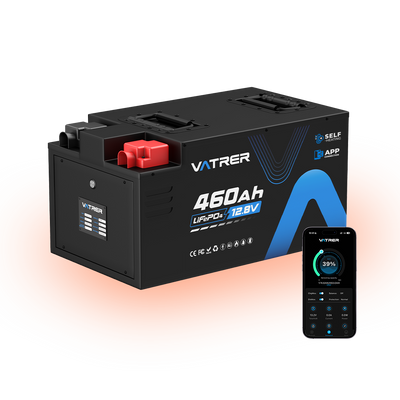
- Self-heating function
- Integrated temperature sensors
Evaluate Weight, Size, and Installation Constraints
Check:
- Battery compartment dimensions
- Ventilation requirements
- Cable gauge and fuse rating
- Trailer tongue weight limits
For 3000W inverter systems, ensure 4/0 AWG cables to minimize voltage drop and heat.
LiFePO4 offers higher energy density and lower weight, ideal for towables.
Review Safety Features and BMS Protections
A high-quality BMS should include:
- Over-current protection
- Over-charge and over-discharge protection
- Short-circuit protection
- High/low temperature protection
- Cell balancing
Pro Tip: In 2026, look for a BMS with low standby power consumption. If you store your RV for months, a high parasitic draw can drain even a large lithium battery.
The BMS is the core safety system of any lithium RV battery.
Verify Warranty, Support, and Certification
Look for:
- UL, CE, UN38.3, IEC62133 certifications
- Clear warranty terms
- Accessible technical support
- Proper documentation
These factors determine long-term reliability and safety.
Which Battery Is Right for You?
Weekend Campers
100–200Ah AGM or entry-level LiFePO4
Full-Time RV Travelers
200–400Ah LiFePO4
Off-Grid / Boondocking
300–600Ah LiFePO4 + solar system
High-Load Users
High-discharge LiFePO4 + 2000–3000W inverter
Cold-Climate Users
Self-heating LiFePO4
Solar-Dependent Users
High-cycle LiFePO4 with fast charge acceptance
Conclusion
Before purchasing an RV battery, evaluate:
- Power needs
- Battery chemistry
- Usable capacity
- Cycle life
- Discharge capability
- Charging compatibility
- Low-temperature performance
- Installation constraints
- BMS safety
- Certifications and warranty
A data-driven decision ensures better runtime, higher safety, and lower long-term cost.
FAQs
How many amp-hours do I need for my RV?
Most RVs require 200–400Ah depending on daily energy consumption, inverter size, and whether solar contributes to recharge.
Is lithium always better than lead-acid?
For most RV applications, yes. Lithium offers higher usable capacity, longer cycle life, and better voltage stability. Lead-acid may still be suitable for low-budget or mild-use scenarios.
Can I replace AGM with lithium directly?
Not without checking compatibility. You must verify your AC charger, solar controller, and alternator charging system. A DC-DC charger is highly recommended to protect your alternator from overheating when switching to lithium.
Do I need a new charger for lithium batteries?
Usually yes. Lithium requires a different charging profile (bulk/absorption/float) and higher charge acceptance. Using an incompatible charger reduces lifespan.
How long do RV batteries last?
Lead-acid: 2–4 years
LiFePO4: 8–15 years depending on DoD, temperature, and charging accuracy.
Can I charge RV batteries with solar?
Yes, as long as your MPPT or PWM controller supports the correct charging profile for your battery chemistry.
Is a heated battery necessary for winter camping?
Yes if temperatures drop below freezing. Lithium cannot charge below 0°C without heating.
What is the difference between rated and usable capacity?
Rated capacity is the label value. Usable capacity is the real-world energy you can draw. Lithium provides significantly higher usable capacity than lead-acid.
Share