RV Lithium Battery vs Portable Power Station: Which is Better?
Reading time: 13 minutes

Share
You pull into a desert campsite outside Moab with a Class B van. Your 12V compressor fridge is cycling normally, drawing around 4–6A. A Maxxair roof fan runs at medium speed, pulling another 2–3A. LED lights add maybe 1–2A. Everything feels stable early in the evening. By midnight, voltage drops faster than expected. The fridge shuts off briefly. The fan slows down. You’re no longer thinking about the view outside, you’re managing power.
That’s where the difference between an RV lithium battery vs portable power station becomes obvious. Both store energy, but in real use, they behave very differently. One is designed as a convenient power device. The other is built as a complete energy system that supports how your RV actually operates.


It’s Not Just a RV Power Product Choice
When you compare these two options, you’re not just choosing between brands or specs. You’re deciding how your entire RV electrical system setup works. That includes how power is stored, distributed, recharged, and scaled over time.
A portable power station is built like a sealed appliance. You use it, recharge it, and live within its limits. A lithium RV battery system is different. It becomes part of your RV’s infrastructure, wired into your fuse panel, inverter, and solar system.
Think of it this way. One is similar to a high-end power bank with AC output. The other is closer to installing a residential electrical backbone inside your RV. That difference impacts everything: runtime, appliance support, charging flexibility, and long-term cost.
What Is an RV Lithium Battery System?
A lithium battery system in an RV is not a single box. It’s a full setup built around a deep cycle lithium battery for RV use. Typically, you’re looking at 12V, 24V, or 48V LiFePO4 batteries connected to an external inverter/charger, MPPT solar controller, and DC distribution system. These batteries are installed under seats, inside storage compartments, or within dedicated battery bays.
In real use, this system powers everything directly through your RV wiring. Your 12V fridge, water pump, lighting, and even 120V appliances like a microwave or rooftop AC run through the inverter. A 12V 300Ah lithium battery provides about 3.84kWh. A 51.2V 100Ah setup gives you over 5kWh usable energy.
- System-level power: You’re not plugging devices into a box. You’re powering the RV itself. Every outlet, switch, and appliance works like it would on shore power.
- Expandable capacity: You can start with 200Ah and scale to 400Ah or more by adding batteries. This is where an expandable battery system vs all-in-one unit becomes a real advantage.
- Stable performance: Voltage stays consistent even under load. That matters when running compressors or high-draw equipment.
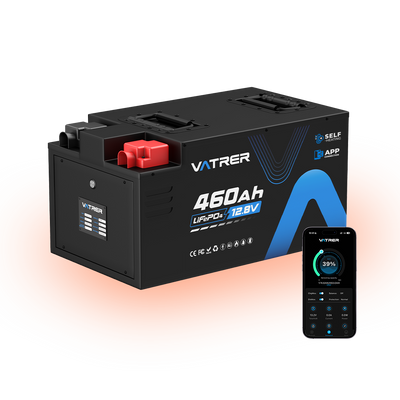
If you’re building or upgrading, Vatrer lithium RV batteries are designed for this type of setup. Our 12V LiFePO4 batteries support 4000+ cycles, built-in BMS protection, and Bluetooth monitoring. Some models include low-temperature cut-off and self-heating, which matters when you’re camping in sub-32°F conditions.
What Is a Portable Power Station?
A portable power station is often described as a “battery in a box.” That’s accurate. Inside one unit, you have a lithium battery, built-in inverter, solar charge controller, and multiple output ports. You can place it on a table, plug devices into it, and start using it immediately.
These systems are popular because they remove complexity. No wiring. No installation. No need to understand RV electrical systems.
- Plug-and-play convenience: You charge it from a wall outlet or portable solar panel, then use it anywhere. It works for camping, tailgating, or home backup.
- Defined limits: Capacity is fixed. Most units range from 500Wh to 3000Wh. Once you exceed that, you need to recharge.
- Integrated inverter: You don’t choose inverter size. You’re limited by what’s built inside.
This simplicity is the main reason people ask, "Do I need a portable power station for an RV?" The answer depends entirely on how you use power.
RV Lithium Battery vs Portable Power Station: Key Differences
Both can store and deliver energy, but they behave very differently when installed in an actual RV electrical system setup. One is a self-contained device designed for convenience. The other is a scalable energy system designed to support continuous loads, solar charging, and high-demand appliances. If you’re trying to decide which is better for an RV lithium battery or portable power station, you need to look at how they perform across capacity, output, charging, and long-term usability.
RV Lithium Battery System vs Portable Power Station
| Key Metric | RV Lithium Battery System | Portable Power Station |
|---|---|---|
| Typical Capacity | 2kWh – 20kWh+ (expandable) | 300Wh – 5000Wh (fixed) |
| Output Power | 2000W – 5000W+ (external inverter) | 500W – 3000W (built-in inverter) |
| Expandability | High (parallel/series battery expansion) | Limited (brand-specific expansion only) |
| Solar Input | 600W – 1500W+ (MPPT supported) | 100W – 500W (input capped) |
| Installation | Requires system setup | Plug-and-play |
| System Integration | Fully integrated with RV wiring | Standalone unit |
| Reliability | Modular, partial redundancy | Single unit, single failure point |
| Lifecycle | 4000+ cycles (LiFePO4) | 500–1500 cycles typical |
| Best Use Case | Full-time / off-grid RV | Weekend / light use |
If your goal is flexibility and short-term convenience, a portable power station works. If your goal is building a stable off-grid RV power system that can scale and support real appliance loads, a lithium battery system is the more capable option.
Battery Capacity vs Usable Power
When comparing battery capacity vs power station capacity, you need to focus on watt-hours (Wh), not amp-hours (Ah). This avoids confusion across different voltages.
- Portable Power Station: Most units range from 500Wh to 3000Wh. That sounds sufficient until you run a 12V fridge (~60W), a fan (~30W), and a laptop (~50W). You can burn through 800–1200Wh in a single evening.
- RV Lithium Battery System: Even a modest setup, two 12V 100Ah batteries gives you around 2.56kWh usable energy. That supports multiple days of use without recharge.
With a portable unit, you’re managing power daily. With lithium, you have buffer capacity, which reduces stress and improves usability.
Power Output and Appliance Support
Power output determines what you can actually run, not just how long.
- Portable Power Station: Built-in inverter limits output. Even if rated at 2000W, running multiple appliances can trip the system. Startup surges (like an RV AC needing 2500W+) often cause shutdowns.
- RV Lithium Battery System: Paired with a 3000W–5000W inverter, it can handle continuous loads and surge demands. You can run a microwave, coffee maker, and even a 13,500 BTU AC with proper configuration.
This is where inverter vs built-in inverter system matters. External inverters are sized for real RV loads, not just occasional use.
Expandability and System Growth
Your energy needs rarely stay the same. Expansion matters.
- Portable Power Station: You're locked into the internal battery. Some brands offer expansion packs, but they are expensive and limited.
- RV Lithium Battery System: You can add more batteries anytime. Increase from 100Ah to 600Ah without replacing your system.
This is the core difference in an expandable battery system vs all-in-one unit. One grows with you. The other gets replaced.
Vatrer lithium RV batteries are designed for scalable setups. With support for parallel and serial expansion and stable BMS control, allow you to upgrade your system step-by-step instead of replacing it entirely.
Solar Integration and Charging Limits
Solar charging defines how independent your RV power system can be, especially when you're parked for multiple days without hookups.
- Portable Power Station: Most units cap solar input at 200W–500W, with strict voltage limits. This restricts charging speed and prevents full use of larger rooftop solar arrays.
- RV Lithium Battery System: With a dedicated MPPT controller, you can support 600W–1200W+ solar input. Higher voltage and current handling improve efficiency and allow faster energy recovery.
If you’re building a true off-grid RV power system, lithium battery setups make far better use of available solar energy and reduce reliance on external charging.
Charging Speed and Energy Recovery
Charging speed determines how quickly you can recover from daily energy use, especially after running high-demand appliances.
- Portable Power Station: Charging is limited by built-in input capacity. Even with AC charging, a full recharge often takes 4–8 hours, and solar charging is slower due to input caps.
- RV Lithium Battery System: Supports multiple charging paths, including solar, shore power, and alternator charging. Higher input capacity allows faster recovery, often within a few hours under good conditions.
The difference is not just speed, it’s flexibility. Lithium systems give you more ways to recharge, which is critical during extended off-grid travel.
Installation vs Plug-and-Play Convenience
Ease of setup is often the first factor RV owners consider, especially when deciding between a portable unit and a full system.
- Portable Power Station: No installation required. You take it out of the box, charge it, and start using it immediately. Ideal for users who don’t want to modify their RV.
- RV Lithium Battery System: Requires installation, including battery mounting, wiring, inverter setup, and system configuration. Initial setup takes time and planning.
The trade-off is simple: portable systems offer instant convenience, while lithium systems require upfront effort but deliver a more seamless long-term experience.
System Reliability and Redundancy
Reliability becomes critical when you’re far from shore power, especially in remote areas like deserts, forests, or long-distance overlanding routes.
- Portable Power Station: Single-unit design means a single point of failure. If the system shuts down or malfunctions, all connected devices lose power instantly.
- RV Lithium Battery System: Modular design with separate batteries, inverter, and components. If one part fails, the rest of the system may still operate or be temporarily bypassed.
This is a key difference in system resilience. Lithium battery setups provide redundancy and serviceability, making them more dependable for long-term or remote RV use.
RV Lithium Battery vs Portable Power Station: Which is Better
Power needs change based on trip length, appliance load, and how often you rely on off-grid setups. The best way to decide which is better for RV lithium battery or portable power station is to match each option to real-world usage scenarios.
Short Trips and Weekend Camping
For short trips, like a 2-day stay at a state park in a Class B van or small travel trailer, a portable power station is often enough. It can handle basic loads like charging phones, running LED lights, and powering a small 12V fridge for limited hours. You don’t need to modify your RV, and setup is immediate. For occasional use, the simplicity outweighs the limitations.
Frequent Travel and Multi-Day RV Use
If you’re traveling 3–5 days at a time and using more equipment—like a 12V fridge, roof fan, water pump, and laptop, a lithium battery system becomes more practical. You get higher battery capacity and more stable output, which reduces the need for constant recharging. This is where a portable unit starts to feel restrictive, especially when energy demand increases daily.
Full-Time RV Living and Off-Grid Setups
For full-time RV living or extended stays in places like Arizona desert camps or national forest boondocking areas, a lithium battery system is the better fit. It supports a full off-grid RV power system, including solar charging, HVAC loads, and continuous appliance use. A portable power station simply cannot provide the capacity, output, or charging efficiency required for this level of use.
Remote Work and Digital Nomads
If you’re working remotely from your RV, running Starlink, a laptop, external monitor, and charging devices throughout the day power stability matters. A lithium system delivers consistent output and can be paired with larger solar arrays to maintain uptime. Portable power stations can handle light work setups, but frequent fan noise, limited capacity, and slower recharge cycles can become noticeable over time.
RV Lithium Battery vs Portable Power Station Cost Comparison
Cost is often the deciding factor, but the real difference isn’t just the upfront price. You need to look at how much energy you get over time, how often you’ll need to replace or upgrade, and how the system fits into your RV electrical system setup.
Upfront Cost Comparison
| System Type | Typical Capacity | Initial Cost Range (USD) | Included Components |
|---|---|---|---|
| Portable Power Station | 1000Wh – 2000Wh | $800 – $2,000 | Battery + built-in inverter + charge controller |
| RV Lithium Battery System | 2000Wh – 5000Wh+ | $1,500 – $4,500 | Battery + external inverter + wiring + installation |
Portable power stations have a lower entry cost and require no installation, making them appealing for beginners. Lithium battery systems cost more upfront due to additional components and setup, but they deliver higher capacity and integration with your RV.
Long-Term Cost (Total Cost)
| System Type | Cycle Life | Usable Capacity | Estimated Lifespan | Cost per kWh (Over Time) |
|---|---|---|---|---|
| Portable Power Station | 500 – 1500 cycles | 1–3kWh | 2–5 years | Higher |
| RV Lithium Battery System | 4000+ cycles | 2–20kWh+ | 8–10 years | Lower |
Over time, lithium battery systems provide significantly better value. With 4000+ charge cycles and larger usable capacity, they reduce replacement frequency and lower cost per kWh. Portable power stations may need to be replaced or upgraded sooner, especially if your power needs increase.
How to Choose the Right Power Setup for Your RV
Choosing between an RV lithium battery vs portable power station isn’t about picking the biggest system. It’s about matching your setup to how you actually use power in your RV.
Step 1: Identify Your Essential Loads
Start by listing what you use daily. A typical setup includes a 12V fridge (50–70W), roof fan (~30W), LED lights (10–20W), and a water pump (~60W intermittent). If you plan to run high-demand appliances like a microwave or air conditioner, your power requirements increase quickly.
Step 2: Calculate Daily Energy Use (Wh)
Estimate how long you use each device and calculate total watt-hours. For example, a fridge at 60W for 8 hours uses 480Wh, while Starlink at 60W for 10 hours adds 600Wh. You can also use Vatrer’s online calculator to simplify this step.
Step 3: Check Peak Power Needs
Some appliances require extra power to start. Air conditioners, coffee makers, and induction cooktops often have surge loads above their rated wattage. A 13,500 BTU RV AC, for example, may need over 2500W at startup.
Step 4: Decide Between System vs Portable
If you want simple, portable power for light use, a power station works. If you want your RV outlets and appliances to run like a home system, a built-in lithium battery setup is the better choice.
Step 5: Plan for Future Expansion
Power needs usually grow over time. Adding solar, Starlink, or more appliances increases demand. Portable units are limited, while lithium battery systems allow you to expand capacity without replacing the entire setup.
Conclusion
The real difference in RV lithium battery vs portable power station comes down to how you use your RV. If you take short trips and want simple, flexible power, a portable station works. If you live in your RV, travel long distances, or rely on solar, a lithium battery system becomes the more practical choice.
For RV owners planning long-term upgrades, Vatrer lithium batteries are built for these scenarios, with a 4,000+ cycle life, built-in BMS protection, fast charging, and scalable configurations that support real off-grid use.


FAQs
Can a portable power station run an RV?
Yes, but only partially. It can handle lights, small appliances, and electronics. Running air conditioners or full RV systems usually exceeds its capacity and output limits.
Which is better for RV lithium battery or portable power station?
It depends on usage. Portable units are better for short trips. Lithium battery systems are better for full-time or off-grid RV setups where higher capacity and expandability are required.
Do I need a portable power station for RV if I already have batteries?
Not necessarily. If your RV already has a lithium system with an inverter, a portable unit may be redundant unless you need portable backup power outside the RV.
What is the best power solution for off-grid RV?
A lithium battery system with solar integration is the most reliable option. It provides scalable storage, higher output, and continuous energy replenishment.
Can I upgrade from a portable power station to a lithium system later?
Yes, but they are separate systems. Most users eventually move to a dedicated lithium battery setup for better integration and long-term performance.
Share